Longest U.S. Shutdown Nears its End, but Crypto Shows No Reaction

The United States Senate has voted 60–40 to advance a bipartisan funding bill designed to end the longest government shutdown in the nation’s history.
Key Takeaways
- Senate votes 60–40 to advance funding bill ending record shutdown
- Measure extends government funding through January 2026
- Bitcoin and Ethereum trade flat around $105K and $3.5K
- $380M in crypto positions liquidated in 24 hours
- Traders await clarity from the December Fed meeting
The measure extends federal funding through January 30, 2026, and includes three major appropriations packages for Military Construction and Veterans Affairs, Agriculture, and the Legislative Branch.
The spending package now returns to the House of Representatives, which must approve the compromise before sending it to the President’s desk for his signature. Once enacted, the bill will restore government operations after more than forty days of disruption, during which hundreds of thousands of federal employees went without pay.
Senator Ted Budd hailed the agreement as a long-overdue step toward restoring government stability. “After more than forty days, eight Senate Democrats agreed to come to the table and work in a bipartisan manner to end the longest shutdown in American history,” Budd stated. He also praised federal workers such as air traffic controllers, border patrol agents, and law enforcement officers for maintaining essential services during the standoff.
Funding Details and Policy Measures
The finalized Senate funding package allocates $680 million for military construction projects across North Carolina’s major installations, including an F-35 Aircraft Sustainment Center at Marine Corps Air Station Cherry Point, a Combat Arms Training and Maintenance Complex at Seymour Johnson Air Force Base, and a Special Operations Command Center at Fort Bragg.
Additionally, the legislation provides $709 million for the Department of Veterans Affairs’ opioid prevention and treatment programs, clarifying the intent to ensure accountability and program stability. The measure also gives the U.S. Food and Drug Administration expanded authority to curb the illegal import and distribution of e-cigarettes from China and other regions, while closing the hemp loophole that had allowed unregulated Delta-8 products to be sold without oversight.

Crypto Market Unfazed by Political Progress
While the political deadlock in Washington appears to be nearing its end, the cryptocurrency market showed little enthusiasm. Bitcoin remained steady around $105,000, reflecting minimal reaction to the Senate’s decision. Ethereum hovered near $3,550, also unchanged over the past 24 hours.
Market data indicates total liquidations of $380 million in the last day, including $248 million from long positions and $132 million from short positions. Analysts suggest that after several weeks of volatility driven by macro uncertainty, traders are waiting for confirmation that the shutdown’s resolution will translate into stronger risk appetite.
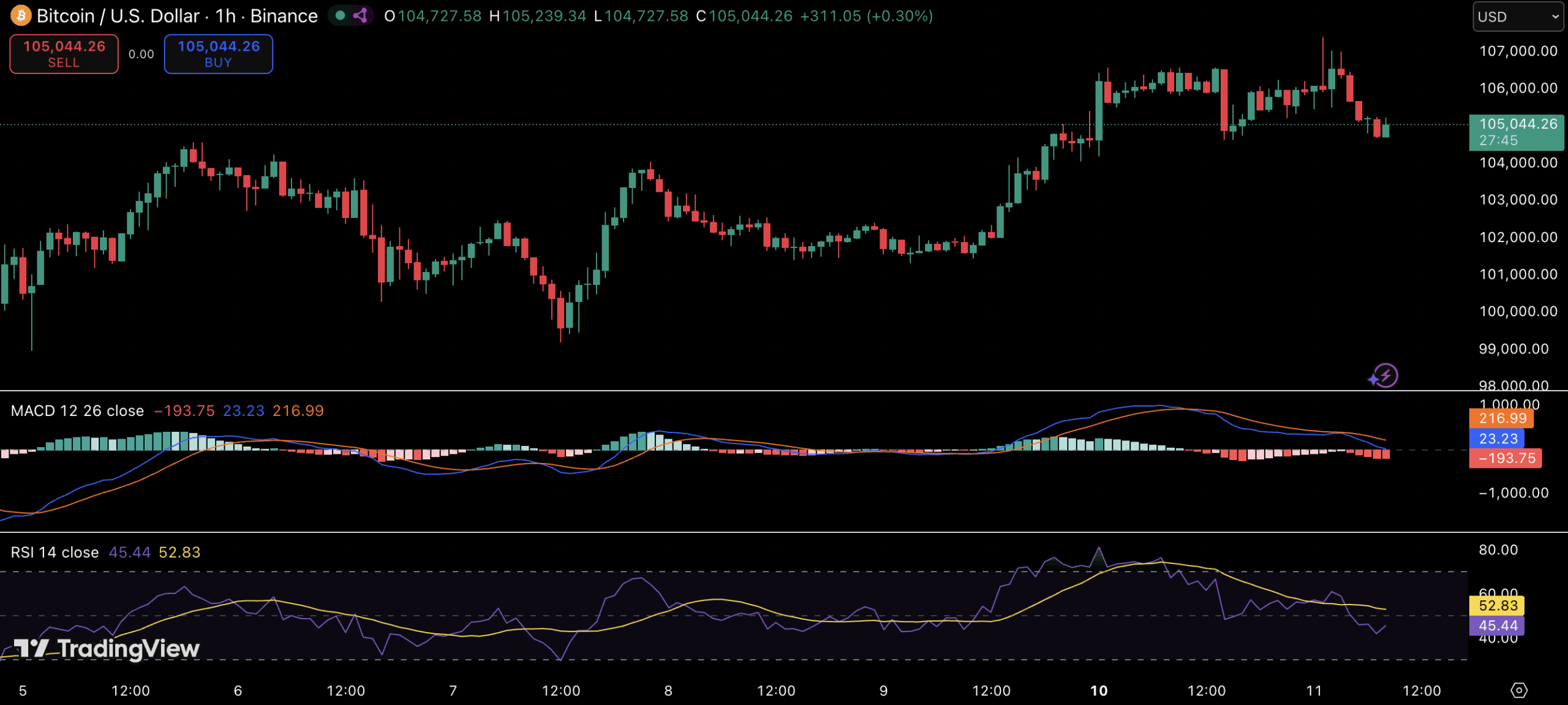
Technical indicators also support a neutral stance. On the one-hour Bitcoin chart, the MACD histogram turned slightly negative, signaling cooling momentum, while the Relative Strength Index (RSI) dipped to 45, pointing to mild bearish pressure but no clear trend direction.
Broader Market Context
Despite muted price action, sentiment remains cautiously optimistic. The end of the government shutdown removes one of the key uncertainties weighing on both traditional and digital asset markets. However, analysts warn that macroeconomic risks remain ahead of the December Federal Reserve meeting, where interest rate expectations and inflation data could influence investor positioning.
Some traders argue that crypto’s lack of immediate reaction is a sign of consolidation after weeks of strong moves, with Bitcoin holding above the $100,000 psychological level for several sessions. Others see the subdued response as evidence that liquidity remains thin, particularly as institutional investors await fresh policy signals from the Fed.
The information provided in this article is for educational purposes only and does not constitute financial, investment, or trading advice. Coindoo.com does not endorse or recommend any specific investment strategy or cryptocurrency. Always conduct your own research and consult with a licensed financial advisor before making any investment decisions.



Alex is Editor-in-Chief of Coindoo and co-founder of Millennial Media Group, with nearly a decade of experience covering financial markets - crypto first, then everything else. It started in 2016 with Bitcoin. Like most people at the time, he didn't fully understand it - so he kept digging. Blockchain, tokenomics, the projects, the cycles. That curiosity never stopped, and eventually pulled him into traditional markets too: equities, commodities, macro. Not because he left crypto behind, but because you can't properly understand one without the other. What drives him is straightforward: he wants to know why something is happening, not just that it's happening. Most market coverage stops at the headline - price up, price down, here's a chart. Alex finds that kind of reporting actively unhelpful. If you walk away from an article without understanding the mechanism behind the move, what did you actually learn? He holds a degree in Tourism from New Bulgarian University - not the most obvious path into financial markets, but markets have a way of pulling in people who are simply too curious to stay out. He has authored over 200 in-depth analyses and more than 10,000 articles across crypto and traditional finance. He still thinks every day in markets teaches him something new. That's probably why he hasn't stopped.