Jobless Claims Hit 18-Month Low: What It Means for Bitcoin Before Tomorrow’s Payrolls

Initial claims fell to their lowest 4-week average since 2024. Historically strong claims data is often interpreted as bearish for Bitcoin, But the environment this number lands in makes the read more complicated than usual.
Key Takeaways
- Initial jobless claims fell to 202,000 for the week ending March 28.
- The 4-week moving average dropped to 207,750 – the lowest since September 2024.
- Strong claims data is often interpreted as bearish for Bitcoin.
- Bitcoin is currently at $66,000 with RSI at 38.
What the Data Says
Initial jobless claims for the week ending March 28 came in at 202,000, a decrease of 9,000 from the prior week’s revised figure of 211,000, according to data from Department of Labor. The market had been watching for any sign of softening in the labor market. It did not get one.
The more durable signal is the 4-week moving average, which smooths out week-to-week noise and gives a cleaner read on the underlying trend. It fell to 207,750 – a decrease of 3,000 from the prior week and the lowest level recorded since September 2024. A 4-week average at an 18-month low is not a one-week anomaly. It is a sustained signal that the labor market remains structurally tight.
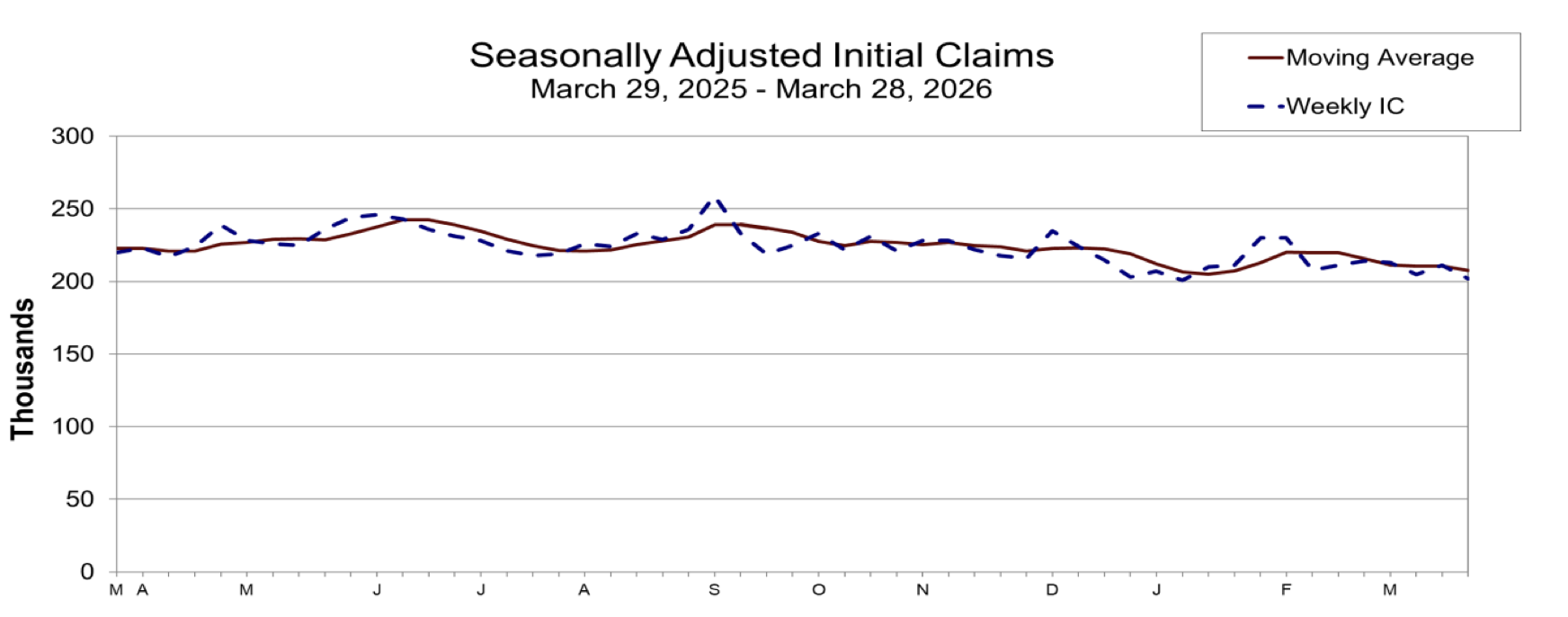
The insured unemployment figures add one layer of nuance. For the week ending March 21, the number of Americans already receiving benefits rose to 1,841,000, an increase of 25,000 from the prior week, while the insured unemployment rate held steady at 1.2%. On the unadjusted side, actual initial claims totaled 184,845 for the week ending March 28, coming in below seasonal expectations which had projected a 3.7% increase, running approximately 8% below the comparable week in 2025.
One data point worth watching separately: former Federal civilian employees filed 584 initial claims for the week ending March 14, down from 643 the prior week. With federal workforce reductions actively underway in 2026, analysts have been monitoring this figure as a leading indicator of whether government layoffs are beginning to register in the broader claims data. At 584, the number remains contained and ticked down in the most recent week, though the series has been volatile, and it remains an open question whether larger-scale federal layoffs will eventually show up more forcefully in the data.
The labor market is not sending distress signals. And that, for crypto markets, is the problem.
Why This Number Moves Crypto
When jobless claims fall, it sets off a chain of macroeconomic reactions that can influence crypto markets, though the relationship is more complex and less reliable than commonly presented.
A tighter labor market signals that wage growth and consumer spending remain elevated. Elevated spending keeps inflation sticky. Sticky inflation gives the Federal Reserve justification to hold interest rates higher for longer. Higher rates push Treasury yields up. Rising yields strengthen the U.S. dollar and tighten overall financial conditions across every asset class simultaneously.
That last step is where crypto feels it most directly. Tighter financial conditions mean less liquidity in the system, less capital flowing freely into risk assets. Institutional allocators who might otherwise rotate into Bitcoin or Ethereum stay in yield-bearing Treasuries instead. Leveraged positions in crypto become more expensive to maintain. Spot demand softens. Price follows.
The popular explanation, that high rates raise the “opportunity cost” of holding Bitcoin, is technically correct but incomplete. The deeper mechanism is liquidity. When financial conditions tighten, the total pool of capital available to chase risk assets shrinks. Crypto, sitting at the far end of the risk spectrum, feels that contraction before almost any other asset class.
The inverse runs the same chain in reverse. Rising claims signal a cooling labor market. Cooling growth reduces inflation pressure. Lower inflation gives the Fed room to cut rates. Falling rates compress yields, weaken the dollar, and ease financial conditions. Liquidity expands. Risk appetite returns. Bitcoin and high-growth crypto assets are historically among the first beneficiaries of that expansion, which is why, counterintuitively, bad jobs data has repeatedly been good news for crypto prices.
This transmission mechanism has been a recurring narrative in crypto markets over the past several years, though its reliability remains debated. While institutional participation has grown, academic research suggests Bitcoin does not systematically respond to macroeconomic data in the way traditional assets do.
What the Past Three Months Confirm
The mechanism is not theoretical. The past three months have produced four clean examples of it playing out in real time.
On February 26, 2026, initial claims came in at 212,000 – below the market forecast of 215,000. Bitcoin dropped below $68,000 the same session, according to CoinGape, as the beat signaled a labor market rebound that reduced the case for near-term Fed rate cuts. Two weeks earlier, on February 19, claims fell by 23,000 to 206,000, and Bitcoin slipped below $66,000 as institutional capital moved into risk-off positioning.
In early January 2026, Bitcoin was already trading near $91,000–$93,000 as crypto markets entered the new year on stronger footing following months of deleveraging. Mixed labor data during that period – including softer payrolls alongside a still-resilient unemployment picture – helped sustain that level by keeping rate-cut hopes alive.
Raoul Pal, CEO of Real Vision, whose macro-to-crypto analysis has influenced how institutional money reads Fed signals, put it plainly at the time:
“A mixed jobless claims report suggests that we are still in for a soft landing rather than a hard recession, which can be bullish for risk assets like BTC and ETH”.
The relationship is not mechanical, and the directional correlation is far from guaranteed. Institutional traders do monitor Thursday’s claims release as a potential market signal, but its actual impact on crypto prices tends to be modest and is frequently overwhelmed by other factors such as geopolitical events, sentiment shifts, and broader liquidity conditions.
Why Today’s Print Is Harder to Read Than Usual
Today’s jobless claims data, paired with a 4-week average at its lowest since September 2024 and unadjusted figures running below seasonal expectations, would under any normal macro backdrop be a clean bearish signal for crypto, tighter labor market, less Fed flexibility, tighter financial conditions, less liquidity, lower prices.
This is not a normal macro backdrop.
Bitcoin is trading at $66,000, down from the $69,200 high reached earlier this week, with the RSI at 38 and the Fear and Greed Index for BTC pinned at “extreme fear” for a full month.
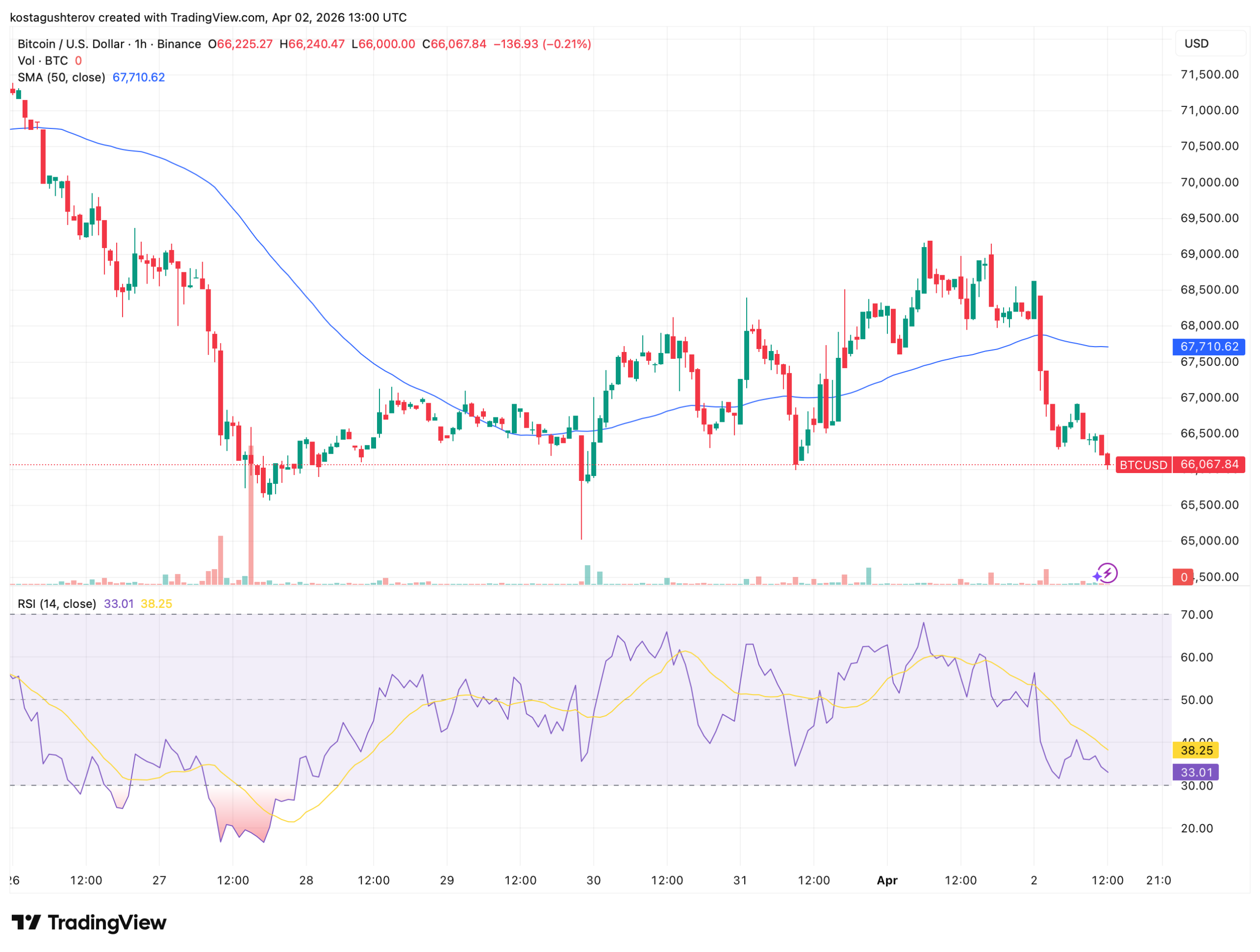
The dominant driver of crypto price action right now is not the Federal Reserve. It is the war in the Middle East, oil above $100, and the five-week rhythm of escalation and de-escalation headlines that have locked Bitcoin in a $60,000–$73,000 range. In that environment, the Fed signal from today’s claims data is a secondary input competing against a primary one that has shown no sign of resolving.
What matters more arrives tomorrow. The March Non-Farm Payrolls report, scheduled for 8:30 AM ET on April 3, is the highest-impact labor release of the month. Today’s claims are the leading indicator. Tomorrow’s payrolls are the verdict.
If the NFP report confirms what today’s data suggests, a labor market that remains tight, the combined signal gives the Fed no justification for near-term rate cuts, layering macro headwinds onto an already geopolitically pressured market. If the payrolls number disappoints, the calculus reverses: a weaker-than-expected print, landing on a Bitcoin RSI of 38 with sentiment at Extreme Fear, could create conditions for a sharp relief rally, not because the war has ended, but because the macro layer would suddenly be pointing in the opposite direction.
Today’s number tells you the labor market is healthy. Tomorrow’s number will tell you what it means for crypto.
The information provided in this article is for educational purposes only and does not constitute financial, investment, or trading advice. Coindoo.com does not endorse or recommend any specific investment strategy or cryptocurrency. Always conduct your own research and consult with a licensed financial advisor before making any investment decisions.



Kosta joined the team in 2021 and quickly established himself with his thirst for knowledge, incredible dedication, and analytical thinking. He not only covers a wide range of current topics, but also writes excellent reviews, PR articles, and educational materials. His articles are also quoted by other news agencies.