Hyperliquid Strategies Opens a $2.5B Funding Door – Will HYPE Benefit?
Hyperliquid Strategies expanded its Chardan equity facility from $1 billion to $2.5 billion, increasing its potential HYPE-buying capacity without reporting any completed share sales or token purchases.
Key Takeaways
- The facility’s maximum commitment increased to $2.5 billion.
- The $2.5 billion is not cash already raised.
- Lower-priced PURR sales face a 42.64 million-share limit.
- Direct HYPE demand requires completed share sales and token purchases.
What the $2.5 billion figure actually means
Hyperliquid Strategies’ September 1 filing increased the total commitment under its equity-purchase agreement with Chardan Capital Markets from $1 billion to $2.5 billion. The additional $1.5 billion gives the company more room to issue and sell PURR common shares under the agreement’s conditions.
The figure represents the maximum aggregate gross purchase price of those shares, rather than money already held by Hyperliquid Strategies. The filing concerns the Nasdaq-listed treasury company trading under PURR, not the Hyperliquid protocol itself.
And still the company’s wider strategy makes the amendment relevant to HYPE. Its latest annual report identifies accumulating the token as its primary business, although the expanded agreement provides no fixed allocation or buying schedule. Any future purchases would still begin with transactions in the equity market.
Four steps separate the facility from HYPE demand
1. Hyperliquid Strategies must issue PURR shares
The agreement allows the company to create and sell new common shares, but issuance does not happen automatically. Management decides when to use the facility and how much stock to offer.
2. The share sales still have to occur
Hyperliquid Strategies can raise money only when shares are purchased under the agreement. The amount collected will depend on how often the company uses the facility, how many shares it issues and the prices calculated under its terms.
Those prices determine the cost to existing shareholders. A lower PURR price requires more shares to raise the same amount of money, increasing dilution and using the applicable share allowance more quickly.
That constraint becomes more important after the first $1 billion of sales. From that point, shares issued below $12.02 count toward an aggregate limit of 42,641,847 shares, representing 19.99% of the common stock outstanding immediately before the amendment.
At just under $12.02 per share, raising the additional $1.5 billion would require more than 124.8 million shares—nearly three times the 42.64 million-share limit. Reaching the full capacity at those prices would therefore require shareholder approval unless Nasdaq rules permit an exception.
The $12.02 figure is not a minimum sale price. It is the threshold below which the share-count restriction applies, making PURR’s market value an important factor in how much of the facility can be used efficiently.
3. Completed sales must produce usable cash
Only completed transactions create cash that Hyperliquid Strategies can deploy. The $2.5 billion ceiling describes the agreement’s maximum gross purchase value, not proceeds already received.
4. Management must direct the money toward HYPE
Cash from PURR sales does not enter the HYPE market on its own. Management must authorize token purchases and report them before any portion of the expanded facility can be counted as direct HYPE demand.

Will HYPE benefit?
HYPE could benefit, but not from the amendment alone. The token receives direct demand only when Hyperliquid Strategies completes PURR sales and uses the resulting capital to purchase HYPE.
Previous transactions show that this route is more than theoretical. In its August 27 financial update, the company reported raising $647 million through PURR issuance during the fiscal year while deploying $773 million from its available capital to acquire HYPE.
Those purchases helped increase its treasury from an initial 12.5 million tokens to 29.3 million HYPE by June 30. The figures should not be read as a one-to-one flow of the same money, but they show that equity financing has already supported the company’s broader accumulation strategy.
The latest amendment could extend that process, although management retains flexibility. The company’s annual filing says future capital may also support acquisitions involving businesses connected with the Hyperliquid ecosystem.
Confirmed treasury purchases would add buying demand, but they would not guarantee an equivalent increase in HYPE’s market value. The price effect would depend on how quickly the company bought, the liquidity available at the time and how much supply other holders brought to the market.
HYPE holds near its record as the wider market slips
While that future buying power remains unconfirmed, HYPE is already displaying relative strength in the spot market. The token traded near $83.3 at approximately 07:00 UTC on September 2, about 4% below its late-August record near $86.70.
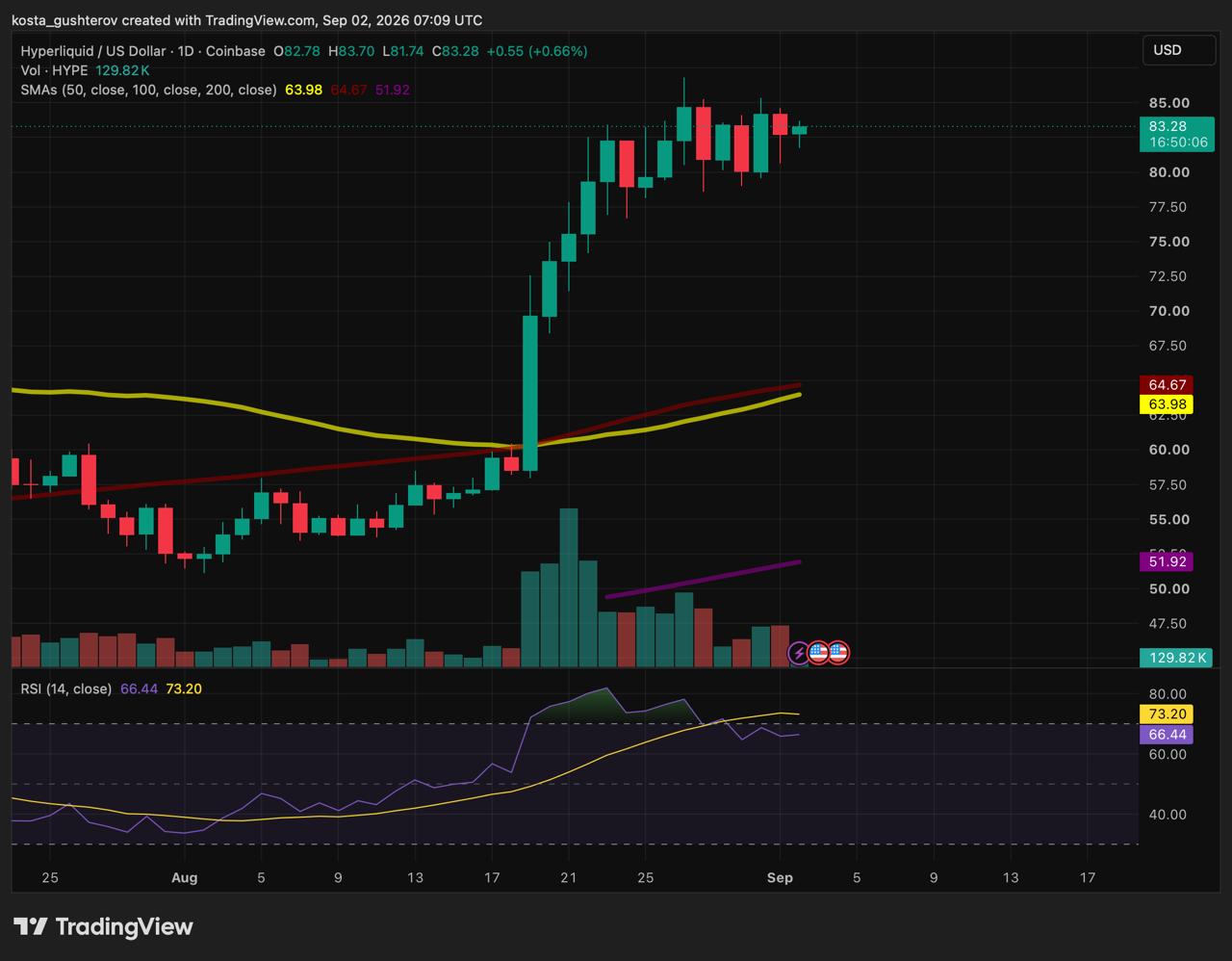
HYPE reached that record before the September 1 amendment, so the expanded facility cannot explain the rally but it may add another possible source of future demand. But for now no reported PURR sale or treasury purchase connects the agreement with the token’s current price.
HYPE’s resilience stands out against a market in which XRP fell to $1.32 despite positive ETF inflows. Larger assets were also contending with the yield and yen pressures weighing on crypto as September began.
The plan depends on two markets
Financing a HYPE treasury with newly issued stock ties the company’s buying power to the market value of PURR. A stronger PURR price allows Hyperliquid Strategies to raise capital with fewer new shares, while a weaker price makes the same strategy more dilutive and brings the exchange cap into play sooner.
That relationship becomes more demanding after HYPE’s August rally. New capital now buys fewer tokens than it did before the advance, leaving the company to weigh the price paid for HYPE against the number of PURR shares issued to finance each purchase.
The facility’s real strength will become visible in PURR’s sale prices, not in its $2.5 billion ceiling. Those prices could determine whether the expanded agreement provides efficient HYPE-buying power or remains largely unused capacity.
Disclaimer: This article is for informational purposes only and does not constitute financial or investment advice.



Alex is Editor-in-Chief of Coindoo and co-founder of Millennial Media Group, with nearly a decade of experience covering financial markets - crypto first, then everything else. It started in 2016 with Bitcoin. Like most people at the time, he didn't fully understand it - so he kept digging. Blockchain, tokenomics, the projects, the cycles. That curiosity never stopped, and eventually pulled him into traditional markets too: equities, commodities, macro. Not because he left crypto behind, but because you can't properly understand one without the other. What drives him is straightforward: he wants to know why something is happening, not just that it's happening. Most market coverage stops at the headline - price up, price down, here's a chart. Alex finds that kind of reporting actively unhelpful. If you walk away from an article without understanding the mechanism behind the move, what did you actually learn? He holds a degree in Tourism from New Bulgarian University - not the most obvious path into financial markets, but markets have a way of pulling in people who are simply too curious to stay out. He has authored over 200 in-depth analyses and more than 10,000 articles across crypto and traditional finance. He still thinks every day in markets teaches him something new. That's probably why he hasn't stopped.