Ethereum Technicals Hold Steady Despite Middle East Risk

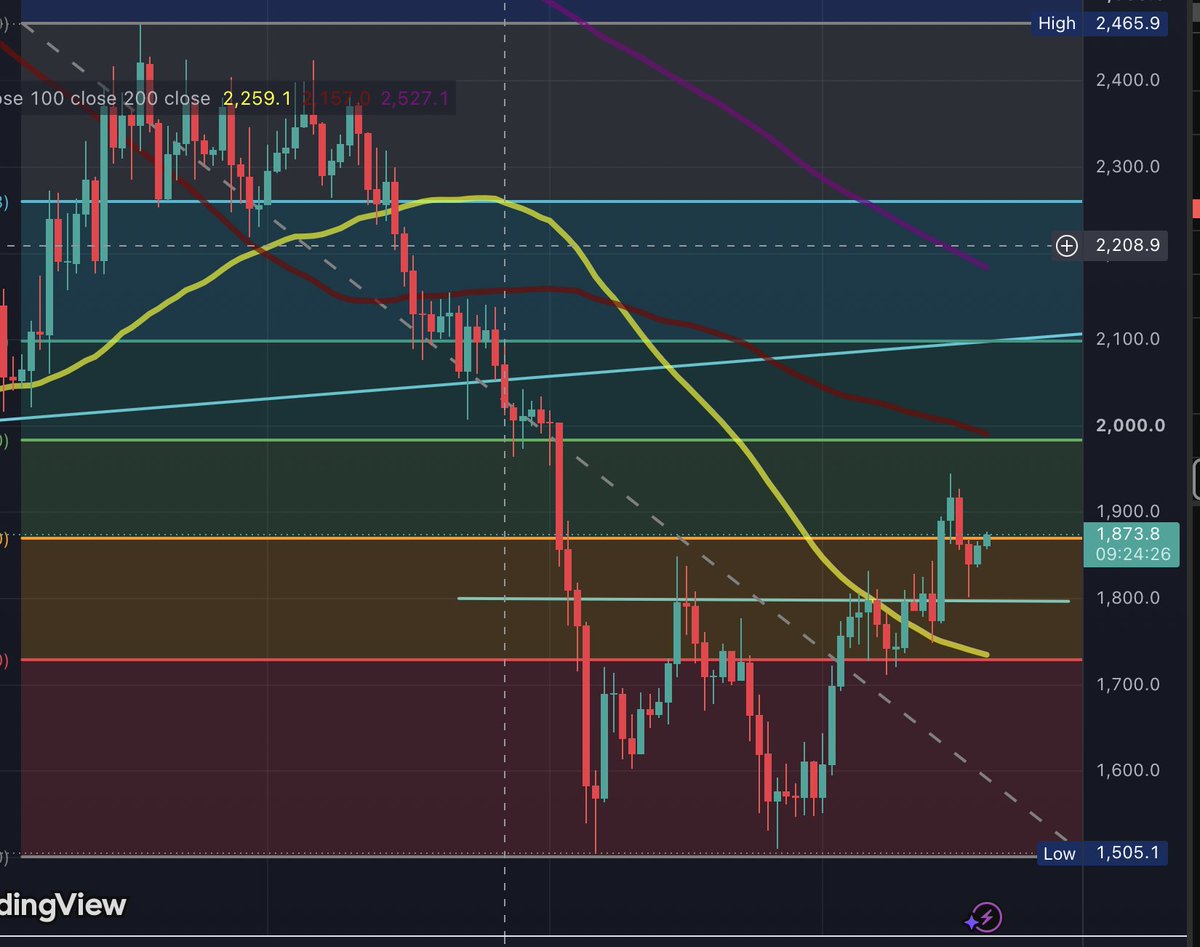
Ethereum has confirmed $1,800 as near-term support after buyers stepped in and pushed the price back toward the 0.382 Fibonacci retracement near $1,870.
Key Takeaways
- ETH defended $1,800 and is testing the 0.382 Fibonacci resistance near $1,870.
- A close above the level followed by a successful retest might support a move toward $1,990.
- Exchange outflows and a record staking rate are reducing Ethereum’s liquid supply.
- A daily close below $1,800 would expose the $1,730 area.
ETH was trading around $1,875 at the time of writing, placing it slightly above the resistance line but not yet far enough beyond it to confirm a clean breakout. The next reaction around this level should show whether the recovery can continue or whether the latest advance was another temporary move within the broader downtrend.
ETH Needs to Hold $1,870 After the Breakout
Moving above the 0.382 retracement is only the first part of the setup. ETH also needs to return to the level and hold it as support.
A successful retest would show that buyers are prepared to defend prices above the previous resistance rather than simply chase a brief intraday move. That would bring the following levels into view:
- 0.5 Fibonacci retracement near $1,990
- 0.618 Fibonacci retracement near $2,100
The first target sits close to the psychological $2,000 mark, where selling pressure could increase. ETH would need to reclaim that region before the recovery could begin challenging the larger bearish structure visible on the chart.
A rejection near $1,872 would shift attention back to $1,800. Another reaction from that area could allow Ethereum to build a higher base before making a new breakout attempt.
A daily close below $1,800 would weaken that scenario and place the 0.236 Fibonacci retracement near $1,732 back in focus.
Exchange Flows Support the Price Setup
CryptoQuant data provides a possible explanation for the stronger response around support.
Ethereum has recorded persistent negative exchange netflows over the past two weeks, meaning more ETH has been withdrawn from exchanges than deposited. At the same time, the staking rate has climbed to a record 33.5%.
Both trends reduce the amount of ETH immediately available for trading. Exchange withdrawals move coins away from venues where they can be sold quickly, while staking commits a growing part of the supply to the network.
This does not guarantee a shortage or an immediate price increase. Withdrawn ETH can return to exchanges, and staked coins are not permanently removed from circulation. The data does show that new demand may be competing for a smaller liquid pool than before.

Binance Has More Available Buying Power
Stablecoin netflows into Binance have risen by approximately 506% compared with their 90-day baseline, averaging more than $72 million in daily inflows.
These funds can be deployed into ETH and other cryptocurrencies without waiting for additional fiat deposits. Their arrival gives traders more capital to use if the breakout attracts demand.
Stablecoin deposits alone do not show that Ethereum is being purchased. Some of the funds may remain unused, move into other assets or serve as collateral. Rising ETH spot volume alongside a successful retest of $1,872 would provide stronger evidence that the available liquidity is entering the market.
Binance funding rates have also fallen by around 31% week over week. The cooler reading suggests that the recovery is not being driven by an unusually crowded group of leveraged long positions.
That reduces the immediate threat of a long-liquidation cascade, although it also means ETH may need stronger spot participation to maintain the advance.
Iran Escalation Could Give Ethereum Its Next Direction
The Iran-US conflict has intensified, with strikes continuing on both sides and the US military carrying out another round of attacks against targets linked to Iran. According to the BBC, the escalation has also raised concerns around regional security and commercial shipping through the Strait of Hormuz.
The renewed uncertainty could become the outside force that gives Ethereum a clearer direction around its current technical levels. The crypto market rallied when tensions with Iran first broke out earlier this year, but the same reaction is not guaranteed as the conflict enters a more serious phase.
A move above $1,870 followed by a successful retest would show that buyers are absorbing the geopolitical risk. A rejection would return attention to $1,800, where Ethereum has already established a well-defended support zone.
This article is provided for informational purposes only and does not constitute financial, legal or investment advice.



Kosta has reported on cryptocurrency markets and blockchain infrastructure since 2020, bringing over six years of hands-on experience in the crypto industry built through daily tracking of markets, trends, and emerging blockchain developments. Specializing in Bitcoin on-chain analysis, institutional ETF flows, and digital asset price action, his work at Coindoo has been cited by other news agencies and consistently covers market developments with a focus on data-driven reporting across Bitcoin, Ethereum, Solana, and XRP. Over the years, Kosta has contributed to multiple crypto media outlets in different regions, authoring over 6,000 articles across the sector. His reporting spans cryptocurrency markets and the broader fintech industry, tracking not only price action but also the technological and regulatory forces shaping the ecosystem. To support his analysis, Kosta actively leverages on-chain data and metrics from leading platforms such as Santiment, Glassnode, and CryptoQuant, enabling deeper, evidence-based market insights. He believes in the power of transparency and the data that underpins the blockchain ecosystem. His academic background in Marketing Management from Denmark further complements his analytical approach, adding a strong understanding of communication strategy and content positioning to his work.