Crypto Sentiment Hits Top-Three Low Since FTX, Says Bitwise

Bitwise's sentiment index sank to one of its three lowest readings since FTX collapsed in 2022, yet Bitcoin holders realized far smaller losses than during February's capitulation.
Key Takeaways
- Only four of 15 sentiment indicators stayed positive.
- Bitcoin fell about 10%, matching the Nasdaq’s drop.
- Put protection traded at extreme premiums across maturities.
- Fed hike odds for December reached 93%.
The figures come from Bitwise’s Crypto Market Compass for week 48, published Nov. 23. Its sentiment and on-chain readings run through Nov. 20, so they predate Bitcoin’s slide to $55,130 on Saturday.
Sentiment fell to a post-FTX extreme
Bitwise’s Cryptoasset Sentiment Index touched –1.88 standard deviations on Nov. 20, meaning the composite sat almost two standard deviations below its usual level. That is its weakest reading since February’s capitulation and, by the firm’s count, one of the three lowest since FTX collapsed in November 2022. Only four of the index’s 15 indicators were still above their short-term trends, and the separate Crypto Fear & Greed Index stayed in its extreme-fear zone.
Not every input got worse. Two futures gauges improved, BTC long futures leverage dominance and CME commercials’ net positioning, which Bitwise reads as a sign that leveraged longs had already been forced out. Commercial traders on CME cut their net short from 11.11% of open interest to 7.28%. Pulling the other way, investors moved more coins onto exchanges, a pattern the firm links to possible selling, although the report gives no inflow volumes.
Stocks fell just as hard
The decline reached well beyond crypto. Bitcoin lost about 10% over the week covered by the report, roughly the same as the Nasdaq Composite. The S&P 500 dropped 8.6%, Nvidia 22.9% and TSMC 20.1%, its worst week since 2006. Gold fell 8.9% and silver 16%, so the usual hedges offered no shelter. Ether did worse than Bitcoin, falling 14%.
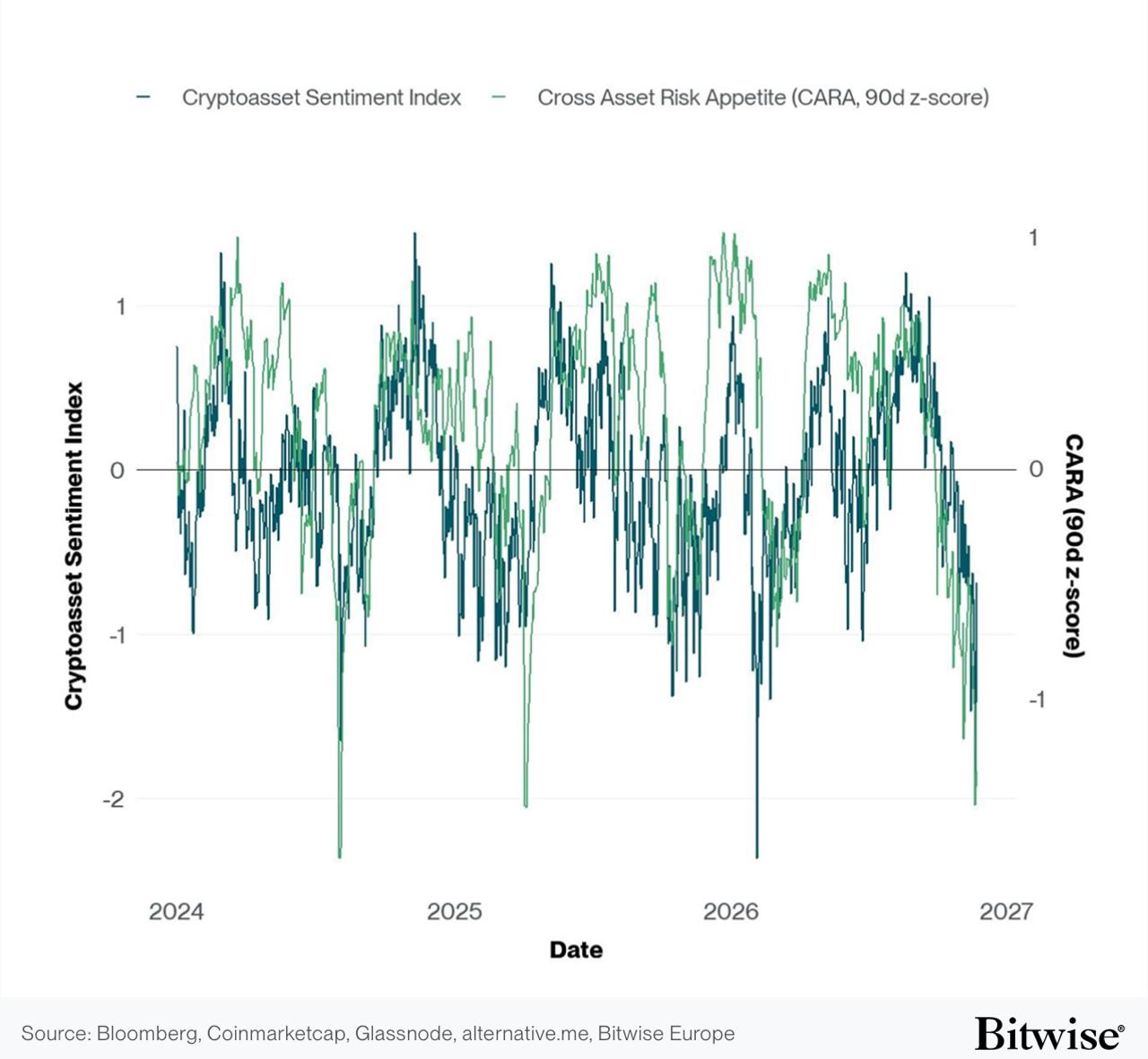
Bitwise’s Cross Asset Risk Appetite gauge, which tracks appetite for risk across traditional markets, slid from −0.51 to −1.11 after touching −1.14 midweek. The firm says that matches the lows of the mid-2024 yen carry-trade unwind and the early-2025 tariff selloff. Bitwise also discounts the Binance hack as a driver, since it happened several weeks earlier.
Equity options were calmer. The VIX, which measures expected 30-day volatility in the S&P 500, closed at 35.89 on Nov. 20. Bitwise notes that was the highest close of 2026, but it stayed below the 38.57 close of August 2024 and the 52.33 close of April 2025. Stock traders paid up for protection, though not at the panic levels of those two episodes. Crypto investors, by contrast, turned about as fearful as at any point since 2022.
Rate-hike bets drove the selloff
The pressure came from interest-rate expectations. According to Bitwise, Fed funds futures priced a 93% chance of a December rate hike and a 63% chance of two more hikes by January 2027. Minutes from the October FOMC meeting showed almost all officials expected further tightening, and Governor Christopher Waller floated a 50-basis-point move in December.
Bitwise argues the Fed is now “approaching peak hawkishness.” Its gauge of the tone of Fed officials’ public comments has returned to levels last seen in 2021, and the ten-year Treasury yield, at 4.95%, sat only 29 basis points above the two-year yield at 4.66%. In the firm’s view, a large December hike would likely invert that curve, pushing short-term yields above long-term ones. Inversions have usually been followed by a pause and later cuts. That is Bitwise’s reading of past cycles; the Fed itself has given no sign of a pause.

Holders are underwater, but most are not selling
On-chain data show how much damage the drop did on paper. In the 14 days to Nov. 20, the share of Bitcoin’s supply held at a profit fell from 59.1% to 43.2%. It had been lower on only 99 of the previous 5,970 days. Bitwise estimates that about $953 billion of invested capital was sitting at a loss, a level it compares with the FTX collapse. Both measures value each coin at the price it last moved on-chain, so they count coins, not investors.
Realized losses show how much of that damage holders actually locked in. Coins that moved at a loss on Nov. 20 accounted for $1.36 billion in losses, a daily total exceeded on only 18 earlier days, and realized profit fell to about 15 cents for every dollar of realized loss. Over seven days, losses totaled $5.3 billion. That is below the roughly $5.7 billion of the November 2025 capitulation and far below February’s $9.1 billion, which Bitwise ranks as the most severe of these episodes. A coin can move between wallets without being sold, so these figures estimate selling rather than record actual trades.
So fear and losses on paper are close to post-FTX extremes, but loss-taking spiked for one day and stayed below the last two capitulations. Bitwise doesn’t say whether holders are refusing to sell or the flush is unfinished, and the on-chain data alone doesn’t settle it.
Traders hedged instead of dumping
Derivatives show the same restraint. Leverage drained out of perpetual futures: open interest fell about 4.5% to roughly 439,000 BTC, annualized funding dropped to about 1.7% from 6.6% a week earlier, and the three-month basis narrowed to about 4.5% from 5.2%. Combined liquidations came to about $4.9 billion.
Options moved the other way. Open interest jumped about 18.5% to roughly 548,100 BTC, and the put-to-call ratio on crypto-native exchanges rose to 0.83, near the 99.9th percentile of its three-year range. Twenty-five-delta skew, which shows how much more traders pay for puts than for comparable calls, sat at or above the 99th percentile for every maturity from one week to six months. Investors bought downside protection instead of selling their coins.
How close Bitcoin came to holders’ average cost
The weekend low was Bitcoin’s weakest price since September 2024 and set a new cycle low below the late-June trough near $58,000. A relief bounce then lifted it to about $61,000. The cost-basis levels Bitwise tracks show how close that range runs to what holders paid.
Saturday’s low came close to the realized price, the broadest measure of what Bitcoin holders paid on average. Bitwise treats a drop to the long-term holders’ cost basis as outside its base case, though it names that level as the next reference if the realized price gives way.
What would mark a turn
Monday gave an early read. The Nasdaq rose 6.5% while Bitcoin gave back its intraday rally. Bitcoin fell with stocks but did not recover with them, which leaves crypto’s own demand as the open question.
Fund flows show where that demand stood during the week. Redemptions hit every major U.S. spot Bitcoin ETF in Bitwise’s data, with BlackRock’s IBIT accounting for about three-quarters of the total, and U.S. spot Ether funds lost assets as well.
| Fund group | Net flow |
|---|---|
| All U.S. spot Bitcoin ETFs | −$1.84 billion |
| BlackRock IBIT | −$1.37 billion |
| Grayscale GBTC | −$119.3 million |
| Bitwise BITB | −$43.6 million |
| All U.S. spot Ether ETFs | −$288.4 million |
Bitwise says sentiment readings this low have historically been followed by strongly positive 12-month returns, though it publishes no hit rate or sample size. Three things will test that sooner: whether ETF redemptions slow, whether realized losses jump again if Bitcoin trades back toward its realized price, and what the Fed does in December. If prices bounce while fund flows stay negative, the bounce would rest on less support than the sentiment index alone implies.
Disclaimer: This article is for informational purposes only and does not constitute financial, investment or trading advice. Figures and historical comparisons are drawn from Bitwise’s research and public market data, and may be revised. Past patterns in sentiment or on-chain data do not guarantee future results. Cryptocurrencies are highly volatile; do your own research and consider consulting a licensed financial adviser before making any investment decision.



Alex is Editor-in-Chief of Coindoo and co-founder of Millennial Media Group, with nearly a decade of experience covering financial markets - crypto first, then everything else. It started in 2016 with Bitcoin. Like most people at the time, he didn't fully understand it - so he kept digging. Blockchain, tokenomics, the projects, the cycles. That curiosity never stopped, and eventually pulled him into traditional markets too: equities, commodities, macro. Not because he left crypto behind, but because you can't properly understand one without the other. What drives him is straightforward: he wants to know why something is happening, not just that it's happening. Most market coverage stops at the headline - price up, price down, here's a chart. Alex finds that kind of reporting actively unhelpful. If you walk away from an article without understanding the mechanism behind the move, what did you actually learn? He holds a degree in Tourism from New Bulgarian University - not the most obvious path into financial markets, but markets have a way of pulling in people who are simply too curious to stay out. He has authored over 200 in-depth analyses and more than 10,000 articles across crypto and traditional finance. He still thinks every day in markets teaches him something new. That's probably why he hasn't stopped.