Crypto Searches on Google Slump, but Bitcoin Still Draws Cash

Crypto interest on Google is fading, according to Alphractal, yet recent Bitcoin ETF inflows show that quieter searches can coexist with substantial buying through other channels.
Key Takeaways
- Search interest measures public attention to crypto.
- Bitcoin ETF flows have recently been mixed.
- Available buyers matter when holders take profits.
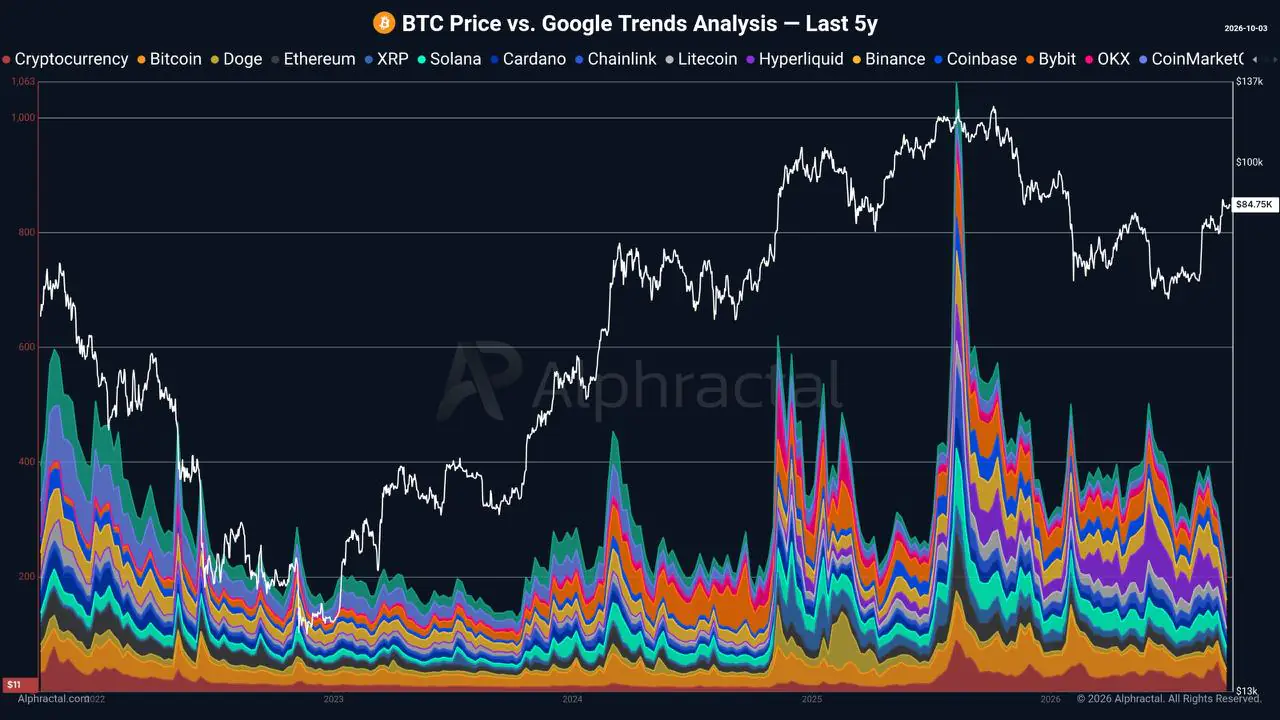
Alphractal reports the weakest Google search interest in crypto since 2024, while its October 3 chart shows Bitcoin near $84,750 after recovering from earlier lows. The search series remain well below their large 2025 spikes, suggesting that the price recovery has attracted less public curiosity than those earlier bursts of activity.
That gap leaves room for several explanations. Existing investors may keep holding or trading without researching crypto again, while new buyers can enter through services they already use. Distinguishing those possibilities from a genuine retreat in demand requires evidence beyond searches.
What falling Google interest actually measures
Google Trends measures relative search interest: how prominent a topic is among searches within a selected location and period. Its scores are based on sampled data and scaled for comparison, rather than reporting an absolute search count. A decline can indicate weaker attention, but it cannot count investors leaving the market.
Alphractal’s chart stacks search series for assets, exchanges and platforms, including Bitcoin, Ethereum, Binance and Coinbase. It does not disclose how those series were combined or whether the sharp drop at the end covers a completed period. The “lowest since 2024” finding therefore remains attributed to Alphractal; the image alone does not establish an exact percentage fall in searches.
Searches also capture different motives. Someone checking an exchange during a crisis can contribute to rising interest without intending to buy. Conversely, a regular customer can open an exchange app and place an order without searching Google at all. Brokerage access adds another way for investment activity to escape this attention measure.
Bitcoin buying has another route
A brokerage customer can buy a Bitcoin exchange-traded fund without opening a crypto exchange account or learning how to manage a wallet. That makes ETF flows useful alongside search data: they record money entering or leaving listed products, rather than people looking for information.
Farside Investors’ figures show approximately $2.39 billion in net inflows into U.S. spot Bitcoin ETFs during September 21-25. Demand subsequently became uneven, with $148.7 million in net outflows on September 30 followed by $102.7 million in net inflows on October 1 and $31.7 on October 2.
Those figures establish that money entered through listed products in late September and again on October 1. They do not identify who supplied it: ETFs serve individuals and institutions, so inflows cannot establish that institutional investors have replaced retail buyers. What they demonstrate is a channel of demand that Google searches do not directly measure.
Selected altcoins have also recorded strong gains. Coindoo’s October 1 review of crypto gainers documented advances in Stacks, Midnight, NEAR, FET and Ethena. Whether those gains survive subsequent selling will reveal more about their support than their position on a single day’s gainers list.

When fewer buyers make a rally fragile
As holders take profits, the market needs buyers willing to absorb their sales. Spot trading volume shows how much trading has occurred, while order-book depth shows the buy and sell orders available near the current price. High volume alone does not establish that fresh money is entering, but these measures together help assess how readily trades can be executed.
Consider a hypothetical $100,000 market sell order. If substantial buy orders sit close to the current price, the sale may be absorbed with limited movement. If those bids are sparse, the same order may execute against progressively lower prices. A relatively modest sale can therefore cause a large price move in a thin market.
Fading attention becomes more consequential when buying activity and available bids weaken too. In that situation, holders seeking to exit may find fewer buyers near the prices reached during the rally. This is a condition to check with trading data, rather than one already established by Alphractal’s search chart.
Evidence of a broader recovery
To assess whether participation is rebuilding, compare search interest with spot activity, ETF flows and the number of tokens holding their gains. Each addresses a different part of the recovery:
A rise in searches without stronger market activity would offer limited evidence that curiosity is turning into purchases. Equally, persistent investment inflows and deeper books could support a recovery while searches remain subdued. Watching these measures over several sessions is more informative than treating one low reading or one strong inflow day as decisive.
The harder test comes when holders sell into the recovery. Prices that retain their gains through profit-taking would suggest buyers are absorbing that supply. Repeated reversals would indicate that buying is struggling to sustain higher prices, even if public interest starts returning.
This article is for informational purposes only and does not constitute investment advice. Search interest is an attention indicator and does not reliably predict cryptocurrency prices.



Alex is Editor-in-Chief of Coindoo and co-founder of Millennial Media Group, with nearly a decade of experience covering financial markets - crypto first, then everything else. It started in 2016 with Bitcoin. Like most people at the time, he didn't fully understand it - so he kept digging. Blockchain, tokenomics, the projects, the cycles. That curiosity never stopped, and eventually pulled him into traditional markets too: equities, commodities, macro. Not because he left crypto behind, but because you can't properly understand one without the other. What drives him is straightforward: he wants to know why something is happening, not just that it's happening. Most market coverage stops at the headline - price up, price down, here's a chart. Alex finds that kind of reporting actively unhelpful. If you walk away from an article without understanding the mechanism behind the move, what did you actually learn? He holds a degree in Tourism from New Bulgarian University - not the most obvious path into financial markets, but markets have a way of pulling in people who are simply too curious to stay out. He has authored over 200 in-depth analyses and more than 10,000 articles across crypto and traditional finance. He still thinks every day in markets teaches him something new. That's probably why he hasn't stopped.