Crypto Market Slumps as Yen Warnings Hit Risk Assets

Bitcoin and most major cryptocurrencies fell sharply on July 31 after a Reuters report said the U.S. Treasury had told banks to prepare for possible intervention in the yen market.
Key Takeaways
- Bitcoin fell 3.5% over 24 hours as losses spread across most major cryptocurrencies.
- A Reuters report on possible U.S. intervention in the yen market triggered a sudden reversal in U.S. equities.
- Apple fell about 9.3% in regular trading despite reporting record quarterly revenue, as chip and memory constraints weighed on its outlook.
- U.S. stocks recovered much of the initial decline, while Bitcoin remained below its previous support area.
The headline revived concern over yen-funded carry trades and triggered a sudden reversal in U.S. equities. Apple added pressure during the same session, falling about 9% in regular trading even after reporting record fiscal third-quarter revenue.
The currency channel was outlined in our previous analysis of how Japanese policy can reach Bitcoin through global funding markets. This time, the concern came from possible currency intervention rather than Bank of Japan rate policy
Stocks Recovered After the Yen Headline
A widely circulated Bull Theory post showed the S&P 500 moving from a 0.7% intraday gain to a 1.2% loss within approximately 40 minutes of the Reuters report.
🚨 Nearly $1 TRILLION wiped off US stocks in 40 minutes after Reuters reported a possible intervention by the US in the YEN market.
The S&P 500 was up 0.70% on the day and had added $540 billion to its market cap.
Then it crashed 1.20% in just 40 minutes, wiping out $920… pic.twitter.com/djAklecP6u
— Bull Theory (@BullTheoryio) July 31, 2026
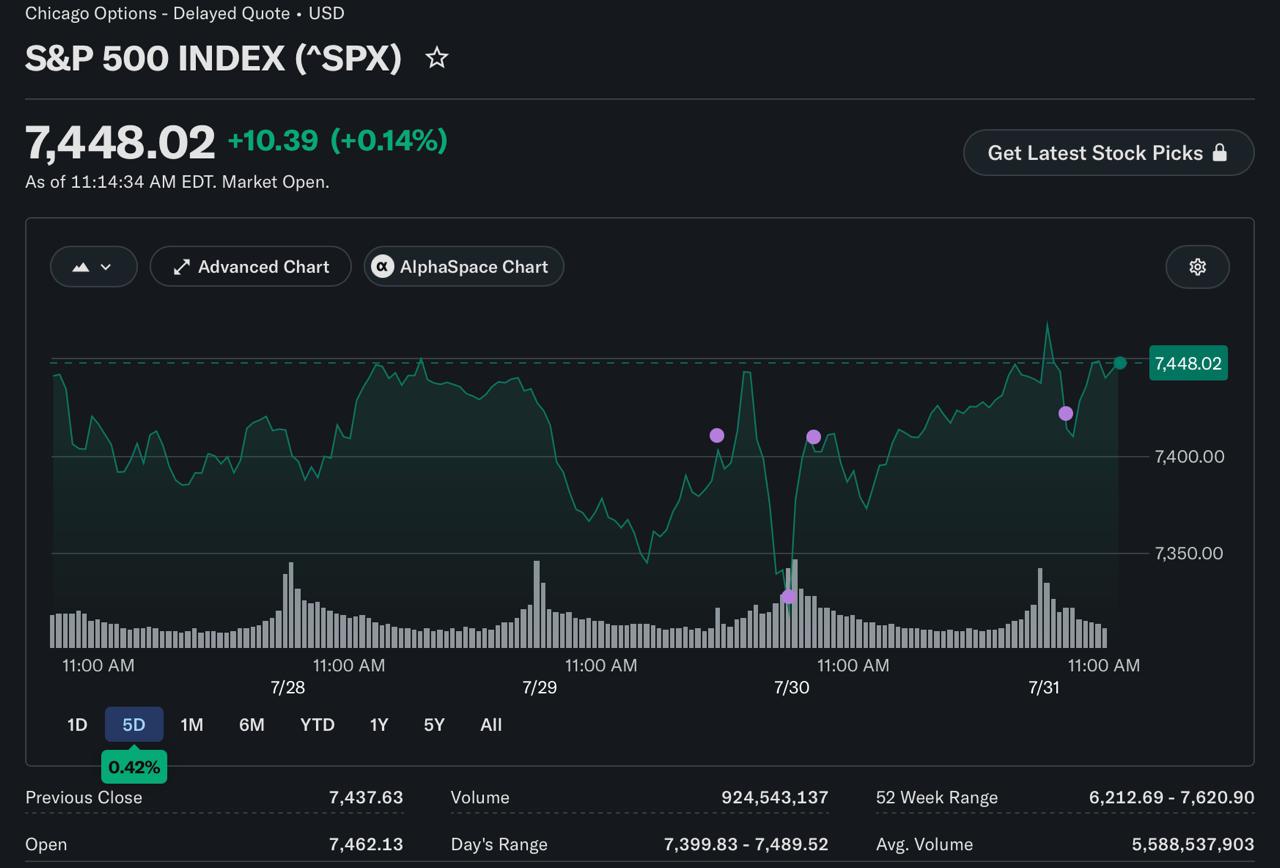
The selling then eased. At approximately 11:14 a.m. EDT, Yahoo Finance data showed the index at 7,448, up 0.14%, after reaching an intraday low of 7,399.
The recovery makes it difficult to treat the initial decline as evidence of a sustained liquidation across U.S. equities. The report prompted a sharp reduction in risk, but the selling did not continue at the same pace.
Crypto Did Not Follow the Equity Recovery
Bitcoin traded at $62,400 according to CoinMarketCap data, down 3.5% over 24 hours.
Other cryptocurrencies lost:
- Zcash: −4.30% at $454.79
- Ethereum: −3.3% at $1,853.13
- XRP: −2.8% at $1.06
- Solana: −2.4% at $72.82
- Dogecoin: −1.9% at $0.06914
Hyperliquid remained 0.3% higher, while BNB and TRON limited their declines to less than 1%.
The recovery in U.S. equities did not carry into crypto. Gains in companies such as Amazon could offset Apple’s fall inside the S&P 500, while Bitcoin had no comparable counterweight. Crypto derivatives also continued trading throughout the reaction, allowing pressure to remain after selling in the cash equity market had begun to ease.
Bitcoin also moved below the support area that had contained its previous pullbacks. The band was formed by the 50-day simple moving average near $63,400 and the 0.236 Fibonacci retracement around $63,600.
Trading near $62,410 placed BTC below both levels. Recovering that area would reduce the importance of the break, while continued trading underneath it would leave the recent structure weaker.
Why Possible Yen Intervention Matters
Reuters reported that the U.S. Treasury had informed several banks, through the Federal Reserve Bank of New York, that they should be prepared for possible intervention in the yen market.
The report concerned preparations for potential action. It did not confirm that the United States had already entered the currency market.
Investors can borrow at relatively low rates in yen and move the capital into assets offering higher returns. If intervention strengthens the Japanese currency, the dollar value of those liabilities rises and leveraged positions become more expensive to maintain.
Reducing that exposure may require investors to sell liquid assets and buy yen to repay the original funding. The synchronized market reaction is consistent with a broader reduction in risk, although the available data does not identify which investors sold or show how their positions were financed.

Apple’s Supply Warning Overshadowed Record Results
Apple entered the session after reporting its strongest June quarter on record. Revenue reached $109.4 billion, up 16% year over year, while iPhone, Mac and Services each set June-quarter revenue records.
The market’s concern centered on the months ahead rather than the quarter Apple had just completed. The company projected revenue growth of 9% to 11% for the September quarter, below Wall Street expectations of approximately 12%.
Apple also warned that limited advanced chipmaking capacity and memory shortages were restricting its ability to meet demand. Higher memory costs added another concern for future margins.
The company described the problem as a supply constraint rather than weak customer demand. Even so, the warning suggested that Apple might be unable to convert all available demand into sales during the following quarter.
The latest data showed Apple trading near $302, down 9.2% at 11:26 a.m. EDT. That was a regular-session reading rather than the initial after-hours response. Shares had fallen about 5.5% after hours before the decline widened during Friday morning trading.
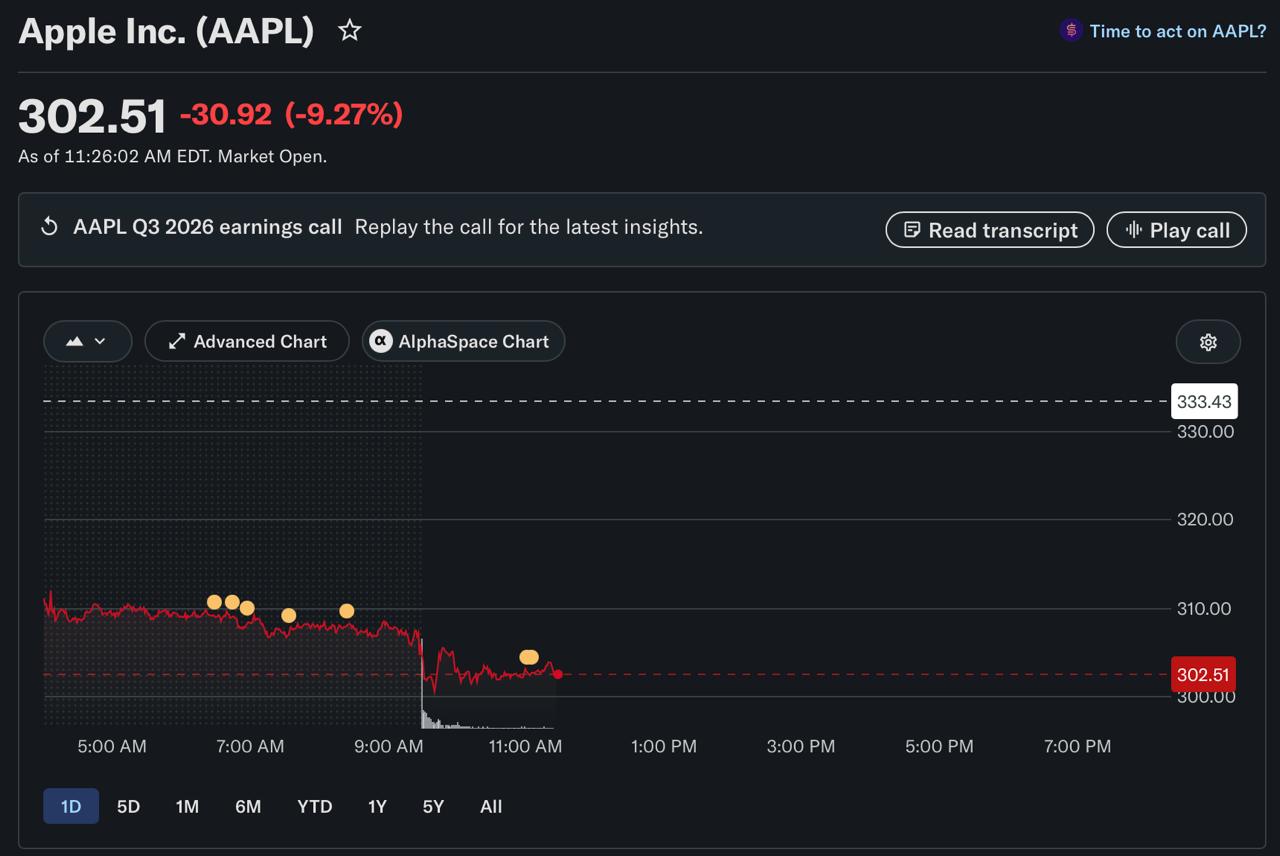
The 9.3% move should therefore not be read as a rejection of Apple’s quarterly performance. The results exceeded expectations, but investors were weighing slower projected growth, supply limitations and their potential effect on future revenue and margins.
Because of Apple’s weight in major U.S. indexes, the decline added pressure during the same period that markets were reacting to the yen report. Gains elsewhere, including Amazon’s post-earnings rally, later helped the broader index recover.
The Carry-Trade Risk Is Not Yet Confirmed
The market reaction shows that the possibility of yen intervention was enough to trigger rapid de-risking. It does not establish that a sustained carry-trade unwind had already begun.
The S&P 500 stabilized after its initial decline, the Reuters report described preparation rather than completed intervention, and there is no direct evidence that the cryptocurrency sellers were closing yen-funded positions.
A continued rise in the yen, renewed weakness across global equities and falling crypto open interest alongside large long liquidations would provide stronger evidence of a broader deleveraging event. Bitcoin remaining below the $63,400–$63,600 support area would add technical weight to that interpretation.
Until then, the move is better understood as a sharp reaction to overlapping risks: concern over global funding conditions, pressure from one of the market’s largest technology companies and Bitcoin’s break below short-term support.
- Disclaimer: This article is for informational and analytical purposes only and does not constitute financial or investment advice. Currency intervention, equity-market volatility and leveraged crypto trading can produce rapid price movements.



Kosta has reported on cryptocurrency markets and blockchain infrastructure since 2020, bringing over six years of hands-on experience in the crypto industry built through daily tracking of markets, trends, and emerging blockchain developments. Specializing in Bitcoin on-chain analysis, institutional ETF flows, and digital asset price action, his work at Coindoo has been cited by other news agencies and consistently covers market developments with a focus on data-driven reporting across Bitcoin, Ethereum, Solana, and XRP. Over the years, Kosta has contributed to multiple crypto media outlets in different regions, authoring over 6,000 articles across the sector. His reporting spans cryptocurrency markets and the broader fintech industry, tracking not only price action but also the technological and regulatory forces shaping the ecosystem. To support his analysis, Kosta actively leverages on-chain data and metrics from leading platforms such as Santiment, Glassnode, and CryptoQuant, enabling deeper, evidence-based market insights. He believes in the power of transparency and the data that underpins the blockchain ecosystem. His academic background in Marketing Management from Denmark further complements his analytical approach, adding a strong understanding of communication strategy and content positioning to his work.