China Slashes U.S. Treasury Holdings to 17-Year Low as Gold Buying Accelerates
China’s retreat from U.S. Treasuries has reached a level not seen since the global financial crisis, marking a structural shift in how the world’s second-largest economy manages its reserves.
Key Takeaways
- China’s U.S. Treasury holdings fell to a 17-year low at $683 billion, down nearly half from their 2013 peak.
- Beijing is accelerating gold purchases, with 15 straight months of buying and official reserves at 74.19 million ounces.
- Several BRICS nations are also reducing exposure to U.S. debt, pointing to broader reserve diversification.
Official data show that China now holds approximately $683 billion in U.S. government debt – the lowest level since September 2008. At its peak in November 2013, Beijing controlled around $1.32 trillion in Treasuries. Nearly half of that position has now been unwound.
The pace of selling has accelerated. Between January and November 2025 alone, China reduced its holdings by roughly $115 billion – more than 14% in just eleven months. This is not a routine portfolio adjustment. It reflects a broader recalibration of reserve strategy.

Gold has emerged as the clear alternative.
China Accelerates Gold Accumulation
The People’s Bank of China has added gold to its reserves for 15 consecutive months. Official holdings now stand at 74.19 million ounces, valued at roughly $370 billion at current prices.
However, several analysts argue that the real figure could be significantly higher. They suggest that additional purchases may be routed through China’s State Administration of Foreign Exchange (SAFE) and other channels not immediately reflected in headline data. If those estimates prove accurate, China’s total gold reserves could approach double the officially reported amount – potentially positioning it as the world’s second-largest gold holder behind the United States.
Gold’s surge above $5,500 earlier this year is increasingly viewed by market participants as more than a speculative rally. For many, it represents a repricing of sovereign trust and a hedge against fiscal expansion in advanced economies.
China is not alone. Several BRICS nations have also been steadily reducing their exposure to U.S. debt in favor of alternative reserve assets, reinforcing the perception of a gradual diversification trend away from dollar-centric instruments.
Big Tech Floods Bond Markets
At the same time that sovereign holders are trimming U.S. debt exposure, corporate issuance is surging.
The technology sector now accounts for 11.8% of all private-sector debt issuance in 2026 – the highest share recorded in data stretching back to 1999. That figure is triple the level seen in 2023 and exceeds the previous peak in 2020 by 4.6 percentage points.

Major technology firms are racing to secure funding for large-scale artificial intelligence infrastructure, including data centers and advanced computing capacity. The most recent wave includes a nearly $33 billion multi-market bond sale by Alphabet. The company also issued an ultra-long 100-year bond – the first such maturity from a technology firm since Motorola in 1997.
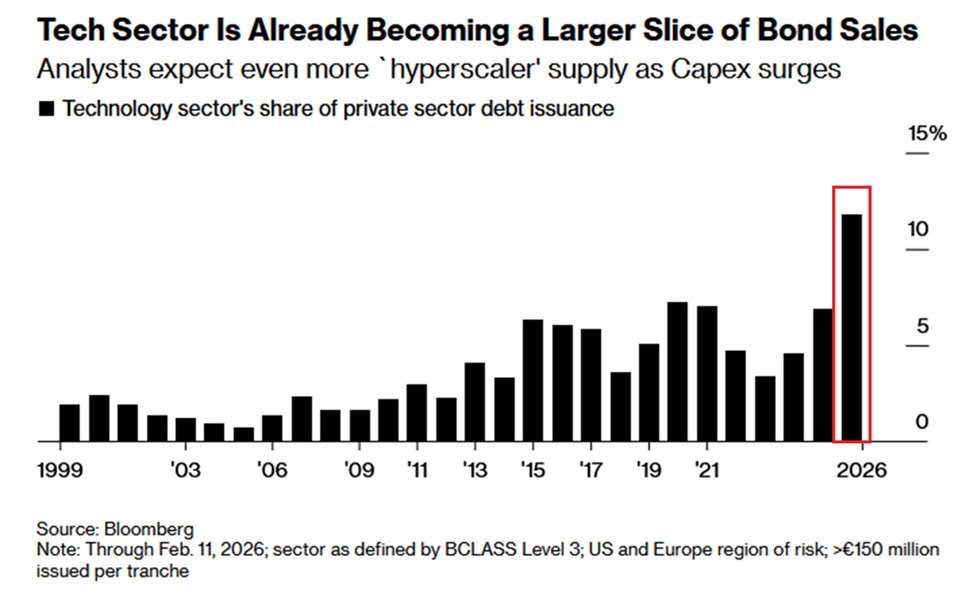
The juxtaposition is striking. While central banks are diversifying away from U.S. sovereign debt and into hard assets like gold, private-sector borrowers – particularly in technology – are tapping bond markets at record pace to finance the next wave of AI expansion.
Taken together, these developments suggest that global capital flows are entering a new phase. Sovereign reserve managers appear focused on resilience and de-dollarization risk management, while corporate America is leveraging still-deep capital markets to fund transformative technological investment.
Whether this divergence proves temporary or structural may define the next chapter in global finance.
The information provided in this article is for educational purposes only and does not constitute financial, investment, or trading advice. Coindoo.com does not endorse or recommend any specific investment strategy or cryptocurrency. Always conduct your own research and consult with a licensed financial advisor before making any investment decisions.



Alex is Editor-in-Chief of Coindoo and co-founder of Millennial Media Group, with nearly a decade of experience covering financial markets - crypto first, then everything else. It started in 2016 with Bitcoin. Like most people at the time, he didn't fully understand it - so he kept digging. Blockchain, tokenomics, the projects, the cycles. That curiosity never stopped, and eventually pulled him into traditional markets too: equities, commodities, macro. Not because he left crypto behind, but because you can't properly understand one without the other. What drives him is straightforward: he wants to know why something is happening, not just that it's happening. Most market coverage stops at the headline - price up, price down, here's a chart. Alex finds that kind of reporting actively unhelpful. If you walk away from an article without understanding the mechanism behind the move, what did you actually learn? He holds a degree in Tourism from New Bulgarian University - not the most obvious path into financial markets, but markets have a way of pulling in people who are simply too curious to stay out. He has authored over 200 in-depth analyses and more than 10,000 articles across crypto and traditional finance. He still thinks every day in markets teaches him something new. That's probably why he hasn't stopped.