Bitcoin Took Over a Decade to Deliver a 5000x Move, While BlockDAG Maps That Scale From Day One
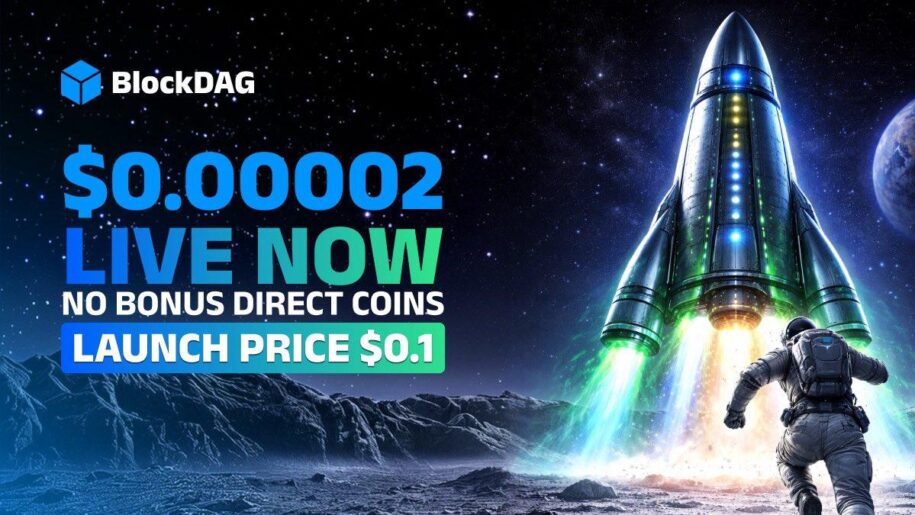
Early Bitcoin holders waited over a decade to see anything close to a 5000x move. The BlockDAG (BDAG) presale shows a similar mathematical scale from a $0.00002 entry to a $0.10 target.
This publication is sponsored and written by a third party. Coindoo does not endorse or assume responsibility for the content, accuracy, quality, advertising, products, or any other materials on this page.
A 5000x move is the kind of number that defines crypto history, the story of someone who bought a fraction of a coin for pocket change and watched it grow into something far larger over time. Bitcoin delivered exactly that for its earliest holders, but it took over a decade of holding through crashes, hacks, bear markets, and years of near-zero attention before that multiple actually materialized. Patience was the price of admission, and most people who could have entered early simply did not have the conviction to hold that long.
That is what makes a presale showing the same scale of mathematical multiple upfront so different. There is no decade of waiting required to see how the numbers are structured; they are published now, calculated directly from today’s entry price against a stated target. The BlockDAG (BDAG) presale presents exactly that: a 5000x pricing gap based on its $0.00002 Stage 1 price and $0.10 target reference, available from day one instead of after a decade of uncertainty.
What It Actually Took to Get There With Bitcoin
Bitcoin’s early history was not a straight line up; it was a slow, uncertain climb through a period when the coin had almost no established value at all. In its first couple of years of real trading, Bitcoin was worth fractions of a cent, changing hands mostly among a small group of early adopters and hobbyists who had no way of knowing whether the project would still exist a year later. The famous story of someone paying 10,000 Bitcoin for two pizzas captures just how little the coin was worth in its early days, a transaction that, at later prices, would represent one of the most expensive meals in history.
Getting from those early fractional prices to a 5000x move meant surviving multiple brutal crashes, a major exchange hack that wiped out significant value overnight, years of regulatory uncertainty, and long stretches where Bitcoin was dismissed entirely by the mainstream. It took Bitcoin holders well over a decade of holding through all of that to see a 5000x actually play out. The move was real, but the runway to get there was long, volatile, and required a level of conviction most market participants never had the chance to test.

BlockDAG (BDAG) Shows the Same Scale, Starting Now
The BlockDAG (BDAG) presale compresses that entire comparison into a structure market participants can review today rather than wait a decade to discover. BDAG currently sits at $0.00002 per coin under the project’s stated terms, with $0.10 marked as the reference price once the presale concludes according to the project. That gap works out to the same 5000x mathematical scale Bitcoin needed years to deliver, calculated directly from published numbers rather than hoped for after the fact. A $500 allocation at today’s price converts into 25,000,000 BDAG, which would be valued at $2,500,000 if BDAG reaches its $0.10 target reference. Scale that to $1,000, and the position becomes 50,000,000 BDAG, valued at $5,000,000 at the same reference price.
That scale is not resting on pricing alone, either. The BlockDAG blockchain is already live and processing network activity, BlockDAG Casino is a functioning consumer product generating on-chain usage, and mining hardware is actively being delivered to participants worldwide. The BlockDAGX exchange is under active development to add trading and liquidity once BDAG lists, a unified Super App is taking shape to bring together wallets, mining, swaps, spending, and rewards, and $100 million in planned launch liquidity is lined up to support trading from day one according to the project. That combination of live infrastructure recently helped pull in $2 million in presale commitments within a single 24-hour stretch, showing that the setup is drawing attention before wider exchange activity begins.

The multiple itself is not the only interesting part of this comparison; Bitcoin already proved a 5000x move is possible in crypto. What is different is how the pricing structure is presented. Bitcoin’s earliest holders had no way of confirming their outcome for years; they simply held through chaos and hoped the technology mattered. BDAG participants can review the numbers upfront: a published entry price, a stated target reference, and a defined structure connecting the two, all supported by products that already exist rather than only long-term potential.
To Conclude
Bitcoin proved that a 5000x move is achievable in crypto, but it took more than ten years of volatility, uncertainty, and conviction to get there. The BlockDAG (BDAG) presale presents a similar mathematical scale without asking market participants to wait a decade to see how the structure is defined: a $0.00002 entry under the project’s stated terms, a $0.10 target reference according to the project, and a live ecosystem already shipping products behind it.
For those who watched Bitcoin’s early story from the sidelines and wondered what a similar early-stage setup might look like, BDAG’s current pricing structure offers a clear comparison point based on published numbers, active infrastructure, and a defined presale model.

Presale: https://purchase.blockdag.network
Website: https://blockdag.network
Telegram: https://t.me/blockDAGnetworkOfficial
Discord: https://discord.gg/Q7BxghMVyu
This publication is sponsored and written by a third party. Coindoo does not endorse or assume responsibility for the content, accuracy, quality, advertising, products, or any other materials on this page. Readers are encouraged to conduct their own research before engaging in any cryptocurrency-related actions. Coindoo will not be liable, directly or indirectly, for any damages or losses resulting from the use of or reliance on any content, goods, or services mentioned.


Krasimir Rusev is a journalist and digital content creator with over 4 years of experience and more than 1,000 published pieces in the financial space. His work focuses on stock markets and commodities, closely tracking asset movements and the factors that drive them. He has a particular interest in gold and oil markets - not just their current movements, but their history, structure, and long-term trends. For him, understanding the context behind prices matters just as much as the prices themselves. A self-described Bitcoin maximalist, Krasimir has been following crypto markets long before he became a journalist. What started as a casual interest in Bitcoin gradually turned into a deep conviction - one that shaped how he thinks about money, value, and the broader financial system. That perspective quietly informs everything he writes. Beyond writing analysis and news, he actively creates content for social media including TikTok, Facebook, and Instagram, presenting market topics in a more accessible and visually engaging format. He believes financial information should reach a wide audience - not just those already following the markets. At Coindoo, he contributes to both editorial content and the development of the platform's digital presence. He works with tools like Photoshop, CapCut, and Canva, with a particular focus on visual storytelling - videos, infographics, and images that add an extra layer of value to news and analysis.