Bitcoin May Have Found a Floor But the $83B Damage Remains

Bitcoin may have completed its cycle correction, but treasury-company shares face a separate repair job because their premiums depend on financing as well as BTC.
Key Takeaways
- Bitcoin held Timmer’s long-term power-law support.
- Treasury-company market value fell roughly $83 billion.
- Strategy dominated the reported market-cap decline.
- Corporate recovery depends on financing discipline.
Bitcoin held Fidelity’s power-law floor
Jurrien Timmer, Fidelity’s director of global macro, said Bitcoin had held the lower boundary of his power-law curve and spent enough time correcting to satisfy what he calls a mild four-year-cycle winter.
The chart uses weekly data through August 23 and marks Bitcoin’s recent low at $59,572 against power-law support at $58,237. The local low therefore came within approximately 2.3% of the model line. The separate 16% reading at the chart’s right edge reflects Bitcoin’s distance above support by August 23, after price had moved away from the trough.
Bitcoin has held the floor of its power law curve and has now corrected long enough to satisfy the time element of its mild 4- year cycle winter. pic.twitter.com/M6QHRWDfA8
— Jurrien Timmer (@TimmerFidelity) August 28, 2026
Timmer’s model places Bitcoin’s long-term price history inside a rising curve whose growth rate slows over time. Previous bear-market lows formed near its lower boundary, including the 2015, 2018 and 2022 bottoms. This year’s decline tested the same region.
The model identifies a zone, not a reversal
Reaching that area supports the argument that the correction is mature. A new bull market would still require buyers to build on the recovery rather than simply defend one historical line.
In Fidelity’s official explanation of the framework, Timmer warns that adoption curves can eventually break. The model organizes Bitcoin’s price history; it cannot make the previous pattern repeat.
We previously examined Bitcoin’s approach toward power-law support. The latest reading adds the test that was missing then: Bitcoin reached the area and recovered without closing decisively through the model floor.
That recovery improves one input on a corporate balance sheet, the market value of its Bitcoin. It does not erase the very different prices companies paid to build their reserves.
Strategy’s average cost hides a divided reserve
A CryptoQuant chart from August 29 separates Strategy’s unrealized Bitcoin profit and loss by purchase year. The breakdown reveals the timing risk concealed by a single blended cost basis.
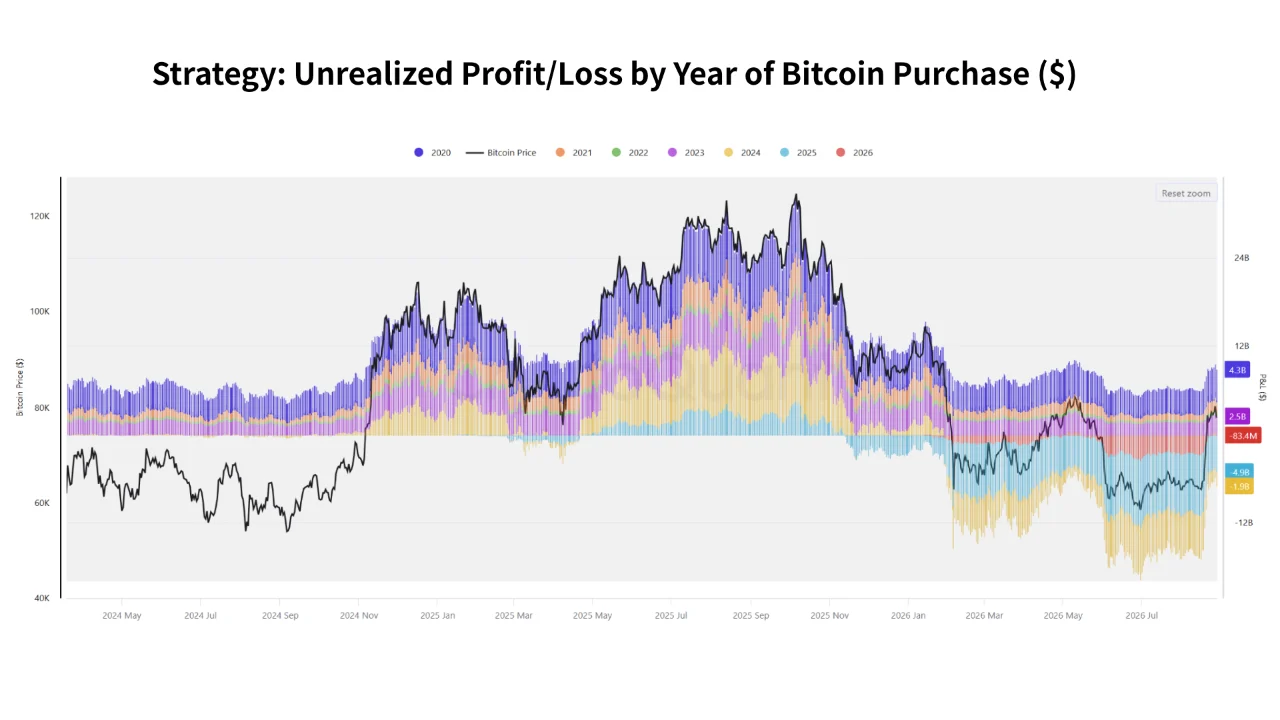
At the chart’s latest reading, Bitcoin acquired in 2020 carried approximately $4.3 billion in unrealized profit. The 2023 cohort contributed another $2.5 billion. Those gains partially offset losses attached to purchases made during later, more expensive periods:
- 2024 purchases: approximately $1.9 billion underwater.
- 2025 purchases: approximately $4.9 billion underwater.
- 2026 purchases: approximately $83.4 million underwater.
This data does not display final values for every purchase-year cohort. Its visible figures should therefore not be added together to calculate Strategy’s total unrealized result. They are also a moving data: every change in Bitcoin’s price alters the gains and losses.
Strategy’s official Bitcoin ledger provides the underlying transaction history, including acquisition dates, amounts and purchase costs.
The chart leaves financing costs outside the frame
CryptoQuant compares the market value of each purchase cohort with its acquisition cost. Preferred-stock dividends, debt interest, issuance expenses and common-share dilution sit outside that calculation. An unrealized loss also creates no automatic requirement to sell Bitcoin.
Strategy shareholders own the company’s entire capital structure, not an isolated pool of BTC. Strategy’s reserve at different Bitcoin prices showed how quickly the paper cushion can change while its corporate obligations remain.
An improving reserve does not guarantee an equivalent recovery for shareholders. Public-company valuations contain financing and dilution risks that the Bitcoin price alone cannot repair.
Treasury stocks fell further than Bitcoin
The Financial Times analysis examined 50 major Bitcoin holders among companies that had recently made accumulation central to their strategy. It excluded miners, exchanges and businesses that held BTC as part of established operations.
Within that sample, combined market capitalization fell from $150 billion in July 2025 to $67 billion in August 2026. The $83 billion decline equals approximately 55%. Over the latest 12 months alone, the group dropped from $124 billion to $67 billion.
Bitcoin declined about 30% over the same one-year period. Shares in 43 of the 50 companies traded below where they stood before the businesses announced their Bitcoin pivots, while 35 had lost at least half their value.
Strategy dominates the reported decline
Strategy’s market capitalization fell by roughly $79 billion from its own peak and accounted for most of the damage identified by the FT. The calculation does not necessarily use the same starting date as the group’s $83 billion decline, so the two figures cannot establish Strategy’s exact percentage of the total.
The concentration also means the headline number does not describe 50 equally severe collapses. The breadth figures – 43 stocks below their pre-pivot prices and 35 down by at least half – provide the better evidence that the problem extended beyond Strategy.
The pressure eventually reached the companies’ Bitcoin reserves. In July 2026, the group became a net seller for the first time, disposing of approximately 2,500 more BTC than it acquired, according to BitcoinTreasuries.net data cited by the FT. Strategy drove much of that reversal as it moved from one-way accumulation toward active capital management. We already examined this change in our report on Strategy’s recent Bitcoin sales.
The gap between Bitcoin’s 30% decline and the group’s roughly 55% market-cap loss points beyond the underlying asset. Investors also withdrew the share-price premiums that had supported the companies’ financing strategies.

Why the share-price premium mattered
The treasury model worked most efficiently when investors valued a company above the net worth of its Bitcoin and other assets. That premium allowed management to raise more capital without giving away as much ownership for every dollar received.
How the premium funded more Bitcoin
- The shares traded above the company’s net asset value.
- Management issued securities on favorable terms.
- The proceeds funded additional Bitcoin purchases.
- Bitcoin per diluted share could continue rising.
- Stronger per-share results supported further financing.
Once that premium contracts, selling common shares may fail to increase Bitcoin per diluted share enough to compensate existing investors. Debt and preferred stock can delay direct common-share dilution, but they add interest, dividends, senior claims and refinancing risk.
A higher Bitcoin price lifts the value of the reserve. It does not automatically restore the premium, lower financing costs or make another securities issuance attractive. Treasury-company shares can therefore remain depressed after BTC itself establishes support.
Four tests matter more than another Bitcoin purchase
Headline reserve growth no longer demonstrates that the corporate model is creating value. Investors now need evidence from the shares and the financing behind them:
- Bitcoin per diluted share: New purchases should increase per-share exposure after accounting for every security issued to finance them.
- Net-asset-value premium: A sustainable premium would reopen financing options without sharply diluting existing holders.
- Cash coverage: Companies need enough dollars to meet interest and dividend obligations without selling BTC at weak prices.
- Performance against spot ETFs: The shares must provide a clear benefit, such as stronger per-share accumulation or operating earnings, to justify their added corporate and governance risks.
Bitcoin no longer has to fall for treasury companies to struggle. From here, BTC determines the value of their reserves; financing discipline determines how much of that value reaches shareholders.
The article is for informational purposes only and does not constitute financial or investment advice. Bitcoin and Bitcoin-linked equities can experience substantial volatility. Corporate treasury companies also carry financing, dilution, liquidity, governance and operational risks that do not apply to holding Bitcoin directly.



Alex is Editor-in-Chief of Coindoo and co-founder of Millennial Media Group, with nearly a decade of experience covering financial markets - crypto first, then everything else. It started in 2016 with Bitcoin. Like most people at the time, he didn't fully understand it - so he kept digging. Blockchain, tokenomics, the projects, the cycles. That curiosity never stopped, and eventually pulled him into traditional markets too: equities, commodities, macro. Not because he left crypto behind, but because you can't properly understand one without the other. What drives him is straightforward: he wants to know why something is happening, not just that it's happening. Most market coverage stops at the headline - price up, price down, here's a chart. Alex finds that kind of reporting actively unhelpful. If you walk away from an article without understanding the mechanism behind the move, what did you actually learn? He holds a degree in Tourism from New Bulgarian University - not the most obvious path into financial markets, but markets have a way of pulling in people who are simply too curious to stay out. He has authored over 200 in-depth analyses and more than 10,000 articles across crypto and traditional finance. He still thinks every day in markets teaches him something new. That's probably why he hasn't stopped.