Aster Price Stays Trapped as AOS-2 Adds a New Supply Fight
ASTER has barely moved out of its late-July range, with buyers defending the lower side while repeated attempts to break higher continue to fail.
The quiet price action comes as Aster introduces several changes that could affect ASTER supply in different directions. AOS-2 is now live, millions of tokens have recently been bought back, and team and advisor vesting is set to begin after the token’s first anniversary in September.
Key Takeaways
- ASTER remains trapped below key resistance.
- AOS-2 introduces an expensive four-year lock.
- Buybacks depend directly on platform activity.
- September introduces a larger supply test.
ASTER Has Been Unable to Reclaim the 50-Day SMA
ASTER was trading around $0.60 on August 13, still below the 50-day simple moving average that has capped the token since June.
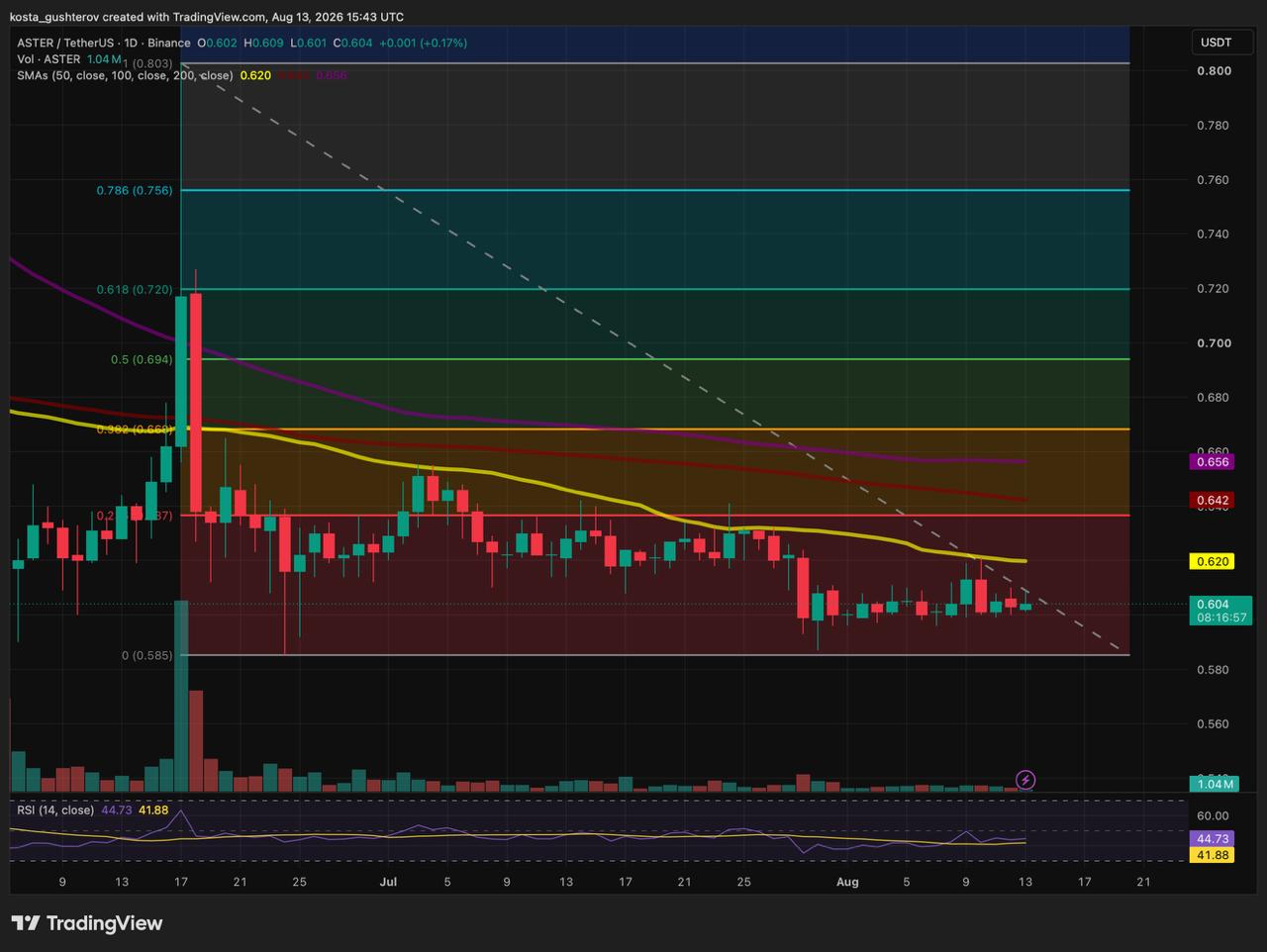
The last meaningful break came around June 17. ASTER briefly moved above the average but failed to hold the advance, and subsequent attempts have stalled around the same area.
Instead of extending the decline, price has spent most of the period since late July inside a much tighter range.
Its lower boundary has also become clearer. ASTER has fallen toward $0.58 twice and bounced on both occasions, establishing the area as the nearest swing low and the strongest visible support below current price.
Much of the structure created during the earlier move higher disappeared during the decline from June’s high, giving $0.58 more significance than another short-term intraday level. Losing it could expose deeper parts of the previous range.
A sustained move above the 50-day SMA would change that picture on the upside after weeks of failed recovery attempts.
AOS-2 Creates Demand, but at a High Price
Aster published the framework for AOS-2 on July 28, extending its open listing system to perpetual markets. The protocol then put AOS-2 into effect on August 11.
Eligible projects seeking a perpetual listing must stake 1 million ASTER, locked for four years with no early exit. Applications then pass through an on-chain validator vote before an approved market can proceed toward launch.
AOS-2 enters into force.
The Aster Open Standards began with AOS-1, which opened spot listings to projects meeting a published set of criteria.
AOS-2 now extends the same principle to perpetual markets, where listing has traditionally depended on private negotiation.
Under… pic.twitter.com/sFtII7bcMl
— Aster 🥷 (@Aster_DEX) August 11, 2026
At ASTER’s current price, that means committing roughly $600,000 worth of tokens for four years.
For ASTER holders, the mechanism has an obvious benefit: every successful application creates direct token demand and removes those tokens from liquid circulation for an extended period.
The same requirement could also limit how widely AOS-2 is used.
Committing hundreds of thousands of dollars for four years is a substantial cost, particularly for smaller projects or teams that may have other options for securing a perpetual listing. AOS-2 can only become a meaningful token sink if enough projects decide that the listing opportunity justifies tying up that much capital.
That makes adoption more important than the launch itself. A handful of applications would have a limited effect on supply, while broader use would begin turning the new standard into a measurable source of long-term ASTER demand.
Buybacks Add Demand, but Their Size Can Change Quickly
Aster’s updated tokenomics direct 99% of daily platform fees toward automated ASTER buybacks. Purchased tokens are distributed to veASTER stakers, while an equal amount is burned from reserves.
The latest official update shows 2,851,653.28 ASTER purchased between July 27 and August 10.
The matching burn initially comes from the team allocation. Aster says the mechanism is intended to continue until total token supply falls from its original 8 billion toward 3 billion ASTER.
The structure combines two effects: platform revenue creates open-market purchases, while the corresponding reserve burn reduces supply elsewhere.
But the 99% figure can look stronger than it is without considering the size of the fee pool behind it. Buybacks expand when trading activity and fee revenue rise and shrink when activity slows. They are therefore not a fixed source of demand.
The latest figures provide some scale. Buying 2.85 million ASTER over roughly two weeks would translate to around 5.7 million tokens per month if that pace were sustained.
That becomes particularly relevant when compared with the supply schedule approaching in September.

September Could Put Aster’s Token Sinks to the Test
Aster’s official tokenomics allocate 400 million ASTER, or 5% of the original supply, to the team and advisors. The allocation carries a full one-year cliff followed by 40 months of linear vesting.
ASTER’s TGE took place on September 17, 2025, putting the end of that cliff around the token’s first anniversary next month.
The entire 400 million allocation will not become liquid at once. Once vesting begins, spreading the allocation evenly across 40 months works out to roughly 10 million ASTER per month.
That is notably larger than the recent buyback pace. If Aster continued purchasing tokens at roughly the rate reported between July 27 and August 10, monthly buybacks would absorb around 5.7 million ASTER – well below the roughly 10 million scheduled to vest each month.
The comparison is not exact. Buybacks fluctuate with platform revenue, while vesting only makes tokens available and does not mean they will automatically be sold.
Still, September changes the balance. Until now, buybacks and long-term locks have been removing or restricting supply without the team vesting schedule working against them. From next month, the market may have to absorb newly available tokens at the same time.
Even a portion of those vested tokens reaching the market could matter if ASTER remains stuck in its current range. With $0.58 already serving as the nearest established support, additional selling pressure would give that level a more serious test.
The next question for ASTER is therefore not simply whether AOS-2 launches successfully or whether buybacks continue. It is whether those mechanisms can absorb enough supply once vesting begins.
- Disclaimer: This article is for informational and educational purposes only and does not constitute financial or investment advice. Cryptocurrency markets are highly volatile, and readers should conduct their own research before making investment decisions.



Kosta has reported on cryptocurrency markets and blockchain infrastructure since 2020, bringing over six years of hands-on experience in the crypto industry built through daily tracking of markets, trends, and emerging blockchain developments. Specializing in Bitcoin on-chain analysis, institutional ETF flows, and digital asset price action, his work at Coindoo has been cited by other news agencies and consistently covers market developments with a focus on data-driven reporting across Bitcoin, Ethereum, Solana, and XRP. Over the years, Kosta has contributed to multiple crypto media outlets in different regions, authoring over 6,000 articles across the sector. His reporting spans cryptocurrency markets and the broader fintech industry, tracking not only price action but also the technological and regulatory forces shaping the ecosystem. To support his analysis, Kosta actively leverages on-chain data and metrics from leading platforms such as Santiment, Glassnode, and CryptoQuant, enabling deeper, evidence-based market insights. He believes in the power of transparency and the data that underpins the blockchain ecosystem. His academic background in Marketing Management from Denmark further complements his analytical approach, adding a strong understanding of communication strategy and content positioning to his work.