Arthur Hayes Flips the Yen Risk Thesis for Bitcoin

A stronger yen is usually bad news for leveraged markets, but Arthur Hayes sees a route that could strengthen Japan’s currency while adding dollar liquidity.
Key Takeaways
- For Bitcoin, how Japan strengthens the yen may matter more than the currency move itself.
- Hayes’s scenario relies on an existing Fed facility, but would require much larger and more persistent use than seen today.
- Japan’s enormous foreign-asset holdings overstate the amount that could immediately enter the Fed’s FIMA framework.
- The thesis becomes actionable only if Fed policy changes are followed by visible growth in foreign-official repo balances.
A Stronger Yen Can Reach Bitcoin in Two Ways
Hayes is looking at a familiar yen problem from a different angle.
In his August 11 “Yen-quake” essay, Hayes argues that Japan could support its currency without forcing the Bank of Japan into an aggressive tightening cycle. His alternative runs through the Federal Reserve’s Foreign and International Monetary Authorities, or FIMA, Repo Facility.
Hayes distills the Bitcoin implication into one line: “The more they print, the higher Bitcoin goes.”
The usual risk from Japan works differently. Years of low Japanese borrowing costs encouraged investors to fund positions elsewhere with cheap yen. When Japanese rates rise sharply or the yen appreciates quickly, those trades become less attractive and can unwind across equities, bonds and crypto.
That was the concern after the BOJ’s July meeting. As we previously examined, the larger Bitcoin risk was not simply another BOJ rate increase, but a yen reversal strong enough to disrupt the funding trades built around the currency.
Hayes is asking what happens if policymakers reach a stronger yen through a different route.
FIMA Offers an Alternative to Aggressive BOJ Tightening
The Federal Reserve’s FIMA Repo Facility allows approved foreign central banks and other monetary authorities to temporarily exchange US Treasury securities held at the Federal Reserve Bank of New York for dollars.
Japan could, in theory, obtain dollars through that facility and sell them in the foreign-exchange market for yen.
The institutional roles already exist. Japan’s Ministry of Finance decides whether to intervene in the currency market, while the Bank of Japan executes those transactions on its behalf, according to the BOJ’s own explanation.
That creates a very different macro setup from a rapid sequence of BOJ hikes. Rather than making yen funding more expensive primarily through monetary tightening, Japan could support the currency while drawing dollar liquidity against assets it already holds.
It would also avoid another potential problem: selling large amounts of Treasuries directly into the market.
FIMA was designed partly to give foreign monetary authorities an alternative to doing exactly that when they need dollars.

The Facility Exists, but the Bitcoin Trade Does Not Yet
The biggest reality check comes from the Fed’s own balance sheet.
Its H.4.1 release showed no balance under foreign-official repurchase agreements as of August 5. There is currently no large FIMA operation supplying the liquidity Hayes expects to become bullish for Bitcoin.
The existing framework is also deliberately constrained. The Fed currently limits transactions to approved foreign official institutions, applies a $60 billion daily limit per counterparty and generally offers overnight or seven-day repos.
Those details separate FIMA from quantitative easing.
QE involves outright asset purchases that can remain on the Fed’s balance sheet for years. FIMA is temporary collateralized financing, so its impact depends less on a one-off transaction than on whether large balances remain outstanding through repeated rollovers.
Hayes’s liquidity thesis becomes more consequential if usage is both large and persistent.
Japan’s $1.37 Trillion Is Not a Ready FIMA War Chest
Hayes estimates that Japanese government holdings and assets associated with the Government Pension Investment Fund could provide roughly $1.37 trillion of Treasury collateral.
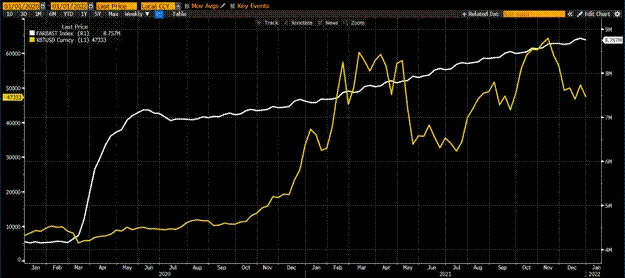
Japan undoubtedly has the financial scale for a large operation, but the headline number combines assets that do not all sit inside the same legal or operational bucket.
The Ministry of Finance reported $1.287 trillion in official reserve assets at the end of July, including $927.3 billion in foreign-currency securities. The ministry does not identify all of those securities as US Treasuries.
US data measures something different. The Treasury Department’s Treasury International Capital data showed Japan holding $1.1431 trillion in US Treasury securities in May, but that is an aggregate country figure rather than a statement that the Japanese government itself owns the full amount.
GPIF widens the gap further. The pension fund owns foreign bonds, but its international fixed-income portfolio spans US, global, high-yield and emerging-market benchmarks. It is also not currently the type of foreign monetary authority that FIMA is designed to serve directly.
The practical ceiling is therefore narrower than Japan’s total overseas wealth. What matters is the amount of qualifying assets controlled by eligible official institutions and held through accounts that can actually access the New York Fed facility.
Macro Breakdown
Arthur Hayes’s FIMA Thesis vs. Current Reality
- Japan uses the Fed’s FIMA facility to acquire and sell dollars for yen.
- Avoids aggressive BOJ rate hikes and forced US Treasury dumping.
- Persistent dollar liquidity expansion acts as a catalyst for Bitcoin.
- Fed H.4.1 release shows zero balance under foreign-official repos.
- Strict caps ($60B limit) and institutional eligibility restrict access.
- Requires major structural changes to Fed rules before becoming actionable.
The Fed Has Room to Change the Rules
The current constraints are not necessarily permanent.
Under the Fed’s standing authorization, its Foreign Currency Subcommittee can modify the counterparty limit and certain operating terms of the facility while reporting those changes to the Federal Open Market Committee.
That makes the $60 billion ceiling adjustable without creating an entirely new emergency program.
Expanding the list of institutions able to participate would be a bigger step. Current Fed guidance restricts access to approved central banks and other foreign monetary authorities with appropriate New York Fed accounts. Bringing a pension institution such as GPIF directly inside the facility would require a broader eligibility framework.
Hayes acknowledges that policy changes would be needed before his larger scenario becomes possible.
Changing a transaction ceiling is one thing. Redesigning who can access the Fed is a much larger policy decision.
There Are Clear Signals if the Thesis Starts Becoming Real
The advantage of Hayes’s argument is that investors would not have to infer it solely from Bitcoin or USD/JPY price action.
The first signal would come from Washington. Any expansion of FIMA limits, maturity terms or counterparty eligibility would materially change the amount of dollar liquidity the facility could provide.
The next evidence would appear directly on the Fed’s balance sheet. A rise in foreign-official repo balances would show that the facility had moved from policy capacity to actual use.
Duration would matter just as much as size. A temporary balance that disappears after several days would look more like conventional currency support. Large balances repeatedly rolled over for weeks or months would create a stronger case that the operation was adding persistent dollar liquidity.
Japan’s reserve reports could then show whether authorities were mobilizing more of their foreign assets, while the yen would reveal whether those operations were having the intended currency effect.
For now, the facility sits empty at zero, marking the exact line between Arthur Hayes’s theoretical plumbing and an actual Bitcoin liquidity catalyst.
- Disclaimer: This article is for informational and educational purposes only and does not constitute financial or investment advice. Arthur Hayes’s FIMA scenario is a forward-looking macro thesis, not a confirmed policy plan. Any impact on Bitcoin would depend on actual changes to Federal Reserve policy, facility usage, market liquidity and Japan’s intervention strategy.



Kosta has reported on cryptocurrency markets and blockchain infrastructure since 2020, bringing over six years of hands-on experience in the crypto industry built through daily tracking of markets, trends, and emerging blockchain developments. Specializing in Bitcoin on-chain analysis, institutional ETF flows, and digital asset price action, his work at Coindoo has been cited by other news agencies and consistently covers market developments with a focus on data-driven reporting across Bitcoin, Ethereum, Solana, and XRP. Over the years, Kosta has contributed to multiple crypto media outlets in different regions, authoring over 6,000 articles across the sector. His reporting spans cryptocurrency markets and the broader fintech industry, tracking not only price action but also the technological and regulatory forces shaping the ecosystem. To support his analysis, Kosta actively leverages on-chain data and metrics from leading platforms such as Santiment, Glassnode, and CryptoQuant, enabling deeper, evidence-based market insights. He believes in the power of transparency and the data that underpins the blockchain ecosystem. His academic background in Marketing Management from Denmark further complements his analytical approach, adding a strong understanding of communication strategy and content positioning to his work.