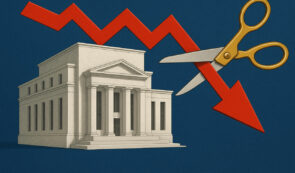
US Policies Are Undermining the Dollar’s Global Role, Warns ECB Official

The balance of power in global currencies may be slowly shifting, and political decisions in Washington are playing a growing role in that process.
That was the core message delivered by Francois Villeroy de Galhau, who argued that recent US policy signals are weakening some of the foundations that have long supported the dollar’s dominance.
Key Takeaways
- European officials warn that political pressure on the Federal Reserve is weakening confidence in the US dollar.
- Concerns over US debt, tariffs, and payment system weaponization are accelerating diversification away from dollar assets.
- ECB policymakers see an opportunity for a more multipolar global currency system, potentially strengthening the euro.
- Renewed discussion around a euro-denominated safe asset could support the euro’s global role.
Rather than pointing to market forces alone, Villeroy framed the issue as one of credibility. He said confidence in the dollar has historically rested on three pillars: the independence of the Federal Reserve, faith in US fiscal discipline, and deep integration with the global economy. In his assessment, all three have come under strain.
Credibility risks are no longer theoretical
Villeroy warned that repeated political pressure on the Federal Reserve is being closely watched by global investors. Public attacks on the central bank, he said, raise doubts about whether monetary policy decisions can remain insulated from short-term political goals. Over time, that uncertainty can erode trust in dollar-denominated assets.
He added that growing concerns around US debt levels and the expanded use of tariffs are reinforcing the perception that the United States is becoming less predictable as a steward of the world’s primary reserve currency.
Payments systems and geopolitical anxiety
Beyond monetary policy, Villeroy highlighted a deeper geopolitical concern. As the dollar underpins much of the global payments infrastructure, fears that it could be increasingly used as a political tool are pushing some countries to seek alternatives.
According to him, this is already encouraging the development of non-dollar payment systems and settlement networks. While these alternatives remain limited in scale, their emergence reflects a broader desire among some jurisdictions to reduce reliance on dollar-based financial channels.
A multipolar system may be more resilient
European policymakers have increasingly described this moment as a potential opening for the euro. Villeroy acknowledged that uncertainty around the dollar creates space for other currencies to gain ground, but he emphasized that the goal should not be to replace one form of dominance with another.
Instead, he argued that a more multipolar monetary system – where several major currencies share global roles – could ultimately be more stable, reducing the risks associated with overdependence on a single anchor.
Reviving the idea of a euro safe asset
For the euro to play a larger global role, Villeroy said Europe must address a long-standing structural gap: the absence of a unified, highly liquid euro-denominated safe asset comparable to US Treasuries.
He suggested that policymakers revisit proposals such as partially mutualizing sovereign debt at the European level or expanding joint supranational borrowing. Such measures, he argued, could strengthen investor confidence in euro assets and make them more attractive as reserves.
Inflation context shapes the message
Villeroy also pointed to recent domestic data to set the economic backdrop. French inflation eased to 0.7% in December, its lowest level in several months. He described this as supportive for household purchasing power and consistent with maintaining accommodative financial conditions.
Taken together, his remarks underline a broader shift in thinking among European officials. The dollar remains central to the global system, but its dominance is no longer viewed as immutable. Policy choices, not just market forces, may determine how quickly the world moves toward a more diversified currency landscape.
The information provided in this article is for educational purposes only and does not constitute financial, investment, or trading advice. Coindoo.com does not endorse or recommend any specific investment strategy or cryptocurrency. Always conduct your own research and consult with a licensed financial advisor before making any investment decisions.



Alexander Zdravkov is a person who always looks for the logic behind things. He has more than 3 years of experience in the crypto space, where he skillfully identifies new trends in the world of digital currencies. Whether providing in-depth analysis or daily reports on all topics, his deep understanding and enthusiasm for what he does make him a valuable member of the team.