TRON Announces Zero Hash Integration After a Month of Big Developments

March 2026 was not a quiet month for TRON. Between a landmark SEC settlement, a federally chartered bank opening its doors to TRX, and now a fresh enterprise integration with Zero Hash, the network is executing a deliberate push into regulated financial territory. The pieces moved fast this month - and they moved in one direction.
Key Takeaways
- TRON integrates with Zero Hash, giving enterprise and fintech platforms regulated access to TRX and TRC-20 USDT
- March 2026 marked a turning point: the SEC dropped its case against Justin Sun and the TRON Foundation with prejudice
- TRX is trading near resistance at $0.32, with RSI and MACD both signaling continued bullish momentum
In a press release shared with Coindoo, TRON DAO has announced an integration with Zero Hash, a regulated infrastructure provider serving crypto, stablecoin, and tokenized asset markets. The deal gives enterprise clients and fintech platforms access to TRX and TRC-20 USDT through Zero Hash’s compliance framework – covering custody, trading, liquidity, and settlement in select jurisdictions.
In plain terms: fintechs, exchanges, and neobanks building on Zero Hash’s rails can now plug into TRON without building their own compliance stack from scratch. Regulatory infrastructure is one of the most expensive problems in institutional crypto, and Zero Hash has already solved it. The integration also includes fiat-to-crypto onboarding – smooth fiat entry points remain one of the biggest friction points for institutions trying to deploy capital into blockchain-based settlement, and removing that barrier tends to have an outsized effect on adoption.
TRON’s underlying numbers justify the pitch. The network has processed over $25 trillion in cumulative transfer volume since its 2018 mainnet launch, supports more than 373 million user accounts, and handles roughly 11 million transactions per day. Daily transfer volume sits above $23 billion. These figures reflect a network that already moves serious money – particularly in stablecoin corridors – and Zero Hash is now giving regulated institutions a compliant on-ramp into that flow.
March Was a Big Month for Tron
The Zero Hash announcement arrives at the end of what has been TRON’s most consequential month in years.
The SEC case is closed. On March 5, the SEC settled its 2023 fraud and market manipulation case against Justin Sun and affiliated entities. A Sun-linked company, Rainberry Inc. (formerly BitTorrent), agreed to pay a $10 million civil penalty. More critically, the SEC dismissed all claims against Justin Sun personally, the TRON Foundation, and the BitTorrent Foundation – with prejudice. That means the regulator cannot bring these same charges again. The enforcement overhang that followed TRON since 2023 is formally gone.
Critics have noted the $10 million figure looks light given the original allegations involved $31 million in alleged gains. The political context has drawn additional scrutiny – the case was paused after the 2024 U.S. election, and Sun’s reported $30 million investment in the Trump-linked World Liberty Financial has led some former SEC officials to call the resolution unusually favorable. Those criticisms may be fair. But for institutional risk desks, what matters is the outcome: the legal cloud has lifted.
On March 26, Anchorage Digital – one of the few federally chartered crypto banks in the U.S. – announced TRX custody support. Anchorage’s federal charter gives U.S. banks and hedge funds a compliant path to hold TRX, something largely unavailable before. Coinbase delisted TRX in the past. That institutional door was shut.
The rollout is phased: TRX custody is live now through Anchorage’s main platform and Porto self-custody wallet, with TRC-20 asset support and native TRX staking planned for later stages. That staking component is worth watching – institutions earning yield on TRX while contributing to network validation tends to drive longer-term holding behavior.
Together, the SEC settlement and Anchorage integration mark a pivot for TRON in the U.S. market: from a high-risk offshore project to something compliance teams can actually work with.
Technical Analysis
The technical picture on TRX/USDT adds context to the macro story. Trading around $0.3166 on the daily, TRX has recovered sharply from the $0.24–$0.27 range it occupied through October and November 2025.
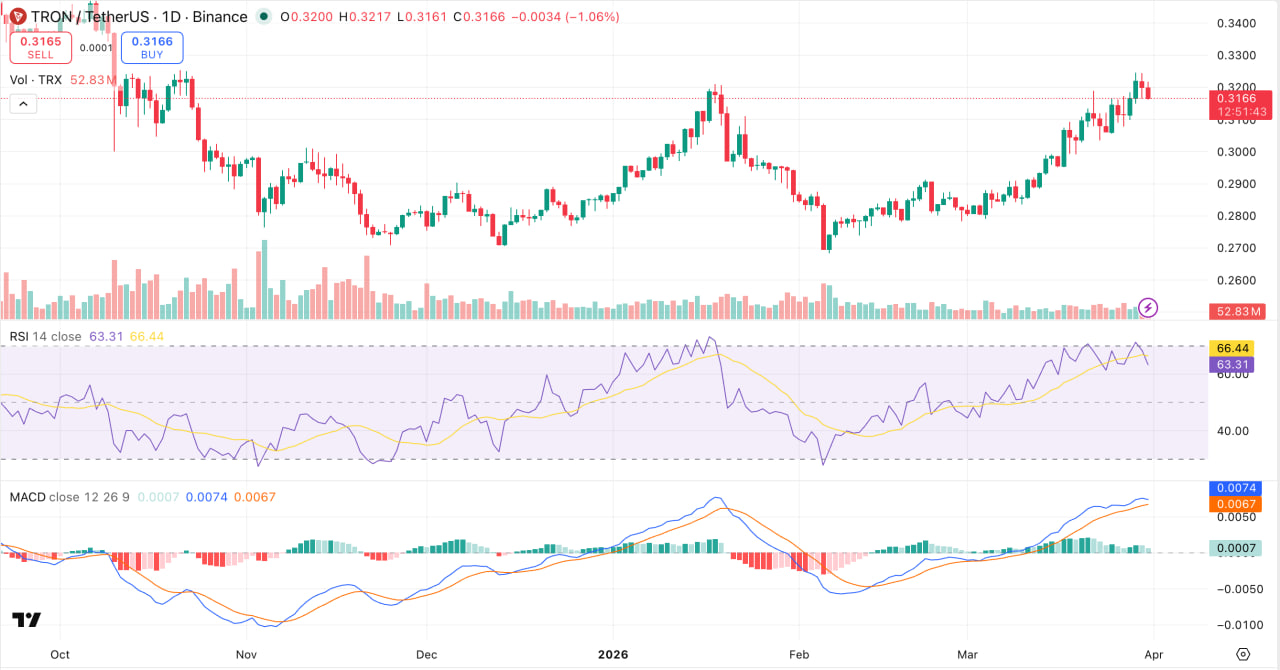
The RSI sits at 63.31 with its signal line at 66.44 – bullish territory, not yet overbought. Crucially, the RSI has been trending higher since late January, suggesting this move has built gradually rather than spiked on a single catalyst.
MACD confirms the trend. The MACD line (0.0074) sits above the signal line (0.0067), histogram printing green, with the spread between the two widening through March – a sign of strengthening momentum, not exhaustion.
The key level is $0.32, which has capped price on multiple occasions over the past six months. TRX is pressing against that ceiling now. A clean break above it opens the path toward $0.33–$0.34. A rejection sends it back toward the $0.29–$0.30 support zone.
Volume has been steady rather than explosive – which is actually constructive. Parabolic moves on thin volume reverse quickly. The measured participation here points to holders, not pure speculation.
Whether March’s regulatory tailwinds are already priced in or still working their way into the market is the real question. The chart says momentum is intact. The news flow says the institutional narrative is only getting started.
The information provided in this article is for educational purposes only and does not constitute financial, investment, or trading advice. Coindoo.com does not endorse or recommend any specific investment strategy or cryptocurrency. Always conduct your own research and consult with a licensed financial advisor before making any investment decisions.



Alex is an experienced financial journalist and cryptocurrency enthusiast. With over 8 years of experience covering the crypto, blockchain, and fintech industries, he is well-versed in the complex and ever-evolving world of digital assets. His insightful and thought-provoking articles provide readers with a clear picture of the latest developments and trends in the market. His approach allows him to break down complex ideas into accessible and in-depth content. Follow his publications to stay up to date with the most important trends and topics.