The Divergent Paths: Bitcoin Adoption in the EU vs the US
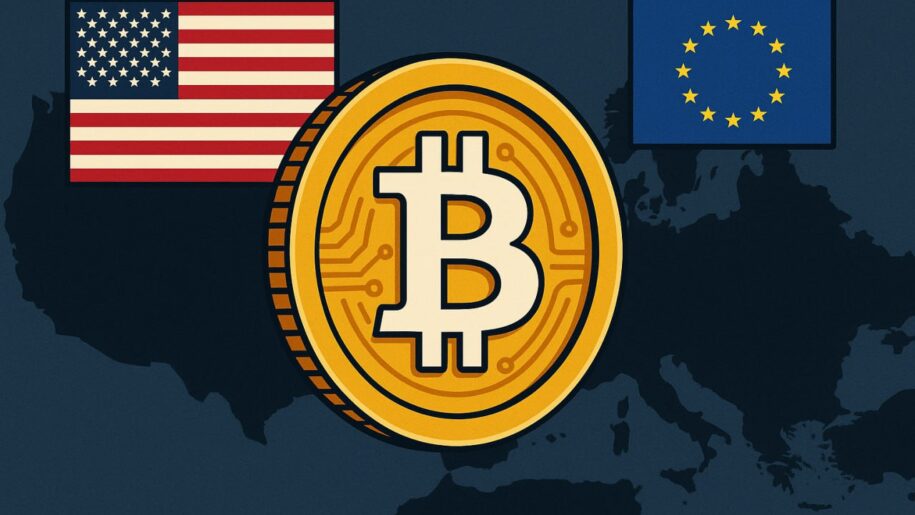
In the evolving world of cryptocurrencies, the journey of Bitcoin adoption has not been uniform. While both the European Union (EU) and the United States share advanced financial systems and high technological literacy, their trajectories with Bitcoin diverge in interesting ways.

This divergence is shaped by regulatory frameworks, institutional participation, public sentiment, infrastructure, and cultural norms. In this article, we compare the adoption patternsin the EU and the US, and explore what drives the differences and what lessons each side canlearn.
Early Landscape and Current Adoption Rates
To ground the discussion, it helps to begin with some data. In the US, a recent study by River indicates that approximately 14.3 % of Americans now own Bitcoin. That places the US nearthe top globally in ownership penetration among developed nations. Meanwhile, adoption across the EU is more fragmented. According to a European Central Bank (ECB) survey, about 9.7 % of households across the euro area held some form of cryptocurrency (notnecessarily Bitcoin) in late 2024, though the amounts tend to be modest (54 % held under€1,000). Other sources suggest that crypto adoption in Europe broadly is around 8.9 % in 2025.
When we examine on-chain metrics rather than just ownership surveys, Central, Northern & Western Europe (CNWE) is a particularly active zone: between July 2023 and June 2024, theregion registered $987 billion in on-chain value—21.7 % of global transaction volume (Chainalysis). Moreover, in that same region, Bitcoin (BTC) alone accounted for around one-fifth of that volume, particularly in retail- and professional-scale transfers.
It is worth noting that when writing about European markets, those using the euro frequentlytrack Bitcoin’s value relative to the euro. Thus, the BTC/EUR rate is a commonly citedfigure in Europe for evaluating the investment dynamics and market sentiment.
Despite strong absolute numbers, growth in Europe has lagged. According to Chainalysis’sGlobal Adoption Index, North America’s crypto adoption grew nearly 49 % year-on-year, while Europe’s increased by about 42 %. The higher base effect in Europe means its growthpercentage is somewhat tamer. But growth is still solid, and Europe remains one of the largestcrypto economies by total volume.
Regulatory Landscape and Clarity
One of the most important factors influencing adoption is regulation. In the US, the past few years have seen significant developments: the approval of spot Bitcoin ETFs was a watershed moment that opened institutional capital to direct exposure to BTC without needing custody or infrastructure. This move has encouraged more asset managers, pension funds, and retail brokers to allocate to Bitcoin. Furthermore, there is increasing clarity(though still evolving) around how regulators such as the SEC, CFTC, and IRS treatcryptocurrencies in the U.S. financial ecosystem.
In contrast, Europe’s regulatory landscape is more fragmented, largely because each member state retains substantial autonomy over financial rules. The European Union’s “Markets in Crypto-Assets” (MiCA) regulation, which came into force in late 2024, aims to unify rules forcrypto across member states and to reduce legal uncertainty. However, the implementationand enforcement of MiCA remain a work in progress, and local regulators still wieldconsiderable discretion. Many European institutions proceed cautiously, citing reputationalrisk, compliance burdens, and uncertainty about future changes.
Thus, in the US the regulatory momentum and clarity have arguably encouraged adoption, especially at the institutional level, while Europe’s slower harmonization and higher cautionhave dampened some risk-taking behavior.
Institutional vs Retail Momentum
In the US, institutional momentum has been a key driver. The presence of large asset managers entering crypto, the launch of Bitcoin ETFs, and corporate treasuries holding BTC have all lifted confidence that Bitcoin is maturing as an institutional-grade asset. Thisinstitutional adoption helps with liquidity, custody infrastructure, pricing transparency, andmainstream legitimacy.
In the EU, while institutional interest is growing, it is more cautious and uneven. SomeEuropean financial institutions are exploring use cases in DeFi, staking, or crypto derivatives, but wide-scale adoption of Bitcoin on corporate balance sheets remains rare. The fragmentation and perceived regulatory risk make large-scale institutional adoption lesscommon.
At the retail level, adoption in both regions is driven by young investors, tech-savvydemographics, and speculative interest. Yet in Europe, cultural factors and more establishedsafety nets (like social welfare and regulated banking) may reduce the urgency of turning toalternative assets such as Bitcoin. Survey data often shows that European adoption is concentrated in certain countries (for example, Slovenia, Cyprus) and less so in largereconomies such as Germany, France, or Italy.
Infrastructure and Payment Use Cases
A key metric of adoption beyond investment is utility: how often Bitcoin is used forpayments, remittances, or daily transactions. Here too, differences emerge.
In the US, merchant acceptance is growing slowly, but remains limited. A forecast byeMarketer indicates that crypto payments in the US are expected to surge by 82.1 % over twoyears, though this still starts from a low base—only a small share of the population is expected to use crypto for payments. In addition, the physical infrastructure is striking: theUS hosts tens of thousands of Bitcoin ATMs, significantly more than in Europe. For instance, back in 2021 the US had more than 24,700 Bitcoin ATMs, while the EU had around 1,000 in total.
In Europe, fragmented regulatory regimes, banking restrictions, and lower appetite forpayments in crypto limit real-world usage. Even though many European projects are exploring blockchain-based payments, stablecoins, and interoperability, Bitcoin usage as a medium of exchange remains a niche. Some proponents argue that Europe’s existing efficientpayment systems (e.g., SEPA, instant euro transfers) reduce the urgent need for crypto as a payments alternative.
However, in on-chain activity, retail-level Bitcoin transfers have shown strong growth. In Central, Northern & Western Europe, retail-scale Bitcoin transactions (under $1 million) grewby nearly 75 % year on year. This suggests that while Bitcoin’s role as a payments layer is limited, its use as a digital value transfer medium (investment-related or peer-to-peer) is gaining traction.
Barriers and Cultural Differences
Several structural and cultural factors explain why the US may have gained slightly more momentum than the EU in Bitcoin adoption:
The US, despite its regulatory complexity, benefits from centralized federalinstitutions and a clearer process for approvals (e.g. ETFs). Europe must coordinateacross dozens of jurisdictions, each with its own financial authority, legal traditions, and risk tolerance.
Americans often have higher risk tolerance in investments, and a strong private equity/ venture culture that encourages speculative adoption. European investors tend to bemore conservative, favor regulated financial instruments and distrust opaque assets.
The US has deeper capital markets, more fintech innovation hubs, and strongerventure funding for crypto projects. Europe has faced a “brain drain” of blockchain talent and declining venture funding in recent years.
In some EU countries, banks’ willingness to cooperate with crypto-related firms is limited. Some exchanges or crypto businesses find regulatory friction with localbanks. In the US, although banking relationships have also been a challenge, thepresence of large custodians and regulated service providers has eased bridgingbetween fiat and crypto.
Europe benefits from mature, low-cost, instant payment rails (e.g., SEPA, nationalinstant transfers) that reduce the need for alternatives like Bitcoin for payments. Thisreduces the marginal value proposition for crypto in day-to-day transactions.
Looking Ahead: Convergence or Divergence?
Which side is better poised for acceleration?
The United States has demonstrated that regulatory clarity, institutional capital, andinfrastructure investment strongly boost adoption. More spot Bitcoin ETFs, better custodialservices, and greater integration with traditional finance could further entrench BTC as a mainstream asset class.
In the EU, the rollout of MiCA may be a turning point. If member states align and adoptconsistent enforcement, regulatory risk diminishes and institutions may feel more confident. European projects in decentralization, payments, and policy-driven innovation could begin tocatch up. Also, as public awareness and education increase, more European retail investorsmay adopt Bitcoin as part of diversified portfolios.
However, Europe must overcome its fragmentation and encourage cross-border consistency. If it succeeds, adoption growth might accelerate, closing the gap with the US.
It is entirely possible that in five to ten years, the difference in Bitcoin adoption between theEU and the US will narrow. Institutional flows, cross-Atlantic capital allocation, and globalcrypto financial markets may encourage a more unified approach. The question is not whetherEurope will catch up, but when — and whether the regulatory and institutional foundations are laid in time.
This publication is sponsored. Coindoo does not endorse or assume responsibility for the content, accuracy, quality, advertising, products, or any other materials on this page. Readers are encouraged to conduct their own research before engaging in any cryptocurrency-related actions. Coindoo will not be liable, directly or indirectly, for any damages or losses resulting from the use of or reliance on any content, goods, or services mentioned. Always do your own research.


Krasimir Rusev is a journalist with many years of experience in covering cryptocurrencies and financial markets. He specializes in analysis, news, and forecasts for digital assets, providing readers with in-depth and reliable information on the latest market trends. His expertise and professionalism make him a valuable source of information for investors, traders, and anyone who follows the dynamics of the crypto world.