Standard Chartered: Stablecoins Moving Faster Than Expected

Analysts at Standard Chartered say stablecoins are moving through the financial system faster than expected, which challenges one of the key assumptions behind long-term growth forecasts for the sector.
Key Takeaways
- Stablecoin velocity rising faster than expected.
- Ethereum stablecoin volume reaches $8 trillion.
- Bank deposits may shift into stablecoins.
- Stablecoins becoming global financial infrastructure.
In a new research note, shared by The Block, Geoffrey Kendrick, the bank’s global head of digital assets research, said stablecoin velocity, a measure of how often tokens change hands, has increased in recent months after years of relative stability. Velocity matters because the bank’s widely cited projection that stablecoin supply will reach $2 trillion by 2028 depends not only on demand, but also on how frequently existing stablecoins are used.
If stablecoins move faster through the system, the same supply can support more transactions. Higher velocity therefore reduces the need for new issuance even if total transaction volume continues to grow. This means the growth of stablecoin usage and the growth of stablecoin supply are not necessarily the same thing.
Stablecoins Are Being Used More Frequently
According to the report, overall stablecoin velocity has roughly doubled over the past two years, with tokens now turning over about six times per month on average. Standard Chartered says the increase has been driven largely by Circle’s USDC, which has seen accelerating activity across multiple blockchains.
The bank links this shift to changing use cases. Stablecoins are no longer used primarily for crypto trading or emerging market savings. They are increasingly functioning as a substitute for traditional financial rails and are being used for payments, settlements, transfers, and business transactions.
Standard Chartered describes this as unstable velocity, meaning the increase reflects new types of usage rather than a structural change in how all stablecoins behave. Low velocity use cases such as dollar savings in emerging markets, where Tether’s USDT remains dominant, have not changed significantly. The increase in velocity is coming mainly from payment and settlement activity rather than from savings behavior.
Transaction Volumes Are Rising At The Same Time
The increase in stablecoin velocity is happening alongside a major rise in transaction volumes on blockchain networks, particularly Ethereum. According to data from Token Terminal, in the first quarter of 2026, Ethereum processed approximately $8 trillion in stablecoin transfer volume, a figure that follows a sharp acceleration that began in 2024.
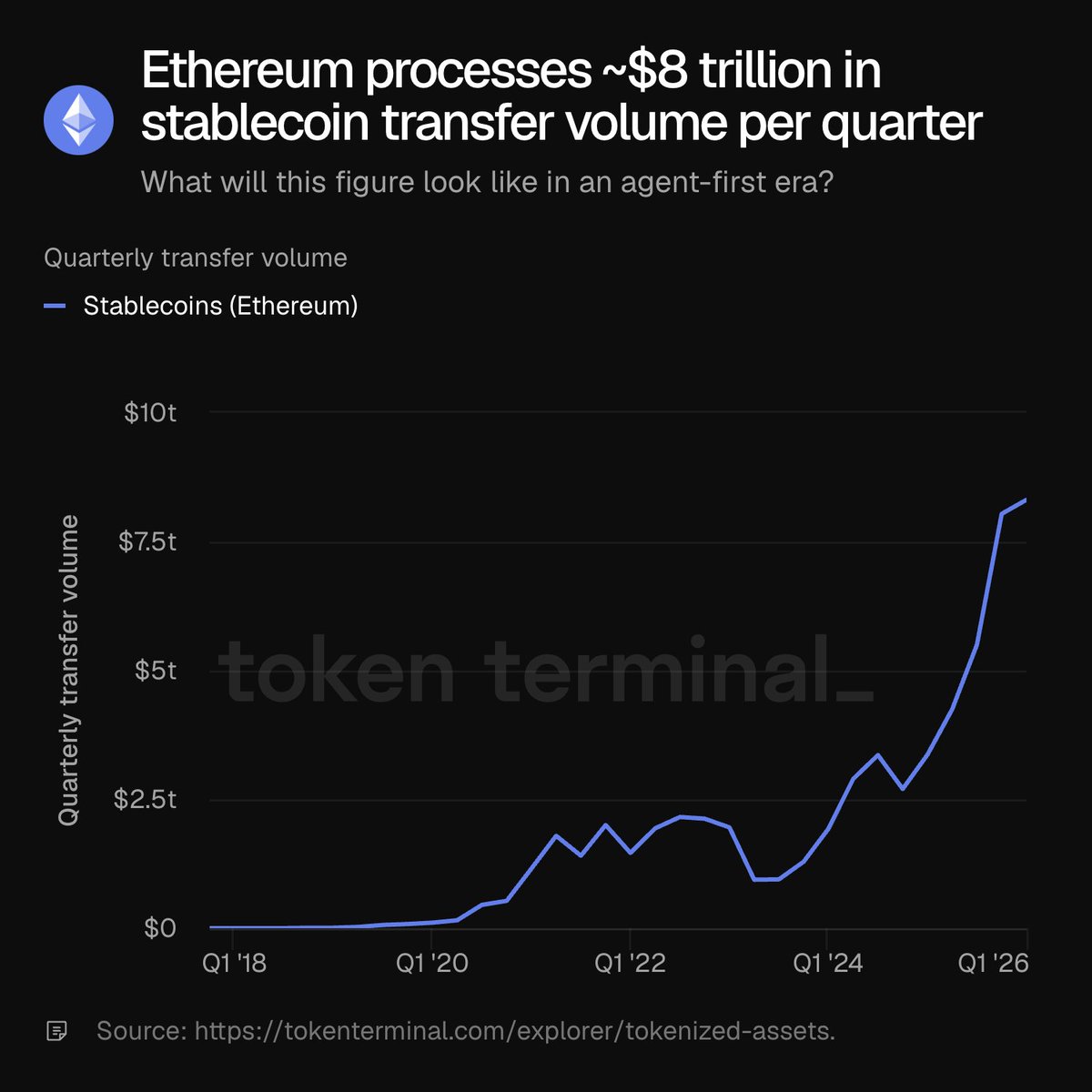
From 2018 through 2021, quarterly stablecoin transfer volume on Ethereum grew steadily to around $2.5 trillion. The market then plateaued through 2022 and 2023. Beginning in 2024, however, the trend changed and volume began rising rapidly, reaching roughly $8 trillion per quarter by early 2026.
Volume alone does not distinguish speculation from real usage, but the trajectory does. A volume curve that accelerates while crypto markets decline, macro uncertainty rises, and institutional frameworks develop suggests stablecoins are increasingly being used for payments, settlements, savings, and transfers rather than purely for trading.

The User Base Is Expanding
Usage data supports this shift. At the start of 2025, approximately 22% of USDC holders on Ethereum were active on a monthly basis, meaning they were sending stablecoins rather than simply holding them. By the end of 2025, that figure had risen to approximately 43%, indicating that a larger share of users are actively transacting.
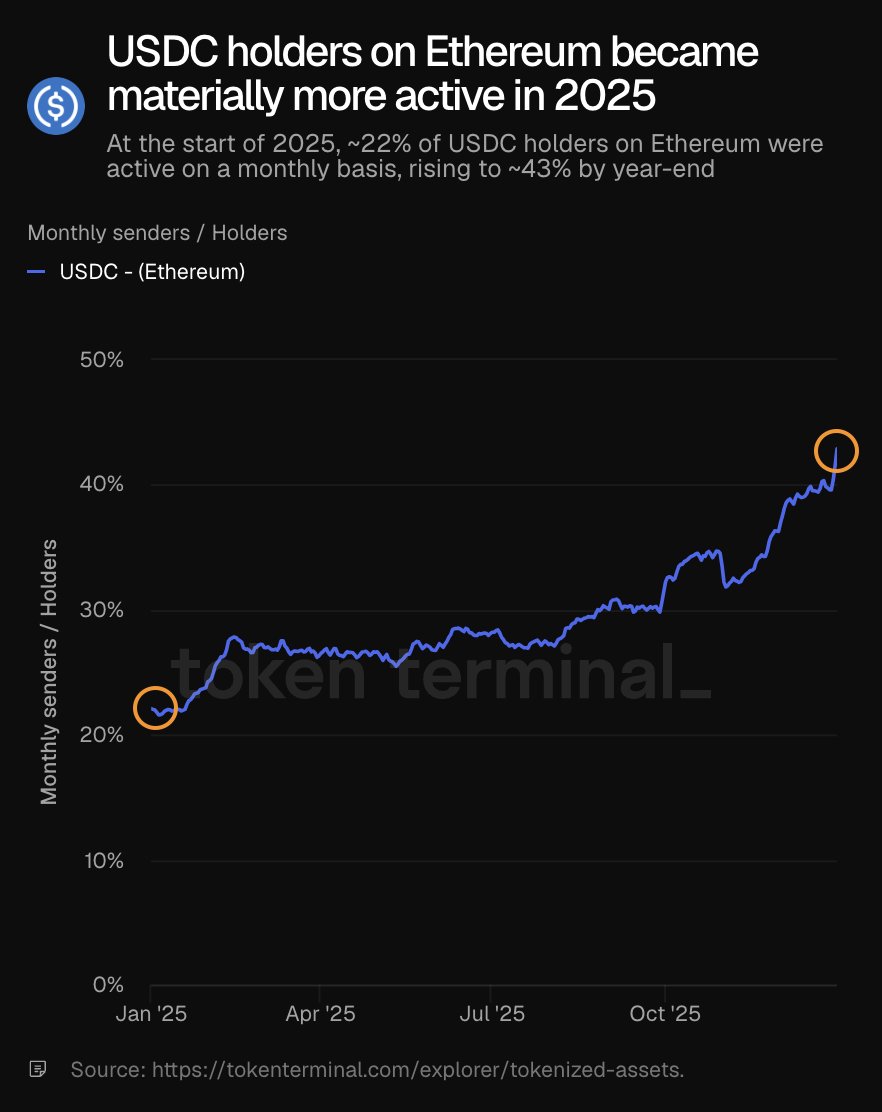
Standard Chartered’s analysis shows that stablecoin growth is also shifting from a small number of large wallets to a larger number of smaller wallets. The user base is broadening, and the use cases are expanding with it.
In emerging markets, two-thirds of stablecoin usage is now driven by savings rather than speculation. People are holding stablecoins as dollar-denominated savings because they offer a more stable store of value than local currencies experiencing inflation or depreciation.
Why This Matters For Banks
In 2025 Standard Chartered projected that up to $1.5 trillion could leave traditional bank deposits for stablecoins by the end of 2028. The projection is split into two main flows with different drivers.
The larger share, around $1 trillion, is expected to come from emerging markets, where users are seeking a reliable alternative to local banking systems and volatile currencies. The remaining $500 billion is projected to come from the United States, where stablecoins are increasingly used for payments, payroll, international transfers, and business-to-business settlements.
When deposits move into stablecoins, banks lose a key source of funding. This compresses Net Interest Margin, the spread banks earn between what they pay depositors and what they charge borrowers. Standard Chartered identifies regional banks as the most exposed because they rely more heavily on deposit funding than large global institutions.
The shift could also affect monetary policy. Central banks influence the economy partly through the banking system and deposit flows. If a significant portion of economic activity moves onto stablecoin payment rails instead of bank accounts, the transmission of interest rate policy becomes less predictable.
Regulation And Infrastructure Are Developing Together
Regulation is beginning to catch up with the technology. Standard Chartered cites the GENIUS Act in the United States and MiCA in the European Union as key frameworks that provide the regulatory clarity institutions need to adopt stablecoins more broadly.
This is happening at the same time that infrastructure, transaction volume, and user adoption are all increasing. Technology, regulation, and capital are moving in the same direction, which historically is what allows new financial systems to scale.
The Bigger Picture
The increase in stablecoin velocity, the surge in transaction volume, and the projected migration of bank deposits are all parts of the same structural shift. Stablecoins are moving from being a tool used mainly inside crypto markets to becoming part of the broader financial system.
Standard Chartered’s $2 trillion stablecoin supply forecast may still be achievable, but rising velocity means the growth of stablecoin usage could be even larger than supply growth alone suggests. Faster moving stablecoins can support a larger financial system without the supply increasing at the same pace.
The question is no longer whether stablecoins will become part of financial infrastructure. In many parts of the world, they already are.
The information provided in this article is for educational purposes only and does not constitute financial, investment, or trading advice. Coindoo.com does not endorse or recommend any specific investment strategy or cryptocurrency. Always conduct your own research and consult with a licensed financial advisor before making any investment decisions.



Kosta joined the team in 2021 and quickly established himself with his thirst for knowledge, incredible dedication, and analytical thinking. He not only covers a wide range of current topics, but also writes excellent reviews, PR articles, and educational materials. His articles are also quoted by other news agencies.