Pi Network Sets Hard Upgrade Deadline as Price Continues to Slide

Pi Network has given node operators a firm deadline: upgrade to Protocol 21.2 by April 6, 2026, or be disconnected from the network.
Key Takeaways
- Pi Network mandates a node upgrade to Protocol 21.2 by April 6 – miss it and you’re off the network
- PI is trading ~$0.177, roughly 94% below its all-time high, with mixed signals from technicals
- The upgrade roadmap runs through May, building toward a DEX and smart contract support
- KYC delays and decentralization risks remain the project’s most stubborn unresolved problems
Nodes that miss the cutoff will be barred from consensus participation and validation – no exceptions, no extensions. It is among the most unambiguous directives the Core Team has issued since the project’s Open Network launch in February 2025.
Whether it translates into renewed market confidence is a separate question.
The April 6 deadline is the first of three mandatory upgrades scheduled through mid-May. Operators must then complete a migration to v22.1 by April 22, followed by a final transition to v23.0 on May 18. The Core Team has described the sequence as non-negotiable, with each version serving as a technical prerequisite for the next. The end goal is a network capable of supporting a native decentralized exchange, on-chain PiUSD liquidity swaps, and full smart contract functionality – features the project has been working toward for years, and that have yet to materialize in any meaningful form.
The Pi Mainnet is upgrading to Protocol 21 – Deadline: Apr 6. All Mainnet nodes are required to complete this step before the deadline to remain connected to the network. Details here: https://t.co/9VehO7hhj1
— Pi Network (@PiCoreTeam) March 27, 2026
Protocol 21 is specifically designed to address node stability and performance under load – which matters if Pi ever sees genuine DeFi volume. But operators have been warned not to update all their nodes simultaneously, as the sequential nature of the rollout could destabilize the network if too many go offline at once. It’s a logistical headache that underscores just how much coordination a decentralized network actually requires.
The Chart Tells a Cautious Story
Meanwhile, PI/USDT is trading around $0.177 on OKX as of late March 2026 – a number that sits uncomfortably close to 94% below its all-time high. The 4-hour chart shows a coin that had one meaningful spike in early March before selling off hard. RSI sits at 42.53, with its signal line at 39.80, both hovering in that ambiguous zone that suggests neither panic selling nor any real buying conviction. MACD is marginally negative, which doesn’t add urgency to the bull case.
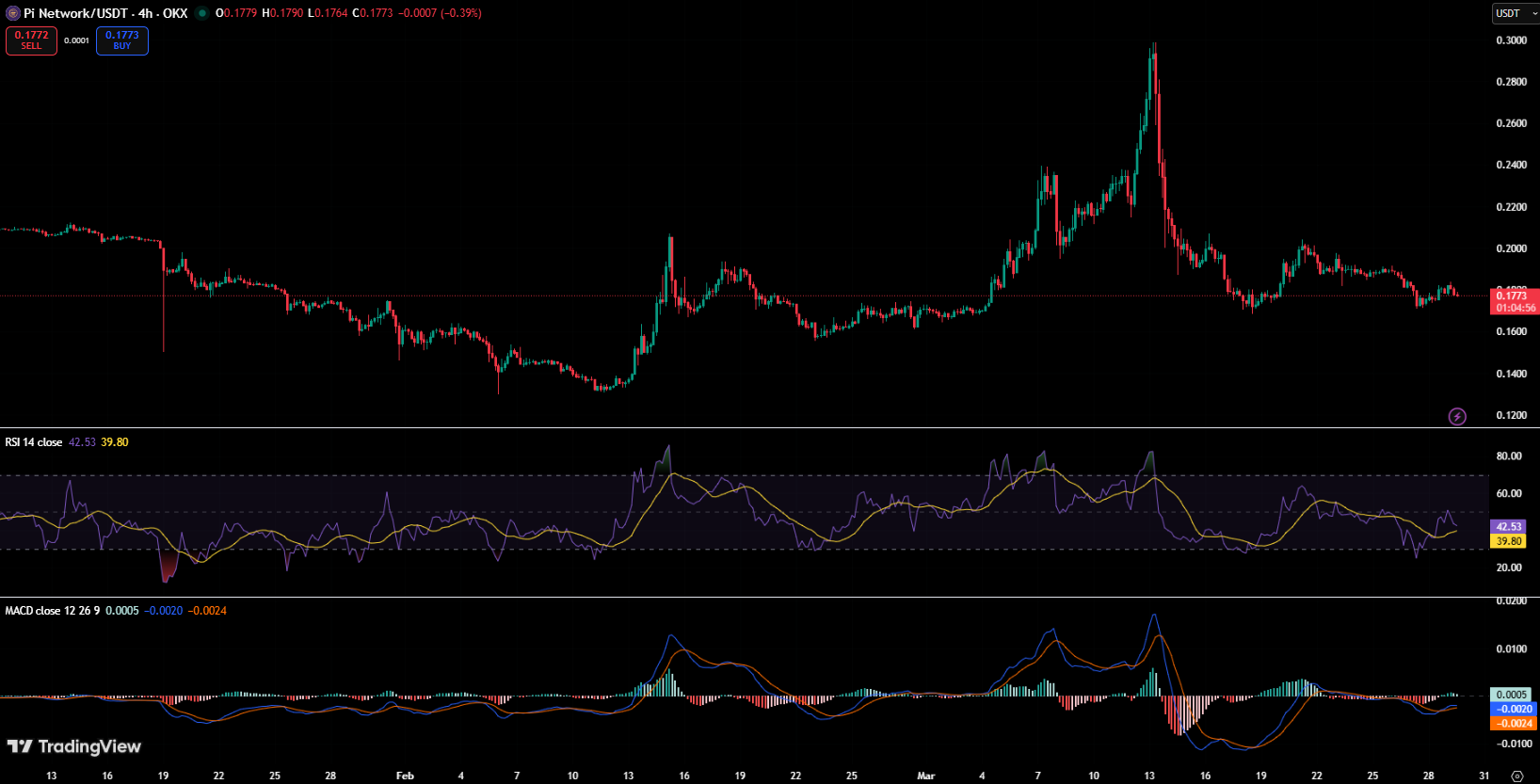
Analyst projections are all over the place. Bearish models point to $0.14 as a plausible next stop if current momentum holds – a roughly 23% drop from here. On the other side, optimists who see the current consolidation as a base argue that a recovery toward $0.30 is possible if network utility catalysts materialize. Gate.io’s modeling puts an average 2026 price around $0.2082. None of these figures are particularly exciting for a project that was being positioned as a top-ten asset not long ago.
The technical upgrade deadline may generate a short burst of volatility around April 6, but analysts aren’t treating this as a major narrative driver. It’s being characterized more as a security and compatibility hard fork than a catalyst event – the kind of thing that matters for the network’s long-term health but rarely moves markets in the short term.

What Pi Actually Has Going For It
Strip away the price action and there’s a genuine infrastructure story developing, even if it’s slower than supporters would like. The network officially opened to external blockchains in February 2025, ending its enclosed mainnet phase. Since then, over 16 million Pioneers have migrated to Mainnet, with 10.14 million confirmed through the process and 19 million having completed KYC. A second migration wave is currently rolling out, targeting referral mining balances that had been locked pending additional identity verification.
A technical patch earlier in 2026 cleared a backlog of roughly 2.5 million users who had been stuck in KYC – a fix that was long overdue and had been a source of persistent community frustration. The KYC bottleneck isn’t fully resolved, but it’s less acute than it was. More than 100 Mainnet-ready apps are now live, the Core Team has launched developer tools for deeper Pi-native integrations, and there’s ongoing exploratory work around using node computing capacity for decentralized AI training workloads – a proof-of-concept that’s at least novel, even if it’s early.
On the regulatory side, Pi filed a MiCA whitepaper in late 2025 – a deliberate play for European exchange listings that requires demonstrating compliance with the EU’s crypto asset framework. It’s not listed on Binance or Coinbase yet, but the MiCA filing suggests the team is building toward that, and validator reward distribution is reportedly in final testing ahead of a March 31 deployment date.
The Frustrations That Won’t Go Away
Community sentiment around Pi has always been a complicated mix of genuine belief and fraying patience, and that dynamic hasn’t meaningfully shifted. KYC delays that have reportedly stretched for years remain a sore point – the 2.5 million unblocked users were a relief, but they’re a fraction of the broader verification queue, and there’s no clear timeline for full resolution.
The decentralization concern is more structural. As node upgrade requirements grow more demanding – both technically and in terms of rolling coordination – smaller operators may struggle to keep up. If the node count consolidates among a smaller group of well-resourced participants, the “decentralized” framing becomes harder to defend. It’s a tension that isn’t unique to Pi, but it’s acutely relevant given how central the node network is to the project’s identity.
For now, Pi is a network in technical transition, trading well off its highs, with a forced upgrade deadline that will test operator discipline and, perhaps more importantly, the community’s ongoing willingness to wait.



Alex is an experienced financial journalist and cryptocurrency enthusiast. With over 8 years of experience covering the crypto, blockchain, and fintech industries, he is well-versed in the complex and ever-evolving world of digital assets. His insightful and thought-provoking articles provide readers with a clear picture of the latest developments and trends in the market. His approach allows him to break down complex ideas into accessible and in-depth content. Follow his publications to stay up to date with the most important trends and topics.