PEPE Gets Its First SEC Spot ETF Filing – But Does It Have a Case for Wall Street?

On April 8, 2026, investment firm Canary Capital submitted an S-1 registration statement to the U.S. Securities and Exchange Commission for a spot exchange-traded fund tracking the meme token Pepe (PEPE).
Key Takeaways
- Canary Capital filed the first-ever spot ETF application for PEPE with the U.S. SEC on April 8, 2026.
- The token trades around $0.0000347 with a market cap above $1.4 billion.
- A $500 million token burn is planned by mid-2026, with roughly 1.5 trillion tokens already destroyed.
- Whale wallets have accumulated an additional 23 trillion tokens ahead of the anticipated supply shock.
It is a significant moment for the broader crypto market, as this marks the first time a regulator in the United States has formally received an application for a product built entirely on an asset that originated as an internet joke. At the same time, the project is executing an aggressive supply reduction strategy through large-scale token burns, drawing attention from major market participants.
Inside the Filing
The document outlines a structure where investors gain direct price exposure to PEPE without holding the tokens themselves. The fund would be permitted to allocate up to 5% of its assets in Ether (ETH), exclusively to cover Ethereum network transaction fees rather than for any investment purpose. Shares will be issued and redeemed in baskets of 10,000 units. The filing currently omits the listing exchange, the pricing benchmark, and the digital asset custodian, which is fairly standard practice at this early stage of the process.
The document also flags a significant concentration risk: as of January 2026, the ten largest wallets control roughly 41% of PEPE’s entire circulating supply. That kind of distribution hands regulators a clear point of concern, since the SEC has consistently scrutinized assets where a small number of holders can exert disproportionate influence over the market. Given the precedents set by Bitcoin and Ethereum ETF approvals, the review process is likely to stretch over several months, and rejection remains a real possibility.
Where the Price Stands
PEPE is currently trading around $0.0000347 on Binance, with a market capitalization just above $1.43 billion. The token dropped approximately 4.75% over the past 24 hours, despite posting a 5.45% gain on the weekly timeframe.
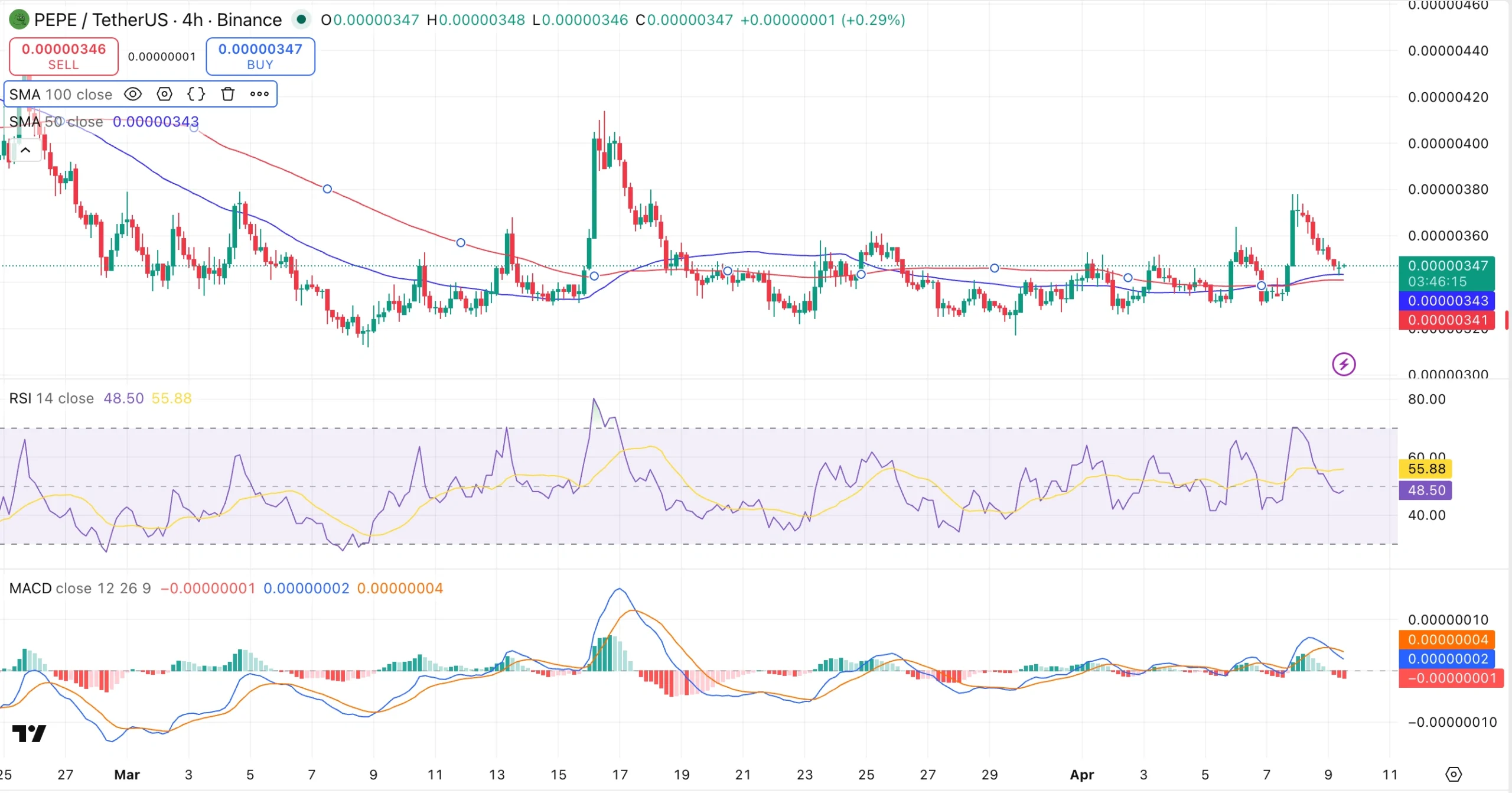
On the four-hour chart, both the SMA 50 and SMA 100 are hovering near the current price, and an RSI reading of 48.50 reflects a neutral, indecisive market. The MACD sits marginally negative, offering no decisive signal in either direction.
The Burn Roadmap
Running alongside both the ETF filing and the technical development is a well-publicized supply burn program. By the end of the first quarter of 2026, approximately 1.5 trillion PEPE tokens had already been permanently removed from circulation.
The current phase involves burning 1 trillion tokens per week over a 10-week period, funded through transaction fees and market operations, with a cumulative target of $500 million in burned value by mid-year. On-chain data suggests that large holders have added 23 trillion tokens to their positions in anticipation of a price move once that milestone is reached.
What It All Adds Up To
More than anything PEPE is currently in an unusual position for an asset that began as a joke. A spot ETF that gives exposure to the token for Wallstreet is not something you would expect. Despite the market cap growth and ecosystem expansion, PEPE remains a memecoin – and with far less activity than Dogecoin.
There is no clear investment utility, unlike commodities like Bitcoin and Ethereum, and stable infrastructure. All approved crypto ETFs by far have had a good market infrastructure before they were considered for approval. Although it may seem silly, PEPE does have a vast active community and a large market cap. There is a chance for approval, despite all the lack of characteristics for a sustainable investment. The question is whether a memecoin with no clear investment utility can function within a regulated traditional finance structure.
The information provided in this article is for educational purposes only and does not constitute financial, investment, or trading advice. Coindoo.com does not endorse or recommend any specific investment strategy or cryptocurrency. Always conduct your own research and consult with a licensed financial advisor before making any investment decisions.



Alex is an experienced financial journalist and cryptocurrency enthusiast. With over 8 years of experience covering the crypto, blockchain, and fintech industries, he is well-versed in the complex and ever-evolving world of digital assets. His insightful and thought-provoking articles provide readers with a clear picture of the latest developments and trends in the market. His approach allows him to break down complex ideas into accessible and in-depth content. Follow his publications to stay up to date with the most important trends and topics.