Nvidia Stock: Price Falls Despite Blowout Q4 Results – Here is Why
NVIDIA stock pulled back sharply in early trading on February 26, falling as much as 5% despite delivering what many described as blockbuster fourth-quarter results a day earlier.
Key Takeaways
- NVIDIA shares dropped up to 5% despite record Q4 results, reflecting a sell-the-news reaction.
- Revenue and earnings surged, driven by strong Data Center growth.
- Investors are questioning how long the AI spending boom can last.
- Technically, support sits near $185, while $195–$200 remains key resistance.
The decline highlights a classic sell-the-news reaction, with investors shifting attention from headline growth to the durability of the AI investment boom.
The chip giant exceeded expectations across revenue, earnings, and forward guidance. However, the market appears increasingly focused on how sustainable the current wave of AI infrastructure spending will be – and whether hyperscale customers can maintain their aggressive capital expenditure pace.
Why Investors Sold the News
Much of the upside surprise had already been priced into the stock. In recent weeks, major customers including Meta and Amazon signaled higher capital expenditure plans, reinforcing expectations for strong demand for NVIDIA’s data center chips. As a result, the earnings beat did not materially change the broader narrative.
There are also growing questions around the long-term return on investment for AI infrastructure. While companies continue to pour billions into accelerated computing, some investors are asking whether enterprise monetization will keep pace with hardware spending.
Not all segments impressed. Although the Data Center division posted record numbers, Gaming revenue of $3.73 billion and Automotive revenue of $604 million both came in below analyst expectations. That divergence raised concerns about concentration risk, with AI-driven data center sales accounting for an overwhelming share of growth.
Broader macro sentiment has added pressure. Ongoing debate around a potential “AI bubble” and signs of rotation out of high-multiple technology stocks have weighed on the sector. At the same time, persistent memory chip supply constraints could limit production flexibility in non-AI segments, adding another layer of uncertainty.
Record Financial Performance
Despite the stock reaction, NVIDIA’s fiscal Q4 2026 results were historically strong:
- Total revenue reached $68.1 billion, up 73% year over year.
- Data Center revenue surged to $62.3 billion, climbing 75% from a year earlier.
- Non-GAAP earnings per share rose to $1.62, marking an 82% annual increase.
- Gross margin expanded to 75.2%, improving by 1.7 percentage points.
The company also issued a powerful outlook for fiscal Q1 2027, projecting revenue of $78.0 billion, plus or minus 2%, well above Wall Street expectations near $72.6 billion. CEO Jensen Huang highlighted sustained demand for the new Blackwell architecture and confirmed that samples of the upcoming Rubin platform are already being shipped to customers.

Technical Analysis
From a chart perspective, NVIDIA shares closed near $187 after a volatile session. The stock briefly traded above $194 before reversing sharply lower.
Price is hovering around the 50-period moving average, while remaining slightly above the 100-period moving average near the $185 area. This zone now acts as immediate support. A decisive break below $185 could open the door toward the $180 level and potentially the mid-$170s.
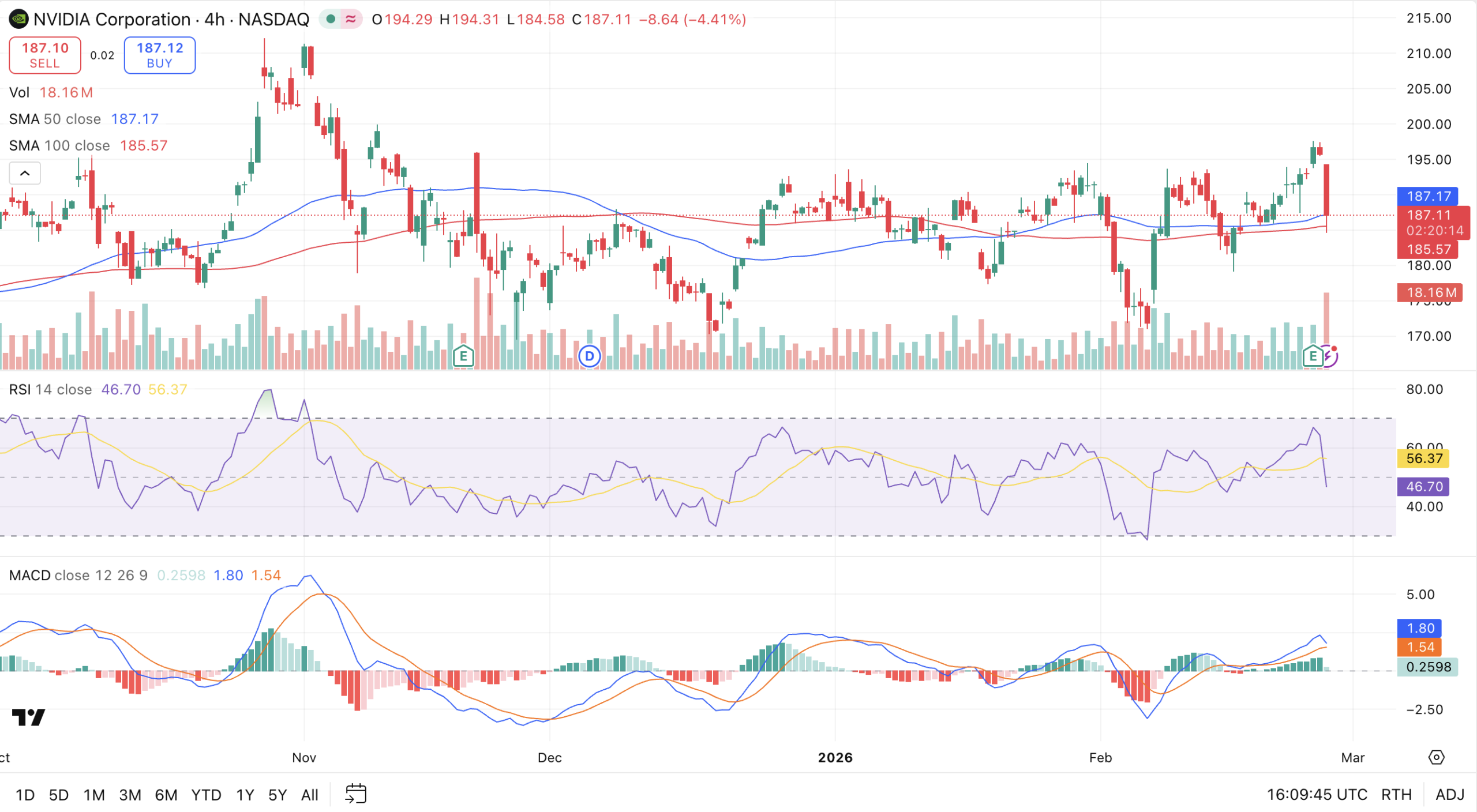
On the momentum side, the Relative Strength Index (RSI) sits near 46, indicating neutral-to-slightly bearish conditions after pulling back from recent highs. There is no immediate oversold signal, suggesting room for further downside if selling pressure continues.
The MACD remains in positive territory but shows signs of losing upward momentum. The histogram has started to contract, hinting at weakening bullish strength.
In the short term, $195–$200 represents key resistance. A sustained move back above that region would likely require renewed confidence in the durability of AI-driven growth. Until then, NVIDIA may remain in a consolidation phase as the market recalibrates expectations around the next stage of the AI cycle.
The information provided in this article is for educational purposes only and does not constitute financial, investment, or trading advice. Coindoo.com does not endorse or recommend any specific investment strategy or cryptocurrency. Always conduct your own research and consult with a licensed financial advisor before making any investment decisions.



Alex is an experienced financial journalist and cryptocurrency enthusiast. With over 8 years of experience covering the crypto, blockchain, and fintech industries, he is well-versed in the complex and ever-evolving world of digital assets. His insightful and thought-provoking articles provide readers with a clear picture of the latest developments and trends in the market. His approach allows him to break down complex ideas into accessible and in-depth content. Follow his publications to stay up to date with the most important trends and topics.