Metaplanet Buys Another $405 Million in Bitcoin – While Whale Selling Accelerates

Metaplanet, the Tokyo-listed investment firm that has spent the past year rebranding itself as Asia's answer to MicroStrategy, announced on April 2 that it purchased an additional 5,075 Bitcoin during the first quarter of 2026.
Key Takeaways
- Metaplanet acquired 5,075 BTC in Q1 2026 for ~$405 million, bringing total holdings to 40,177 BTC
- The Japanese firm is now the fourth-largest publicly traded Bitcoin holder globally, targeting 100,000 BTC by year-end
- Nearly all of Metaplanet’s projected 2026 revenue comes from Bitcoin-related income strategies, not traditional operations
- On-chain data shows whale addresses have shifted to net selling since Q4 2025, with overall Bitcoin demand turning negative by ~63,000 coins
The deal cost approximately $405.48 million, executed at an average price of roughly $79,898 per coin. That brings its total holdings to 40,177 BTC, accumulated at a cumulative cost of approximately $4.18 billion, or $104,106 per Bitcoin on average.
That average cost is notable, because it sits well above what the company actually paid this quarter, meaning Metaplanet is sitting on an unrealized loss on a significant portion of its holdings at current prices. The company’s year-to-date BTC Yield – its own internal metric for measuring Bitcoin accumulation efficiency relative to share dilution – stands at 2.8% through the end of March.
The Company Is Down Billions on Paper and Still Buying
CEO Simon Gerovich has made no attempt to soften the picture. His position, repeated across investor communications, is that short-term price movement is irrelevant to the thesis.
That conviction has cost the company: due to Japan’s mark-to-market accounting rules, Metaplanet recorded somewhere between $680 and $700 million in non-cash impairment losses in 2025 alone, even as it continued raising capital and expanding its position. The company funded much of this through aggressive equity issuance, including a $1.4 billion international stock offering in late 2025 – a move that inevitably dilutes existing shareholders in exchange for more Bitcoin on the balance sheet.
The shareholder base has nonetheless grown dramatically, from 47,200 investors at the start of this push to more than 216,500 today, which suggests the retail appetite for this kind of leveraged Bitcoin exposure remains intact, at least for now.
The Targets Are Enormous. The Risk Is Proportional
Metaplanet’s longer-term targets are ambitious even by the standards of corporate Bitcoin treasury strategies: 100,000 BTC by the end of 2026 and 210,000 BTC by 2027 – roughly 1% of the total supply that will ever exist. Nearly all of the company’s projected 2026 revenue, around 97.5%, is expected to come from its Bitcoin Income Generation business, which relies on options and lending strategies rather than any conventional underlying operation. With a revenue forecast of approximately $103 million and operating profit of around $73 million projected for the year, Metaplanet has effectively restructured itself into a Bitcoin yield vehicle wearing a publicly listed company’s clothing.
What the On-Chain Data Says
Whether the market can absorb that level of institutional accumulation is a separate question, and one that recent on-chain data makes considerably more complicated. According to CryptoQuant’s latest figures, shared by WuBlockchain, apparent demand for Bitcoin – a measure that tracks the change in demand relative to new supply entering circulation – turned negative by approximately 63,000 coins by the end of March. In plain terms, new buyers are not absorbing what existing holders are selling.
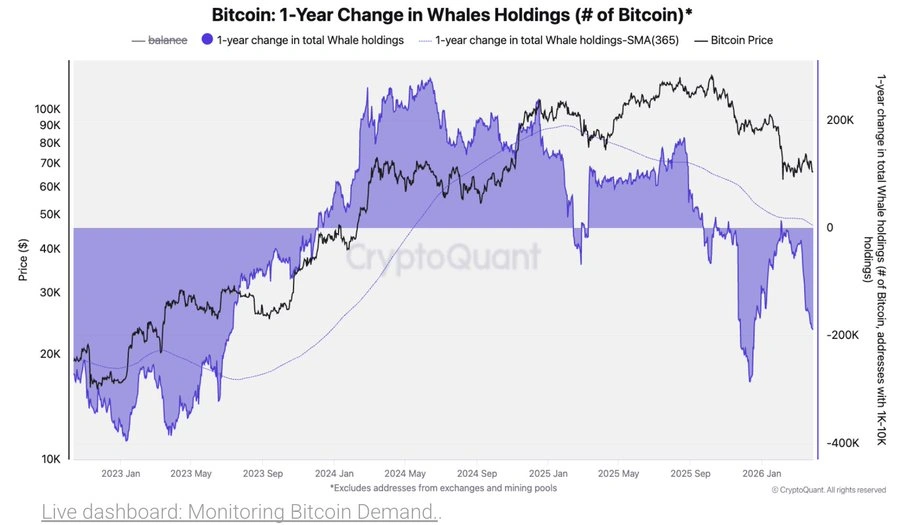
Whale addresses, defined as wallets holding between 1,000 and 10,000 BTC, have shifted from a prolonged period of accumulation to net selling, a trend that began accelerating in the fourth quarter of 2025. Retail participants followed a similar pattern, selling more than institutional buyers were willing to absorb. US-based demand, meanwhile, weakened enough that the Coinbase premium – typically a reliable indicator of domestic buying pressure – flipped negative again.
A Bet That Still Needs the Market to Cooperate
None of this is necessarily a death knell for Bitcoin’s price, but it does complicate the narrative that institutional buying alone can hold the market up indefinitely. Metaplanet’s Q1 purchase of 5,075 coins at sub-$80,000 prices looks prescient if the market recovers; it looks reckless if the demand picture described by CryptoQuant continues deteriorating through the second quarter.
The company started 2024 holding just 1,762 BTC. It now holds more than 40,000. That trajectory is either a case study in conviction investing or a very large concentration of risk – depending almost entirely on what Bitcoin does next.
The information provided in this article is for educational purposes only and does not constitute financial, investment, or trading advice. Coindoo.com does not endorse or recommend any specific investment strategy or cryptocurrency. Always conduct your own research and consult with a licensed financial advisor before making any investment decisions.



Alexander Zdravkov is a person who always looks for the logic behind things. He has more than 3 years of experience in the crypto space, where he skillfully identifies new trends in the world of digital currencies. Whether providing in-depth analysis or daily reports on all topics, his deep understanding and enthusiasm for what he does make him a valuable member of the team.