Ethereum Stabilizes After Turbulence – Is a Major Breakout Next?

Ethereum is regaining strength, with several prominent market analysts arguing that the asset may be significantly undervalued despite improving technical conditions.
Key Takeaways
- Ethereum reclaimed the $2,000 psychological level after a consolidation phase.
- Market sentiment has shifted away from Extreme Fear following major liquidations.
- Staking now locks up roughly 30%-50% of supply, reinforcing the “digital bond” narrative.
- $1,960 remains the critical support that protects the recovery structure.
- 2026 price projections range from $2,500 base case to $7,000+ in bullish scenarios.
Market commentary over the weekend highlighted a growing divergence between sentiment and structure. While retail enthusiasm tends to peak during sharp rallies, some traders argue that the most favorable accumulation phases historically occur during periods of fear, low volatility, and quiet consolidation.
One widely shared market view described the current environment as a transitional phase, suggesting that strong hands typically accumulate before broader market participation returns. According to that analysis, expansion phases often begin only after weaker positions are forced out.
Technical Structure Points to Critical BTC Pair Level
From a technical perspective, Ethereum’s performance against Bitcoin remains a focal point.
Analyst Michaël van de Poppe stated that Ethereum continues to show relative strength and maintains a broader uptrend against Bitcoin since April. However, he emphasized that a decisive breakout above 0.0325 BTC would be required to confirm continuation of the upward trend.
I'm glad to see more strength coming from $ETH.
I still think that this is a must-have in anyone's portfolio, as the markets are undervaluing Ethereum enormously.
Anyways, from a technical standpoint I'd like to see a breakout above 0.0325 BTC in order to clearly see a… pic.twitter.com/PhHekB2wCu
— Michaël van de Poppe (@CryptoMichNL) March 1, 2026
At present levels, the ETH/BTC pair is trading near 0.0295 BTC, with markets attempting to form a potential higher low structure. A confirmed move above 0.0325 BTC would signal a shift in relative momentum and potentially open the door to sustained outperformance against Bitcoin.
Undervaluation Narrative Builds
Beyond short-term price action, some market participants argue that Ethereum is being structurally undervalued by the broader market. The thesis suggests that while attention often shifts toward assets showing immediate breakout signals, long-term positioning tends to reward early accumulation during periods of skepticism.
The argument centers on cyclical behavior – that conviction builds before broad participation arrives, and sustained upside typically follows phases of compression rather than euphoria.
EVERYONE WANTS ETHEREUM
WHEN IT LOOKS READY TO MOON.Red zone. Peak FOMO. Exit liquidity for smart money.
True alpha is forged earlier:
– In extreme fear.
– In boring sideways chop.
– In quiet whale accumulation.Conviction builds before the crowd arrives.
Expansion hits… pic.twitter.com/OnGJKgttIB— Merlijn The Trader (@MerlijnTrader) March 1, 2026
Psychological Support Reclaimed as Sentiment Stabilizes
Ethereum has recently reclaimed key psychological support, trading near $2,004 after a period of consolidation. The recovery follows a sharp sentiment reset that previously pushed the Fear and Greed Index into “Extreme Fear” territory at a level of 12.
That panic-driven phase appears to be cooling. Large-scale liquidations have flushed excessive leverage from the market, and sentiment is now shifting toward cautious stabilization rather than outright fear.

This reset in positioning has coincided with renewed structural demand emerging in the background.
Spot ETF Inflows Reverse After Extended Outflows
One of the most notable structural developments is the reversal in U.S. spot Ethereum ETF flows. After a 35-day streak of continuous outflows, last week recorded $262 million in cumulative net inflows.
On March 1 alone, net inflows reached $80.5 million, signaling that institutional appetite may be returning. Sustained ETF inflows could provide a durable demand floor and reinforce the longer-term recovery thesis.
The “Digital Bond” Narrative Gains Traction
Ethereum’s staking dynamics are also reshaping its investment narrative. Between roughly 30.8% and 50% of total ETH supply is now staked, significantly reducing liquid supply in circulation.
As a result, analysts increasingly frame Ethereum as a “digital bond” rather than purely a growth asset. Current staking yields range between approximately 1.88% and 4.2% APY, strengthening the case for ETH as a yield-generating digital asset within diversified portfolios.
2026 Protocol Roadmap Signals Engineering Maturity
On the development front, Ethereum has transitioned into what core contributors describe as an “Engineering Delivery” phase, operating under a predictable semi-annual upgrade schedule.
The Glamsterdam upgrade, expected in the first half of 2026, focuses on improving gas efficiency and mitigating censorship risks. Later in the year, the Hegotá upgrade aims to enhance Layer-1 security and improve long-term resilience, including quantum-resistance considerations.
This structured roadmap is increasingly viewed as a signal of protocol maturity rather than experimental iteration.
Analyst Outlook for the Remainder of 2026
Price projections for the rest of 2026 vary widely depending on institutional adoption and macroeconomic conditions.
In a bullish scenario, analysts at Bitwise and Standard Chartered suggest that continued ETF inflows combined with potential U.S. market-structure legislation, including proposals such as the CLARITY Act, could drive ETH back toward the $5,000 to $7,000 range by late 2026.
A more conservative base case projected by several algorithmic models and firms like Binance estimates an average price near $3,076 by April 2026 and around $3,284 by year-end.
More aggressive institutional outliers, including Fundstrat’s Tom Lee, suggest Ethereum could reach $7,000 to $9,000 if it solidifies its role as the primary settlement layer for tokenized real-world assets, a market some estimates place near $300 billion this year.
Critical Technical Levels to Watch
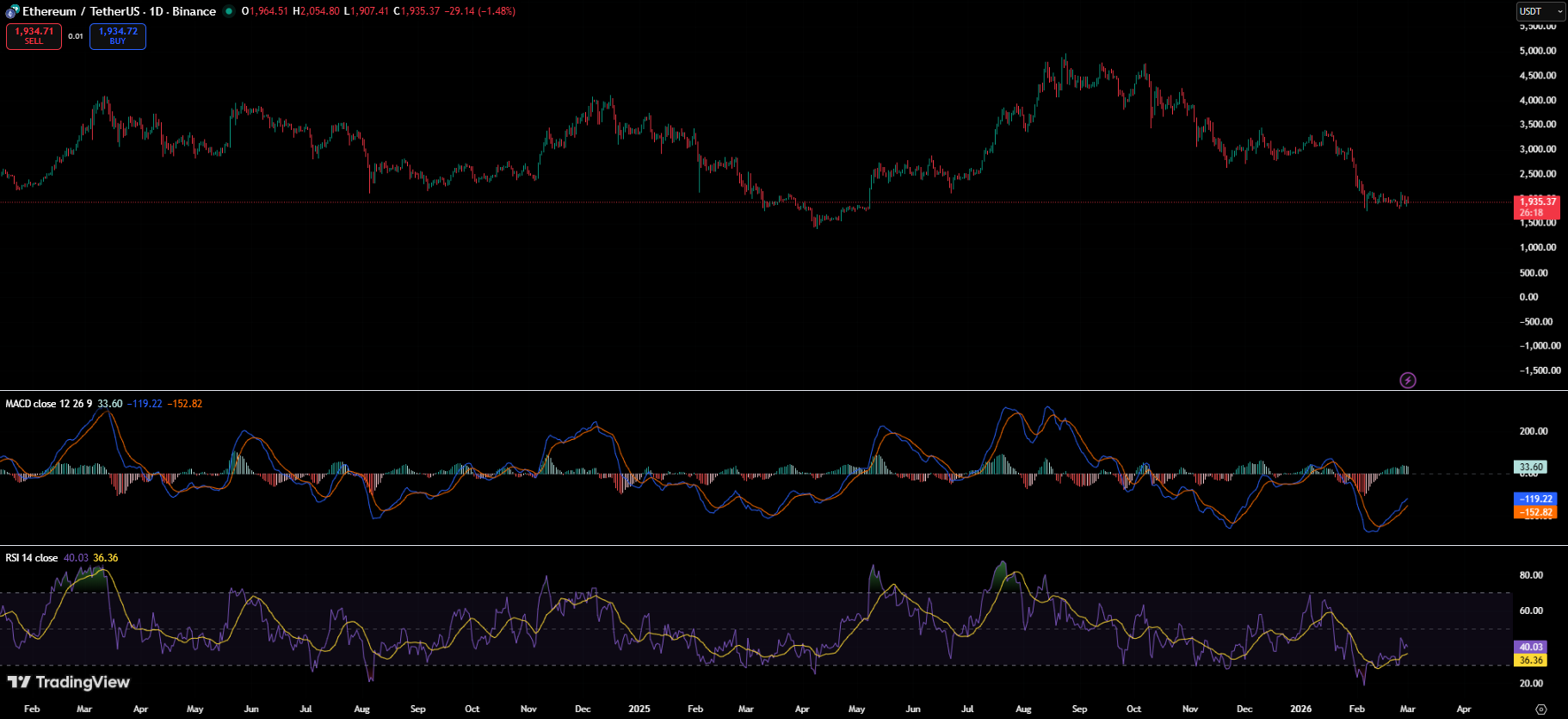
In the near term, technical levels remain decisive.
On the upside, beyond the 0.0325 BTC threshold, Ethereum faces resistance at the 20-day simple moving average near $2,036, followed by the $2,100 region where significant whale positioning has been identified.
On the downside, $1,960 represents the key support level. A breakdown below this zone could invalidate the current recovery thesis and shift momentum back toward a corrective phase.
Market Context
Ethereum is currently trading near the $2,000 region, while Bitcoin remains above $65,000. The ETH/BTC ratio continues to serve as a primary indicator of internal crypto capital rotation.
For now, traders are watching whether Ethereum can decisively reclaim higher technical levels against both the dollar and Bitcoin. If structural inflows, staking dynamics, and technical confirmation align, the current consolidation phase may ultimately be remembered as a base-building period rather than a stalled rally.
The information provided in this article is for educational purposes only and does not constitute financial, investment, or trading advice. Coindoo.com does not endorse or recommend any specific investment strategy or cryptocurrency. Always conduct your own research and consult with a licensed financial advisor before making any investment decisions.




Alex is an experienced financial journalist and cryptocurrency enthusiast. With over 8 years of experience covering the crypto, blockchain, and fintech industries, he is well-versed in the complex and ever-evolving world of digital assets. His insightful and thought-provoking articles provide readers with a clear picture of the latest developments and trends in the market. His approach allows him to break down complex ideas into accessible and in-depth content. Follow his publications to stay up to date with the most important trends and topics.