Lido DAO Votes on $20M LDO Buyback as Token Hovers Near Historic Lows

The Lido DAO is in the middle of a governance vote that could send 10,000 stETH - worth somewhere between $20 and $21 million at current prices - into the open market to buy back its own token.
Key Takeaways
Key Takeaways
- Lido DAO is voting on a $20M one-off LDO buyback using treasury stETH, targeting ~8.5% of circulating supply
- LDO/ETH ratio sits at a historic low – 63% below its two-year median
- Lido V3 launched in January 2026 with modular stVaults; Lido Earn followed in March
- The DAO approved a $60M budget for 2026, shifting strategy toward a multi-product organization
The proposal, submitted March 27, 2026, frames the move as a response to what it calls a severe “price dislocation” between LDO and Ethereum.
At roughly $0.31, LDO is sitting near its lowest levels since the protocol launched. The LDO/ETH ratio currently stands at 0.00016, a figure that is 63% below its two-year median. The token is down approximately 96% from its all-time high.
The buyback, if passed, would be executed by the Lido Growth Committee in tranches of 1,000 stETH. The committee is expected to use limit orders or dollar-cost averaging to reduce market impact. The targeted acquisition is approximately 70 million LDO tokens, representing about 8.5% of the current circulating supply. Any tokens purchased will be returned to the treasury and will not be eligible for governance voting while held there.
The context behind the proposal is straightforward: Lido’s revenue fell 23% year-over-year in 2025, dropping to $40.5 million from $52.4 million the prior year. The protocol still commands a 23.2% market share in Ethereum liquid staking, but that dominance has not translated into token price support. The DAO attributes the revenue decline to capital flowing toward exchange-based staking, spot ETH ETFs, and restaking platforms offering subsidized returns.
Supporters of the buyback argue it signals conviction from the DAO and could establish a near-term price floor. Critics are less certain. Whale wallets have shed close to 80 million LDO tokens since October 2025, and some observers question whether a one-time purchase can hold price if large holders continue to distribute. The DAO has also outlined plans for an automated annual $10 million buyback program set for Q2 2026 deployment, contingent on protocol revenue exceeding $40 million in a given year.
Lido Earn and the MetaVault Rollout
Alongside the buyback vote, Lido launched two new products in March 2026 under a MetaVault framework. The structure aggregates multiple DeFi strategies behind a single interface, reducing the complexity typically required to optimize yield across protocols.
The first product, EarnETH, is a growth-oriented vault that deploys ETH and stETH across what the team describes as blue-chip DeFi protocols. It currently holds approximately 61,000 ETH in total value locked, with an estimated annual yield of around 5%. The second product, EarnUSD, marks Lido’s entry into stablecoin yield. Users can deposit USDC or USDT, and funds are distributed across USD-denominated strategies including lending markets and real-world asset protocols.
Mellow Protocol serves as the strategy curator for both vaults. To backstop user confidence, the DAO approved deploying $5 million from treasury funds as a first-loss layer – meaning protocol capital absorbs initial losses before user funds are touched. Rewards compound daily and are reflected in the rising value of the earnETH and earnUSD share tokens.
The 2026 Budget: $60 Million and a Strategic Pivot
The DAO’s 2026 Ecosystem Grant Request – internally referred to as GOOSE-3 – allocates $60 million for the year. The budget is divided into two buckets: $43.8 million for core maintenance, covering protocol security, upgrades, and operations; and $16.2 million in discretionary growth spending.
That discretionary allocation is directed toward liquidity incentives for stETH and Lido Earn adoption, institutional development work around stETH-based exchange-traded products, and further expansion of the Earn product line into stablecoin-related territory. The framing from the DAO is explicit: Lido is transitioning away from being a single-product protocol toward operating as what it describes as an “innovative organization with a product portfolio.” Whether that language matches execution remains to be seen.
Ethereum Staking
The broader Ethereum staking environment has changed considerably in recent weeks, and that context matters for understanding Lido’s position (which is currently around 23.2%, according to data from Dune Analytics.) On March 17, 2026, a joint SEC and CFTC ruling formally classified Ethereum as a digital commodity.
More consequentially for the staking sector, the SEC declared that staking constitutes an “administrative activity” rather than a securities offering – a distinction the industry had been waiting years for. Within days, BlackRock launched its iShares Ethereum Trust with staking functionality enabled, giving institutional investors a regulated vehicle that captures both ETH price exposure and network yield simultaneously.
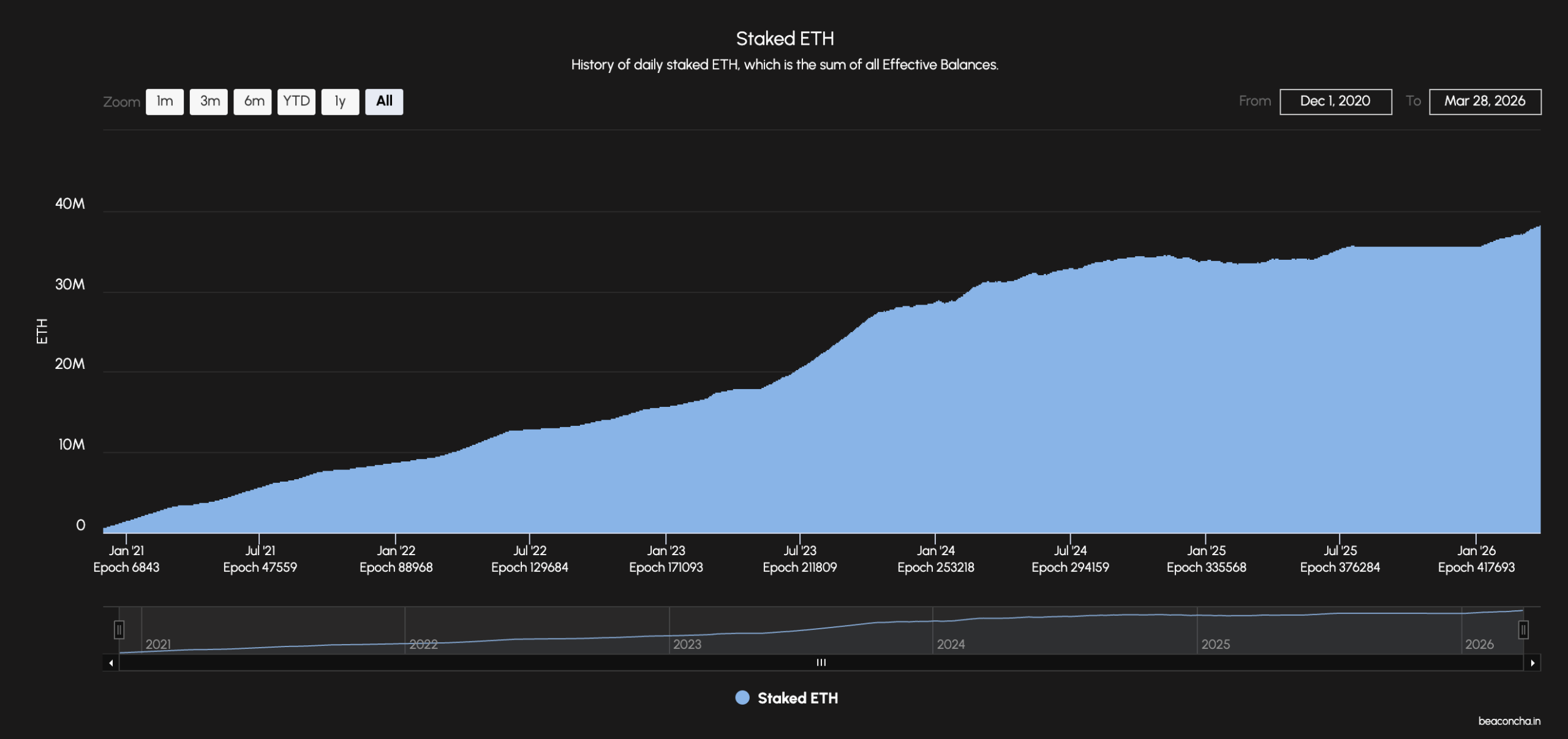
Then on March 30, the Ethereum Foundation disclosed it had staked an additional $46 million of its own ETH treasury to fund core operations and research. The cumulative effect of these developments is visible on-chain: a record 30.9% of the total ETH supply is now staked, representing over 38.1 million ETH (or $53.5 billion at current prices) locked across the network, according to data from BeaconChain. For Lido, which built its entire business on liquid staking, the regulatory clarity is a long-awaited tailwind – though it also invites more serious institutional competition into the same market.
Technical Analysis (LDO)
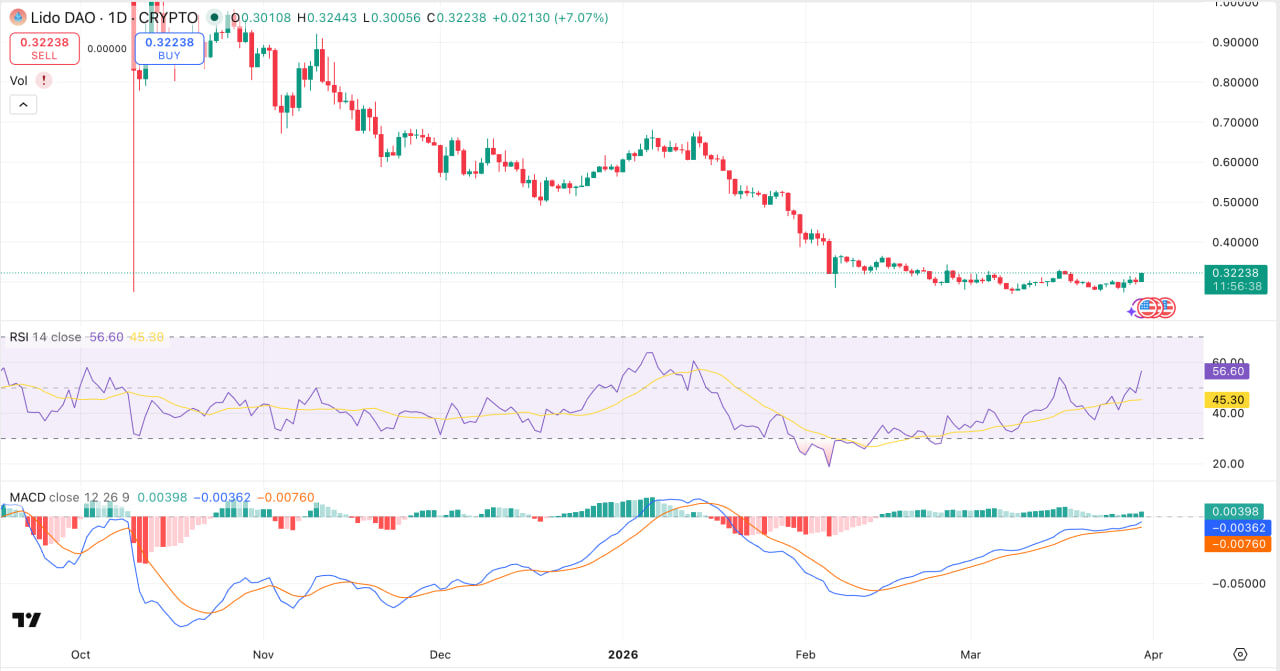
LDO is currently trading around $0.32, up roughly 7% on the day. The daily RSI sits at approximately 56.6, which is elevated relative to where it has spent most of the past six months but still below overbought territory.
The MACD is showing a modest positive reading with the fast line above the signal, suggesting some short-term momentum. That said, the broader chart tells a different story: LDO has been in a sustained downtrend since September 2025, declining from roughly $0.90 to current levels. Price has been consolidating in the $0.28–$0.35 range since late January 2026. A sustained move above $0.35 would be the first meaningful structural development to the upside in months. Until then, today’s price action looks like a bounce within an ongoing range.
The information provided in this article is for educational purposes only and does not constitute financial, investment, or trading advice. Coindoo.com does not endorse or recommend any specific investment strategy or cryptocurrency. Always conduct your own research and consult with a licensed financial advisor before making any investment decisions.



Alex is an experienced financial journalist and cryptocurrency enthusiast. With over 8 years of experience covering the crypto, blockchain, and fintech industries, he is well-versed in the complex and ever-evolving world of digital assets. His insightful and thought-provoking articles provide readers with a clear picture of the latest developments and trends in the market. His approach allows him to break down complex ideas into accessible and in-depth content. Follow his publications to stay up to date with the most important trends and topics.