Global Copper Stockpiles Double Since September – What Is Driving the Surge?
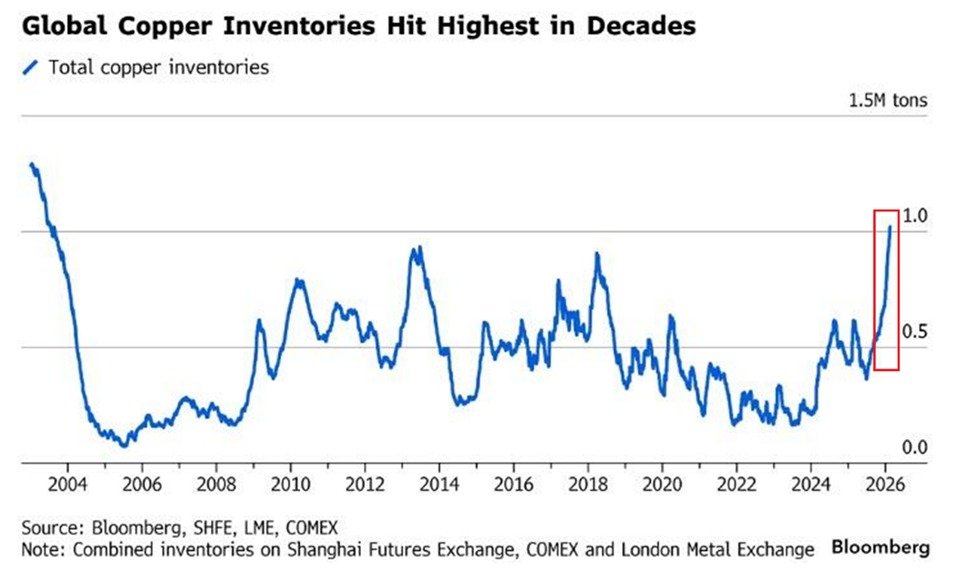
Global copper inventories have climbed to 1.02 million tons, marking the highest level in 23 years and signaling a dramatic build-up across major exchanges.
- Global copper inventories have reached 1.02 million tons, the highest level in 23 years.
- U.S. tariff uncertainty is driving aggressive stockpiling at record levels.
- China’s seasonal slowdown has contributed to short-term inventory builds.
- Major banks still forecast a structural supply deficit in 2026.
- AI data center demand is reshaping long-term copper fundamentals.
Since September, stockpiles have doubled, and compared to 2024 levels, inventories are up nearly 380% – one of the fastest surges on record.
The sharp increase reflects a complex mix of tariff-driven stockpiling, seasonal demand shifts in Asia, and cooling speculative momentum following copper’s early-2026 rally.
Record Builds Across Major Exchanges
On the U.S. side, inventories tracked by the Comex exchange have surged to a record 534,405 tons in early February. Warehouses monitored by the London Metal Exchange have posted 27 consecutive days of increases, the longest streak since 2009. Meanwhile, stockpiles on the Shanghai Futures Exchange reached 196,680 tons in mid-February.
The acceleration comes despite copper’s historically elevated price levels.
Tariff Policy Fuels U.S. Front-Loading
A major driver behind the inventory boom is tariff uncertainty. After the US Supreme Court ruled against President Donald Trump’s use of emergency powers for reciprocal tariffs, the administration introduced a new 10% global levy, later increased to 15%. The White House has also floated the possibility of refined copper tariffs rising to 30% by 2028.
U.S. manufacturers have responded by aggressively building reserves ahead of potential cost increases. Part of the metal stockpiled domestically is reportedly linked to “Project Vault,” a $12 billion initiative aimed at strengthening strategic raw-material reserves for defense and advanced technology sectors.
In China, inventory accumulation has been amplified by the Lunar New Year period, which traditionally slows industrial activity. Reduced short-term consumption has allowed copper stockpiles to expand on the Shanghai exchange even as long-term demand expectations remain intact.
Short-Term Surplus, Long-Term Deficit?
Despite the visible surplus on exchanges, major financial institutions still project a structural supply deficit for 2026. Analysts at J.P. Morgan, Goldman Sachs, Bank of America, and UBS estimate a full-year shortfall of roughly 330,000 tons, largely due to mine disruptions in Chile and Indonesia.
Price forecasts for 2026 remain elevated:
- J.P. Morgan: around $12,075 per tonne
- Goldman Sachs: around $11,400 per tonne
- Bank of America: around $11,313 per tonne
- UBS: around $11,000 per tonne
Copper futures on the London Metal Exchange recently traded below $13,000 per ton, easing from the nominal record of $14,527.50 reached in late January. In U.S. trading, copper hovered near $5.88 per pound on February 23, slightly below the previous close of $5.90.
AI and Data Centers Shift the Demand Narrative
A structural shift is also underway. Data centers are expected to consume approximately 475,000 metric tons of copper in 2026, a 30% increase compared to 2025. Analysts say this growing demand from AI infrastructure is increasingly decoupling copper from traditional drivers such as China’s property market.
Corporate earnings reinforce that theme. In February 2026, BHP Group reported copper earnings of $7.95 billion, surpassing iron ore as the company’s top profit contributor for the first time.
The result is a market caught between short-term oversupply and long-term scarcity. Inventories are soaring, but strategic stockpiling, energy transition projects, and AI-driven infrastructure expansion suggest copper’s structural importance is only intensifying.
The information provided in this article is for educational purposes only and does not constitute financial, investment, or trading advice. Coindoo.com does not endorse or recommend any specific investment strategy or cryptocurrency. Always conduct your own research and consult with a licensed financial advisor before making any investment decisions.



Kosta joined the team in 2021 and quickly established himself with his thirst for knowledge, incredible dedication, and analytical thinking. He not only covers a wide range of current topics, but also writes excellent reviews, PR articles, and educational materials. His articles are also quoted by other news agencies.