Follow the Money: Inside the $15 Billion Bitcoin Scam That Exposed the New Age of Digital Crime

It started like a Hollywood thriller - hidden compounds, coerced workers, fake love stories, and billions in Bitcoin.
By the time global law enforcement closed in, the “Prince Group” scam network had stolen more than $15 billion in digital assets, making it one of the largest financial crimes in history.
Yet this story isn’t just about greed; it’s about how the same technology once hailed as “untraceable” became the very weapon that brought the criminals down.
Before diving into the chase, it’s worth noting that transparency and traceability – the same forces that cracked the case – are also reshaping legitimate crypto industries. Today, trusted directories such as LuckyHat.com and its vetted list of top Bitcoin casinos highlight how open-ledger accountability now separates real operators from rogue ones.
Act I – The Scam That Played Like a Movie
Authorities say the operation began in 2021 across Cambodia, Myanmar, and Laos. Criminal syndicates recruited victims online with promises of call-center jobs, then trafficked them into guarded compounds where they were forced to run “pig-butchering” scams – long-term romance-investment frauds designed to drain victims’ crypto wallets.
Using stolen identities and AI-generated photos, workers posed as investors, lovers, or crypto mentors on social media. Once trust was gained, the victims were funneled into “exclusive trading platforms” – fake exchanges built to mirror real ones.
Over four years, the scheme moved roughly 130,000 BTC through hundreds of shell wallets, layering funds through gambling sites, OTC brokers, and small regional exchanges.
Act II – The Blockchain Betrayal
For months, investigators struggled to keep up. The turning point came when blockchain forensics firms, including Chainalysis and Elliptic, began mapping clusters of suspicious transactions tied to identical smart-contract signatures.
That was the flaw: every stolen coin left a breadcrumb trail. By tracing identical code snippets and wallet reuse patterns, analysts linked wallets across continents. When one address attempted to cash out through a regulated exchange in Singapore, the net tightened.

Within weeks, authorities connected the dots: the same network that laundered funds through obscure gambling portals also recycled wallet keys across multiple jurisdictions. The immutable blockchain, designed to record every move, became the perfect witness.
Act III – The Global Manhunt
The investigation spanned five countries and dozens of agencies, from the U.S. Department of Justice to INTERPOL and Thai cyber-crime units.
In March 2025, raids began. Police seized more than 3,000 computers, arrested 150 suspects, and rescued hundreds of workers who said they’d been beaten or confined until they met “daily scam quotas.”
By October, coordinated warrants led to the seizure of cold wallets containing nearly $15 billion in Bitcoin, along with servers hosting fake trading dashboards and gambling front-ends. It was the largest crypto recovery since the Silk Road takedown a decade earlier.
Act IV – Victims Behind the Screens
Behind every blockchain address was a person, both victim and perpetrator. Reports describe trafficked workers living in cramped dormitories, earning commissions only when their “clients” invested. Many had their passports confiscated; some were physically punished if they refused to scam.
A survivor quoted by Al Jazeera said, “They told me I was just playing a game – but the stakes were people’s lives.”
It’s a grim echo of how digital crime has evolved: not lone hackers in basements, but organized labor built on human coercion and algorithmic manipulation.
Act V – Technology as Both Weapon and Shield
Ironically, the blockchain, the same system the criminals exploited, exposed them. Its public, immutable ledger allowed investigators to reconstruct every transaction, wallet, and routing path.
That same transparency now underpins safer ecosystems in legitimate crypto gaming. Platforms committed to provably fair mechanics and traceable payments show how openness can rebuild trust. The difference between a transparent casino and a criminal one lies not in technology but in intent and auditability.
As LuckyHat.com and similar watchdogs note, “provably fair” systems use cryptographic proofs to verify outcomes and payments, leaving no room for secret manipulation – the polar opposite of the hidden systems that sustained the Prince Group.
Act VI – The Numbers Tell the Story
- $15 billion seized – the largest crypto recovery on record
- 130,000 BTC traced across 280 wallet clusters
- 5 countries involved in joint enforcement
- Hundreds of human-trafficking victims rescued
- Dozens of fake gambling platforms dismantled
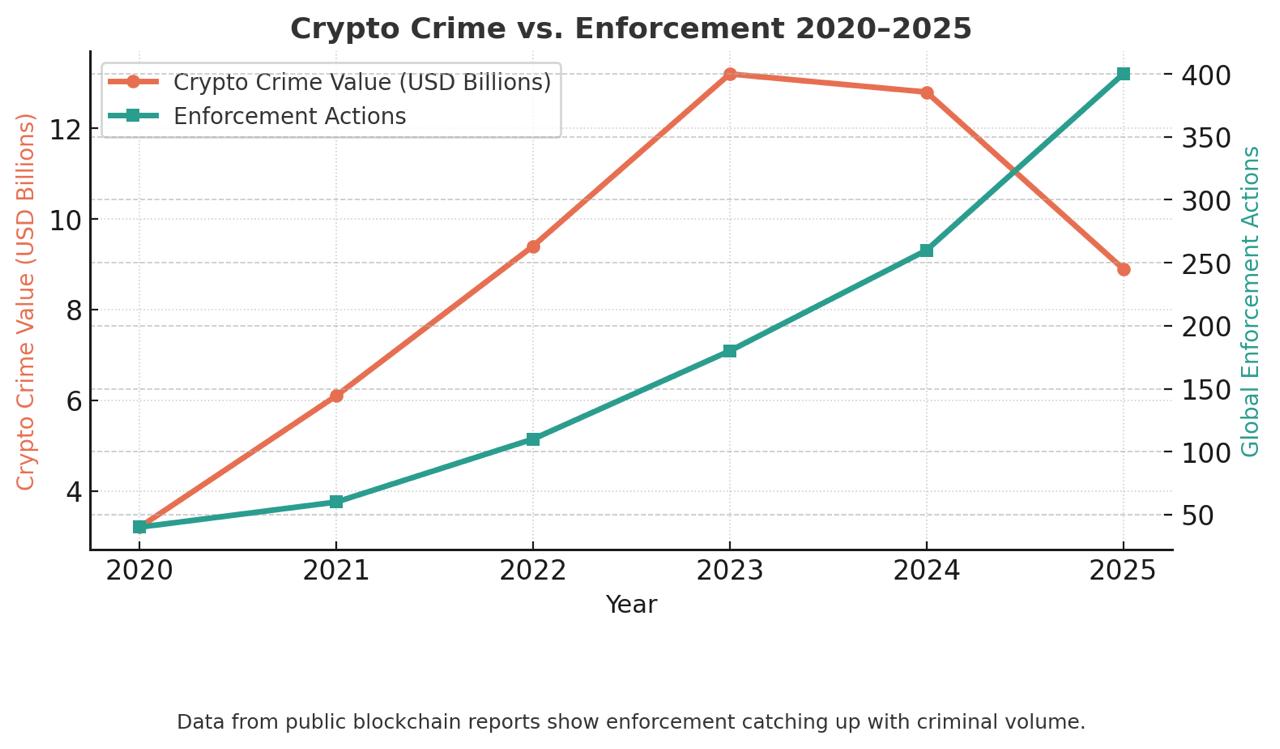
Blockchain analytics data from 2020-2025 also shows enforcement rising 280 percent and illicit gambling flows dropping by a third, evidence that visibility works.
Act VII – What Comes Next
The Prince Group saga closes a chapter but opens another question: what happens when transparency itself becomes the most powerful policing tool?
As more regulators demand wallet verification and casinos adopt on-chain proofs, anonymity shrinks — and accountability grows. The new age of digital crime is also the dawn of digital justice, written permanently onto a ledger that can’t be erased.
This publication is sponsored. Coindoo does not endorse or assume responsibility for the content, accuracy, quality, advertising, products, or any other materials on this page. Readers are encouraged to conduct their own research before engaging in any cryptocurrency-related actions. Coindoo will not be liable, directly or indirectly, for any damages or losses resulting from the use of or reliance on any content, goods, or services mentioned. Always do your own research.


Krasimir Rusev is a journalist with many years of experience in covering cryptocurrencies and financial markets. He specializes in analysis, news, and forecasts for digital assets, providing readers with in-depth and reliable information on the latest market trends. His expertise and professionalism make him a valuable source of information for investors, traders, and anyone who follows the dynamics of the crypto world.