EU and India Seal Landmark Trade Deal
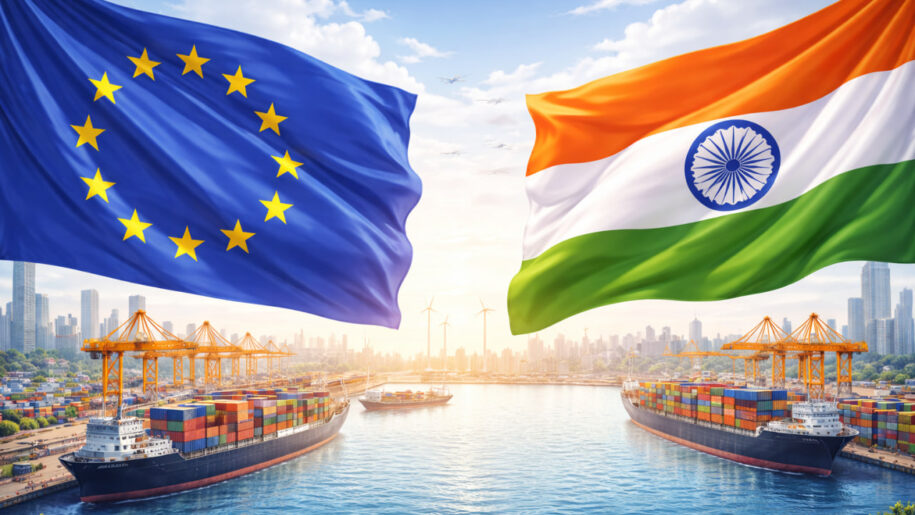
After nearly twenty years of stalled talks, the European Union and India have finally locked in a free-trade agreement, reshaping one of the world’s most important economic corridors at a moment when global trade is fragmenting.
The breakthrough reflects how quickly alliances are being recalibrated as tariffs, protectionism, and geopolitical pressure redefine global commerce under Donald Trump’s administration.
Key Takeaways
- EU and India finalize a long-awaited free-trade deal as global trade blocs realign.
- Tariffs are cut on most goods, with autos, textiles, and machinery among the biggest winners.
- The pact also strengthens strategic and defense cooperation beyond trade.
A strategic deal in a fractured trade world
Rather than being driven purely by economics, the EU–India agreement is rooted in strategy. Brussels is actively reducing its dependence on both the US and China, while New Delhi is seeking new export routes as it absorbs the impact of steep US tariffs and attempts to shed its long-standing protectionist image.
Ursula von der Leyen described the pact as the creation of one of the world’s largest free-trade zones, spanning roughly two billion people. The agreement was finalized during high-level meetings in New Delhi alongside European Council President Antonio Costa.
Indian Prime Minister Narendra Modi framed the deal as a boost for domestic manufacturing, services, and small businesses, arguing it would strengthen investor confidence and expand India’s access to European markets.
Tariffs slashed, trade flows rebalanced
At its core, the agreement dismantles a wide range of trade barriers. India has agreed to remove or sharply reduce tariffs on nearly all EU goods over time, while the EU will phase out duties on almost all Indian imports within seven years.
One of the most notable concessions comes in autos. India will allow a large quota of European-made vehicles to enter the country at sharply reduced duty rates, far exceeding the access granted in its other recent trade agreements.
For India, the pact opens the door for labor-intensive exports such as textiles, footwear, gems, and jewelry – sectors hit hardest by US tariffs. For Europe, it expands access to one of the world’s fastest-growing consumer markets, particularly for machinery, chemicals, aircraft, and premium food and drink products.
Services, mobility, and red lines
Beyond goods, the agreement stretches deep into services and labor mobility. Brussels has offered binding commitments on student movement and post-study visas, alongside market access across more than a hundred services categories.

India, however, drew firm boundaries. Its politically sensitive dairy sector was excluded entirely, highlighting that domestic politics still shape the outer limits of trade liberalization.
More than trade: security and defense alignment
The deal extends well beyond economics. Alongside the trade agreement, the EU and India unveiled a new security partnership that deepens cooperation in defense production, intelligence sharing, and regional monitoring.
The arrangement supports India’s push to expand domestic defense manufacturing while tapping European technology, particularly from countries such as Germany and France. It also strengthens coordination in the Indian Ocean, a region where China’s naval presence has grown steadily.
Von der Leyen said the partnership reflects a broader goal: strengthening both economic resilience and security cooperation in an increasingly unstable global environment.
Part of a broader EU pivot
The India agreement follows the EU’s recent trade breakthrough with the Mercosur bloc in South America, underscoring a clear pattern. Europe is accelerating efforts to diversify trade links as global supply chains become more politicized.
India, for its part, has been rapidly expanding its trade footprint, signing multiple agreements over the past year and pursuing talks with Latin American and Gulf partners to secure resources and new export markets.
Together, the EU–India pact signals a shift away from a US-centric trade order toward a more fragmented, multipolar system – one where scale, strategic alignment, and resilience matter as much as tariffs.
The information provided in this article is for educational purposes only and does not constitute financial, investment, or trading advice. Coindoo.com does not endorse or recommend any specific investment strategy or cryptocurrency. Always conduct your own research and consult with a licensed financial advisor before making any investment decisions.



Alexander Zdravkov is a person who always looks for the logic behind things. He has more than 3 years of experience in the crypto space, where he skillfully identifies new trends in the world of digital currencies. Whether providing in-depth analysis or daily reports on all topics, his deep understanding and enthusiasm for what he does make him a valuable member of the team.