Ethereum Considered as Infrastructure for Potential Euro Stablecoin

Ethereum is reportedly being considered as a potential blockchain infrastructure layer for a future euro stablecoin, signaling a notable shift in how governments evaluate public blockchain networks.
Key takeaways:
- Ethereum is being discussed as a candidate blockchain for a euro stablecoin.
- The discussion reflects growing institutional confidence in public blockchain infrastructure.
- The shift signals deeper convergence between government finance and decentralized networks.
- Ethereum’s maturity and ecosystem depth position it as a leading contender.
Rather than questioning whether public chains can function at scale, policymakers appear increasingly focused on identifying which network is robust enough to support sovereign-grade digital assets.
A Major Narrative Shift
The idea that Ethereum could serve as infrastructure for a euro-denominated stablecoin marks a significant evolution in the digital asset landscape. Public blockchains were once viewed with skepticism by regulators and central banks. Now, the conversation appears to be centered on suitability rather than viability.
MASSIVE:
🇪🇺 Ethereum is being considered as a potential blockchain to launch the Euro stablecoin.
Governments aren’t asking if public blockchains work anymore.
They’re asking which one is good enough.
That’s a major shift. pic.twitter.com/AmS9ygfuXV
— Merlijn The Trader (@MerlijnTrader) February 11, 2026
If adopted, Ethereum would provide an open, battle-tested settlement layer capable of integrating with decentralized finance liquidity, tokenized assets, and global blockchain infrastructure.
Why Ethereum?
Ethereum remains the dominant smart contract platform, supporting the largest ecosystem of decentralized applications, tokenized assets, and stablecoins. Its security model, developer activity, and liquidity depth make it a logical candidate for large-scale tokenization initiatives.

With scaling solutions and Layer 2 networks expanding throughput and lowering costs, Ethereum has evolved into a modular ecosystem capable of supporting institutional-grade applications.
ETH Price
At the time of observation, Ethereum (ETH/USD) traded around $1,949.60, reflecting a modest 0.04% decline on the session. On the one-minute timeframe, price action showed volatility earlier in the session, followed by stabilization in the $1,945 – $1,955 range.
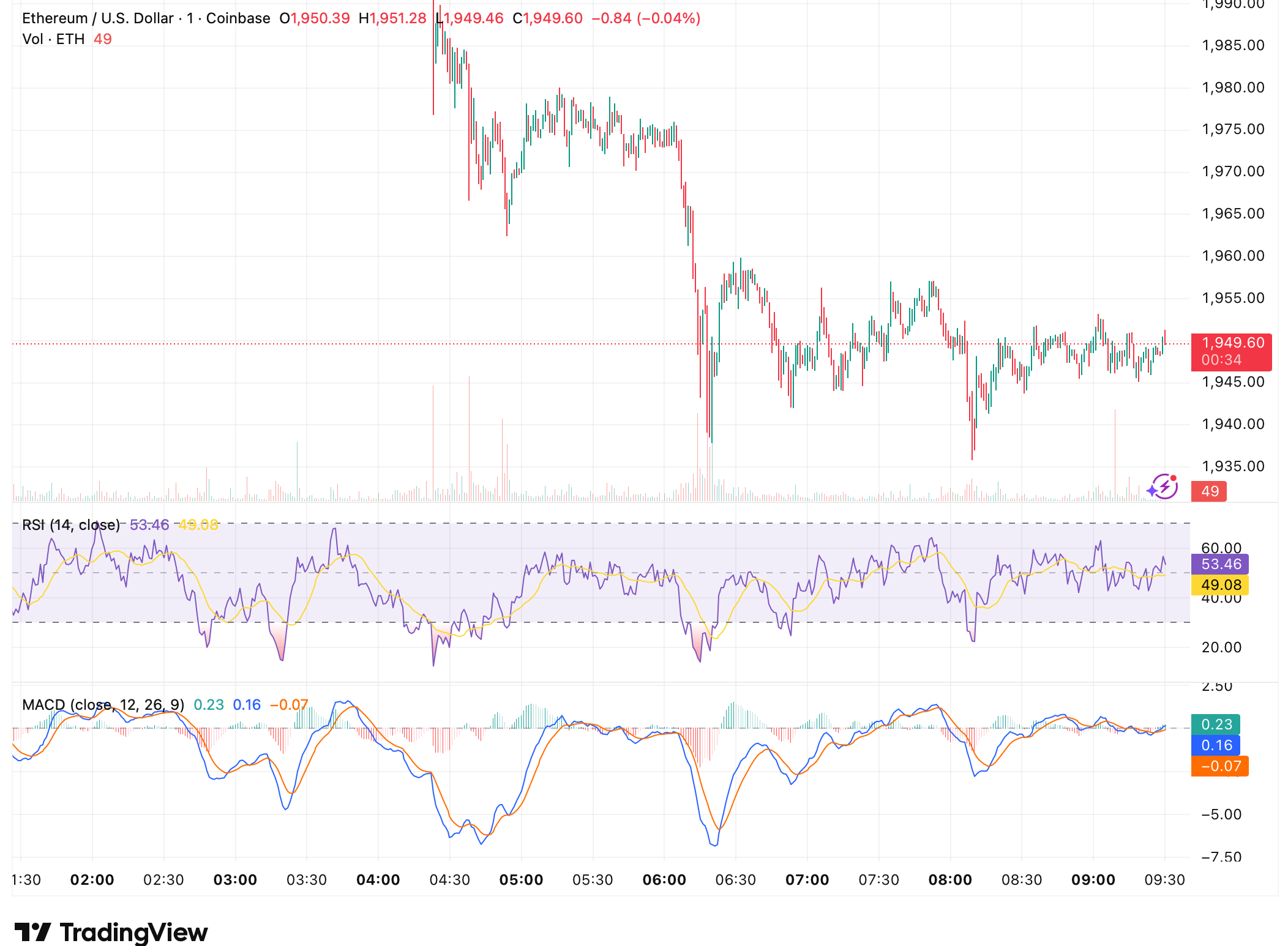
The Relative Strength Index (14) hovered near 53, suggesting neutral momentum with slight bullish bias. Meanwhile, the MACD (12, 26, 9) turned mildly positive, indicating short-term stabilization after earlier downside pressure.
While price has not yet shown a decisive breakout reaction, the broader narrative could strengthen Ethereum’s long-term positioning if further institutional confirmation emerges.
What to Expect
Should discussions around a euro stablecoin on Ethereum gain official backing, it could reinforce Ethereum’s role as foundational infrastructure for tokenized sovereign assets. In the short term, traders may watch for increased volatility and a potential break above the $1,955 – $1,960 resistance zone.
Longer term, continued institutional validation would likely support Ethereum’s structural demand profile, particularly if governments move from exploration to implementation.
The information provided in this article is for educational purposes only and does not constitute financial, investment, or trading advice. Coindoo.com does not endorse or recommend any specific investment strategy or cryptocurrency. Always conduct your own research and consult with a licensed financial advisor before making any investment decisions.



Alex is Editor-in-Chief of Coindoo and co-founder of Millennial Media Group, with nearly a decade of experience covering financial markets - crypto first, then everything else. It started in 2016 with Bitcoin. Like most people at the time, he didn't fully understand it - so he kept digging. Blockchain, tokenomics, the projects, the cycles. That curiosity never stopped, and eventually pulled him into traditional markets too: equities, commodities, macro. Not because he left crypto behind, but because you can't properly understand one without the other. What drives him is straightforward: he wants to know why something is happening, not just that it's happening. Most market coverage stops at the headline - price up, price down, here's a chart. Alex finds that kind of reporting actively unhelpful. If you walk away from an article without understanding the mechanism behind the move, what did you actually learn? He holds a degree in Tourism from New Bulgarian University - not the most obvious path into financial markets, but markets have a way of pulling in people who are simply too curious to stay out. He has authored over 200 in-depth analyses and more than 10,000 articles across crypto and traditional finance. He still thinks every day in markets teaches him something new. That's probably why he hasn't stopped.