Crypto vs. Banks: The $6.6 Trillion Fight Holding Up America’s Digital Asset Law
Washington's attempt to build a regulatory framework for crypto is grinding to a halt - and the reason comes down to one word: rewards.
Key Takeaways
- Banks warn stablecoin “rewards” could drain $6.6 trillion in deposits from the traditional financial system
- Coinbase calls banking opposition pure protectionism, not legitimate regulatory concern
- The CLARITY Act remains stalled in the Senate, with a de facto deadline fast approaching
- A compromise “activity-based” framework is circulating – but neither side is fully on board
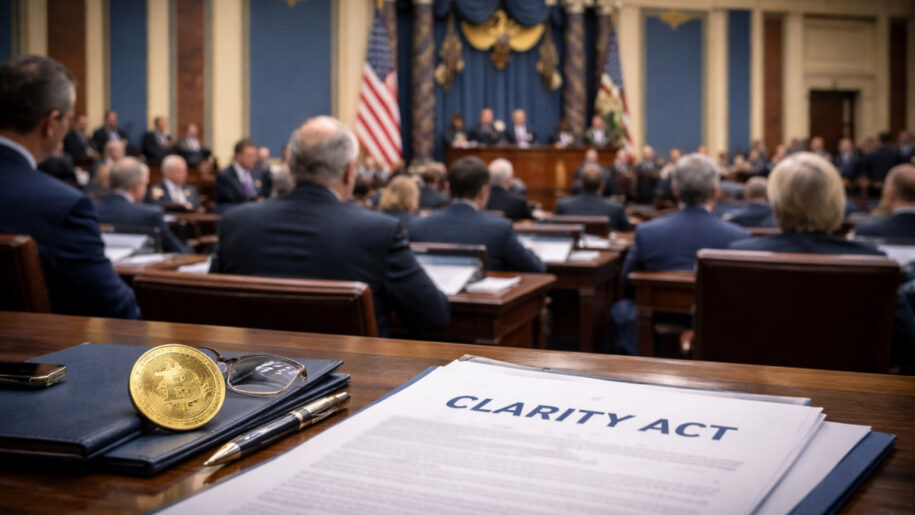
The CLARITY Act, the most consequential digital asset legislation the U.S. has attempted, is deadlocked in the Senate Banking Committee. At the center of the stalemate is a battle between the traditional banking sector and the crypto industry over whether stablecoin issuers should be allowed to offer yield-like returns to customers. The stakes, according to the banks, are nothing short of systemic.
The Banks’ Case
The American Bankers Association and JPMorgan are not mincing words. Their argument: if stablecoin issuers are permitted to offer high-interest “rewards” – effectively functioning as deposit accounts without the regulatory burden of one – customers will move their money. The projected figure being cited in congressional discussions is $6.6 trillion in potential deposit outflows from traditional banks.
A March 2026 Morning Consult survey commissioned by the ABA found that 62% of consumers believe Congress should tread carefully on rules that could weaken community banks. Banking groups are leaning hard on that number.
Their proposed amendments to the CLARITY Act go further than a simple ban on interest payments. They want to close what they’re calling the “affiliate loophole” – a mechanism by which stablecoin issuers could route rewards through a separate entity, like a crypto exchange, to sidestep the GENIUS Act’s prohibition on stablecoin interest. They’re also pushing for blanket restrictions on marketing stablecoin products as “risk-free” or equivalent to FDIC-insured deposits, and demanding that crypto firms meet the same Anti-Money Laundering standards required of banks.
Coinbase Pushes Back
Paul Grewal, Coinbase’s Chief Legal Officer, has a different read on the banks’ position. He’s called it “protectionism” – an effort to “dig regulatory moats” and preserve what he describes as a low-interest deposit monopoly that has long benefited incumbent financial institutions at the expense of consumers.
The CLARITY Act must remain a pro-innovation piece of legislation. Attempts to hijack the legislative process and turn it into an anti-competition bill are shameful.
— Patrick Witt (@patrickjwitt) March 11, 2026
The crypto industry’s counter-position is straightforward: stablecoin rewards are a competitive tool, not a backdoor banking product. Grewal and others argue that because stablecoin issuers, under the GENIUS Act framework, are barred from lending out their reserves, they don’t carry the same systemic risks as traditional banks and shouldn’t face equivalent restrictions.
That argument has found an audience at the White House.
Where the Administration Stands
Patrick Witt, the White House’s crypto adviser, has positioned himself as a mediator – though one who has made clear the administration’s sympathies. Witt recently pushed back publicly on claims made by JPMorgan CEO Jamie Dimon, reiterating that the GENIUS Act’s structure fundamentally distinguishes stablecoin issuers from deposit-taking banks and that deposit flight regulations designed for the latter shouldn’t automatically apply to the former.

President Trump, for his part, has been less diplomatic. After meeting with Coinbase CEO Brian Armstrong in March 2026, he took to social media to accuse banks of “undermining” the crypto sector and warned that continued delays risked pushing the industry toward China – a familiar rhetorical frame his administration has used to press for faster legislative movement.
The Legislative Mess
The GENIUS Act, passed in 2025, established a basic federal framework for stablecoins but left the question of yield and rewards deliberately unresolved. That ambiguity has become the fault line for 2026 negotiations.
The CLARITY Act was meant to settle what the GENIUS Act left open. Instead, it has become the arena for a more fundamental conflict about whether crypto firms are financial institutions in disguise or something categorically different.
The timeline has not helped. Congressional negotiators were operating under an unofficial March 1 deadline to reach a framework deal. That window has passed without resolution.
Analysts are now warning that failure to move soon will push the CLARITY Act past the 2026 midterm elections – effectively shelving it for the foreseeable future.
There is one emerging compromise worth watching. A draft amendment circulating in the Senate Banking Committee as of mid-March would draw a line between “activity-linked” incentives – trading fee discounts, liquidity rewards, payment rebates – which would be permitted, and yield paid simply for holding a stablecoin balance, which would not. Whether that middle ground holds under pressure from both sides remains to be seen.
The Bigger Picture
The regulatory environment has shifted considerably since the aggressive enforcement posture of prior administrations. The SEC under the current administration has moved toward “engagement” over litigation, which has redirected the industry’s energy from courtrooms to committee rooms. The fight over the CLARITY Act is, in many ways, the logical endpoint of that shift – a battle now being waged through lobbying and legislative language rather than enforcement actions.
What hasn’t changed is the underlying tension: two industries competing for the same pool of consumer capital, with Congress caught between them. The outcome of that fight will define how – or whether – the U.S. builds a functioning legal framework for digital assets before the next election cycle resets the board entirely.
The information provided in this article is for educational purposes only and does not constitute financial, investment, or trading advice. Coindoo.com does not endorse or recommend any specific investment strategy or cryptocurrency. Always conduct your own research and consult with a licensed financial advisor before making any investment decisions.



Alexander Zdravkov is a person who always looks for the logic behind things. He has more than 3 years of experience in the crypto space, where he skillfully identifies new trends in the world of digital currencies. Whether providing in-depth analysis or daily reports on all topics, his deep understanding and enthusiasm for what he does make him a valuable member of the team.