Crypto VC Funding Tops $2B as Institutions Double Down on Infrastructure

More than $2 billion in venture capital poured into the crypto sector in the first quarter of 2026, but the money didn’t chase Layer 1 tokens, memecoins, or retail-driven narratives.
Key Takeaways
- Over $2B flowed into crypto in Q1 – mainly into infrastructure.
- Stablecoin platforms and enterprise payment rails led funding.
- Custody firms matured, with BitGo’s IPO marking a milestone.
- RWA tokenization is moving into production, not pilots.
- Capital is targeting pipes and compliance – not speculation.
Instead, the largest checks targeted the foundational layers of the industry – stablecoin infrastructure, institutional custody, and real-world asset tokenization.
January alone accounted for $1.4 billion in funding, marking a 14% year-over-year increase. Interestingly, the number of deals fell from 85 to 60 compared to last year, while average deal sizes expanded significantly. That shift points to a more selective market where capital is concentrating around companies seen as infrastructure winners rather than speculative plays.
Stablecoin Infrastructure Leads the Pack
Stablecoin-related infrastructure attracted more than $495 million in Q1 funding.
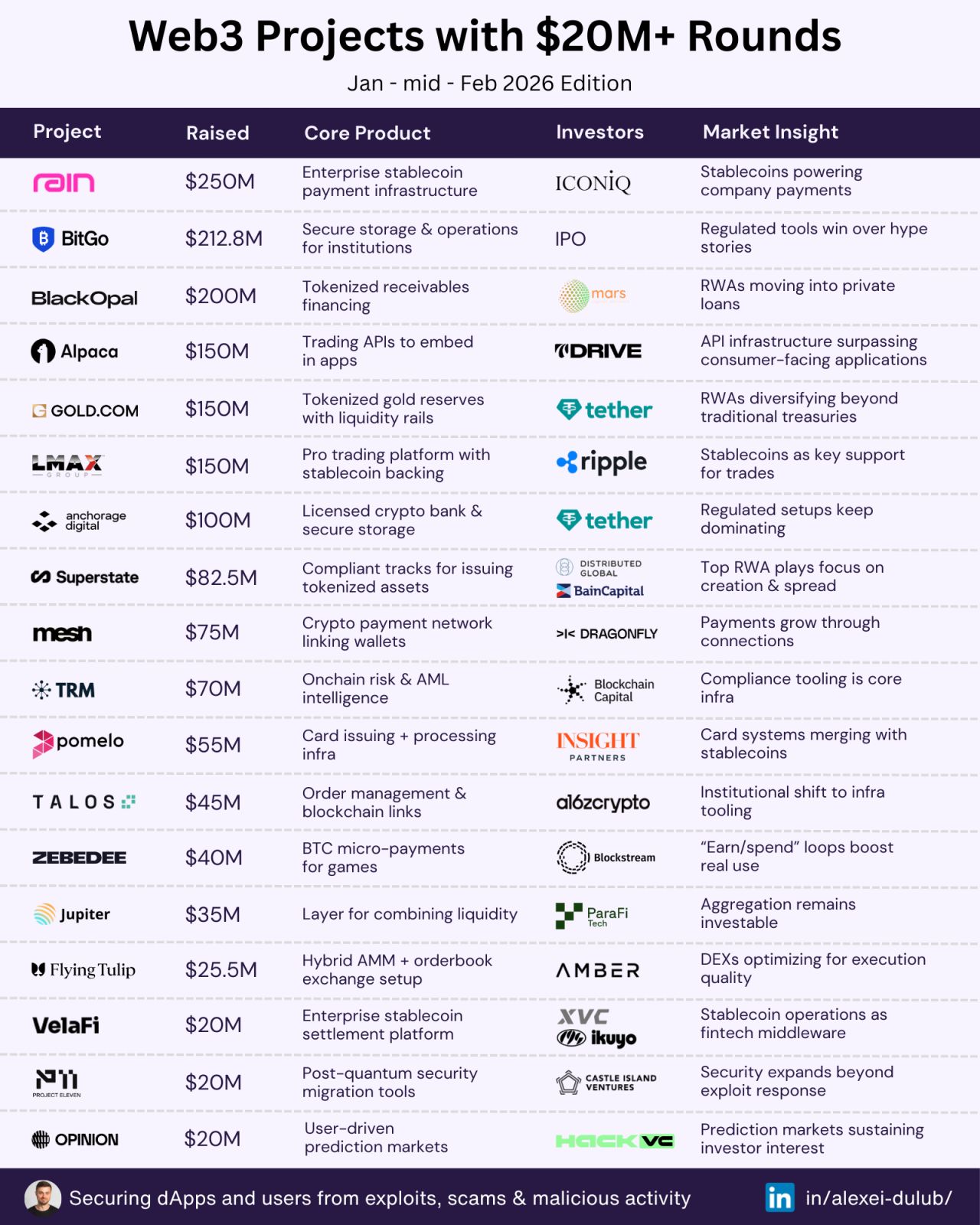
Rain raised $250 million in a Series C round, valuing the company at $1.95 billion. Its platform allows enterprises such as Western Union and Nuvei to issue stablecoin-powered Visa cards, already facilitating over $3 billion in annualized transaction volume. The scale signals that stablecoins are evolving into enterprise-grade payment rails rather than remaining crypto-native tools.
LMAX Group secured a $150 million strategic investment led by Ripple to expand institutional stablecoin liquidity. The message from investors is clear – liquidity, compliance, and settlement infrastructure are now core priorities.
Institutional Custody Goes Public
Institutional custody firms collectively raised roughly $357 million during the quarter.
In a landmark move, BitGo completed a $212.8 million IPO at a $2.08 billion valuation, becoming the first pure-play crypto custody firm listed on the NYSE under the ticker BTGO. Managing approximately $104 billion in assets, BitGo’s public debut marks a new stage of operational maturity for custody providers.
Meanwhile, Fireblocks acquired crypto accounting platform TRES Finance for $130 million, further professionalizing the institutional stack. The trend suggests consolidation and vertical integration across compliance, reporting, and asset protection.
Real-World Asset Tokenization Accelerates
Real-world asset projects attracted $432 million in Q1, underscoring growing institutional appetite for on-chain credit and commodities exposure.
BlackOpal raised $200 million to tokenize Brazilian credit card receivables on the Plume Network. Its GemStone product aims to convert illiquid receivables into blockchain-based yield instruments for institutional allocators, targeting a market estimated at $100 billion.

Beyond startups, major asset managers such as BlackRock and Franklin Templeton have moved tokenized money market funds from pilot phases into production-scale deployment. Tokenization is no longer experimental – it is entering core portfolio allocation strategies.
Trading, Compliance, and the Broader Stack
Another $205 million flowed into trading and fintech convergence plays, including Alpaca and Pomelo, while $90 million went to security and compliance firms such as TRM Labs and Project Eleven. Smaller but still notable rounds totaling $120 million backed companies like ZBD and Jupiter.
Although consumer crypto products remain active, infrastructure dominated the largest funding rounds.
Why Capital Is Concentrating
The pivot reflects a maturing market where institutions are now the primary growth engine. Regulatory clarity, including frameworks like the GENIUS Act in the United States, has provided compliance guardrails for banks and financial institutions to engage with stablecoins and custody services more confidently.
Investors are increasingly prioritizing recurring revenue models – transaction fees, custody fees, compliance services – over volatile token-driven economics. Instead of betting on narrative cycles, venture firms are backing the connectivity layers between traditional finance and blockchain settlement.
The takeaway is straightforward. While retail traders debate price charts, venture capital is building the pipes and rails designed to connect crypto with the global financial system.
The information provided in this article is for educational purposes only and does not constitute financial, investment, or trading advice. Coindoo.com does not endorse or recommend any specific investment strategy or cryptocurrency. Always conduct your own research and consult with a licensed financial advisor before making any investment decisions.



Alexander Zdravkov is a person who always looks for the logic behind things. He has more than 3 years of experience in the crypto space, where he skillfully identifies new trends in the world of digital currencies. Whether providing in-depth analysis or daily reports on all topics, his deep understanding and enthusiasm for what he does make him a valuable member of the team.