What Is Cryptocurrency? A Beginner’s Guide
Last updated: July 2026
Table of Contents
- What Is Cryptocurrency?
- Who Created Cryptocurrencies?
- A Brief History of Cryptocurrency
- Blockchain Explained
- How Does a Cryptocurrency Transaction Work?
- Coins, Tokens and Stablecoins
- Advantages of Cryptocurrencies
- How Cryptocurrency Is Used in 2026
- Common Problems of Cryptocurrencies
- How Many Cryptocurrencies Are There?
- Alternatives to Bitcoin
- Is Cryptocurrency Regulated?
- Frequently Asked Questions
- Final Thoughts
Blockchain technology and crypto assets are already changing the way people store and transfer value. From how businesses settle payments to how investors access digital markets, cryptocurrencies now have uses far beyond simple online payments.
By July 2026, the sector includes Bitcoin, programmable blockchains, stablecoins, decentralized financial applications, tokenized stocks and bonds, and regulated exchange-traded investment products. At the same time, cryptocurrency remains complex, volatile and regulated differently across jurisdictions.
This guide explains what cryptocurrency is, where it came from, how it works and what risks are worth understanding before using it.
What Is Cryptocurrency?
A cryptocurrency is a form of digital asset that can work as a medium of exchange, a store of value, a network utility token or a way to participate in a blockchain-based application. It uses strong cryptographic technology to secure transactions and control access to funds.
Besides cryptography, several other mechanisms help secure cryptocurrency networks. These include distributed nodes, consensus rules, digital signatures and crypto wallets used to manage public and private keys.
But there is a deeper process behind cryptocurrencies and their underlying technology: the blockchain or another form of distributed ledger.
Through wider adoption, cryptocurrencies can make it easier to transfer value, create programmable financial services and give users more direct control over their funds. Blockchain systems are also being explored for payments, securities, supply chains, identity systems and other applications.
Much of the interest around cryptocurrency still comes from its profit potential, with speculators sometimes driving prices rapidly higher. This phenomenon can create a fear of missing out, motivating people to buy and hold crypto without fully understanding the technology or risks.
Most cryptocurrencies have no physical form and can be transferred without using a bank as the central record keeper. Since the launch of Bitcoin, the first widely adopted decentralized cryptocurrency, thousands of other projects have emerged. Yet Bitcoin remains the best-known crypto asset.
Who Created Cryptocurrencies?
Cryptocurrency emerged from decades of work involving cryptography, digital cash and distributed computer systems. There were many attempts to create digital currencies before modern cryptocurrencies appeared.
But everything changed in late 2008, when the mysterious developer, or group of developers, known as Satoshi Nakamoto published a White paper called “Bitcoin: A Peer-to-Peer Electronic Cash System.”
Satoshi’s main goal was to create a digital cash system without a central authority, similar to a peer-to-peer file-sharing network. The idea was radical at the time: a cryptographically secured digital currency that did not depend on a bank or another central administrator to maintain its transaction history.
Bitcoin did not invent every technology it used. Instead, it combined cryptographic signatures, proof of work, peer-to-peer networking and an ordered transaction ledger into a system capable of operating without a central record keeper.
And with it, the modern public blockchain model was born.
Bitcoin’s network began operating in January 2009, laying the foundation for thousands of cryptocurrencies and blockchain-based applications. Its supply is capped at 21 million coins by the protocol’s rules, a fixed limit that remains central to how many investors think about its value.
A Brief History of Cryptocurrency

Phase One: The Foundations of Digital Money
Before Bitcoin, researchers and developers had already experimented with electronic cash, cryptographic signatures and systems designed to transfer value online. Most of these projects still depended on a company or central server, creating a central point that could be controlled, attacked or shut down.
Bitcoin’s main breakthrough was solving the problem of reaching agreement over a digital transaction history without appointing one central authority.
Phase Two: Bitcoin, Exchanges and Early Altcoins
Between 2009 and 2014, Bitcoin developed from an experimental network into a traded digital asset. Wallets, exchanges and payment companies made it easier for people to buy, store and transfer BTC.
Other cryptocurrencies followed. Some changed Bitcoin’s code or mining model, while others focused on faster payments, greater privacy or different methods of distributing new coins.
Phase Three: Programmable Blockchains
Ethereum launched its main network in July 2015 and expanded the idea of a blockchain beyond payments. Through smart contracts, developers could create tokens and applications that run according to rules written in code.
This led to the growth of decentralized exchanges, lending protocols, stablecoins, blockchain games, non-fungible tokens and decentralized autonomous organizations.
Ethereum originally used proof of work, but completed its transition to proof of stake on September 15, 2022. Validators now secure the network by staking ETH rather than using mining equipment.
Phase Four: Broader Adoption and Regulation
Since 2021, cryptocurrency has become more closely connected with the traditional financial system. Stablecoins gained wider use for trading, payments and cross-border settlement, while financial institutions began exploring tokenized funds, bonds, stocks and other real-world assets.
In January 2024, the US Securities and Exchange Commission approved the listing and trading of spot Bitcoin exchange-traded products, allowing investors to gain exposure through conventional brokerage accounts without holding BTC directly.
The European Union also introduced the Markets in Crypto-Assets Regulation, known as MiCA, creating common rules for many crypto issuers and service providers across the bloc.
Tokenization has become another major part of the sector. The Bank for International Settlements has described tokenization as a technology capable of improving payments and securities markets, although questions involving legal rights, settlement, liquidity and interoperability remain. Our guide to RWA tokenization platforms examines how these products work and who provides them.
This phase does not mean cryptocurrency has achieved universal adoption. It shows that the sector has moved from a largely experimental market into a mixture of decentralized networks, regulated products and institutional infrastructure.
Blockchain Explained
Even if individual cryptocurrencies disappear in the future, distributed-ledger technology is likely to continue developing.
Governments, financial institutions and society itself have started to explore blockchain’s potential, although not every suggested use requires a blockchain.
By allowing digital information to be distributed across a network, blockchain technology created a new way to maintain a shared record without relying on one central database.
To put it simply, a blockchain is a transaction ledger. As its name suggests, information is grouped into blocks. Once a block is completed and accepted by the network, it is added to the existing chain of blocks.
A blockchain allows new information to be added while making older confirmed records increasingly difficult to alter. It is more accurate to call public blockchains tamper-resistant than absolutely unchangeable, because their security depends on the consensus model and the strength of the participating network.
There are notable applications of blockchain in the public and private sectors. They include financial services, supply chains, digital identity, media, tokenized assets and record keeping. So, if you are starting to become interested in crypto, you should know that it is not the last time you will encounter blockchain technology.
How Does a Cryptocurrency Transaction Work?
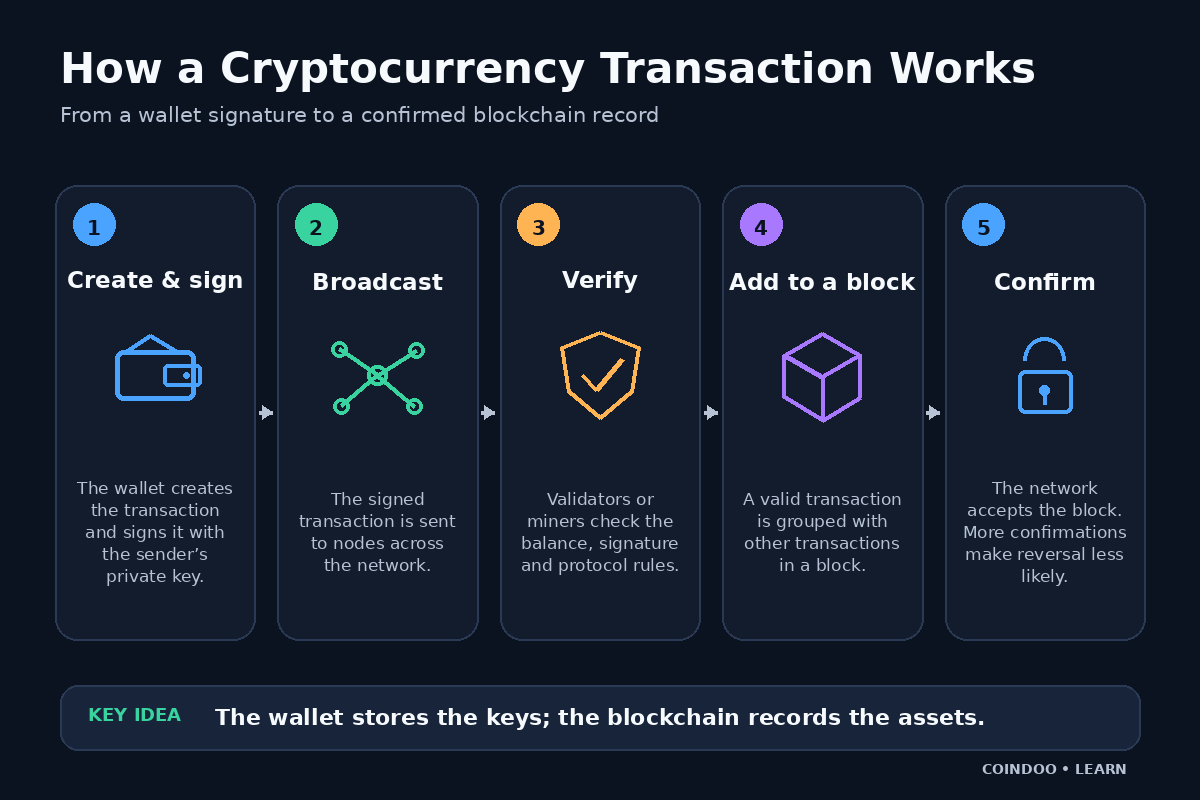
When a person sends cryptocurrency, the wallet creates a transaction and signs it with the sender’s private key. The signature proves that the transaction was authorized without exposing the private key itself.
The transaction is then transmitted to the network. Miners, validators or another group of participants check whether it follows the protocol’s rules, including whether the sender controls the funds and has not already spent them.
Once accepted, the transaction is included in the network’s ledger. The time required and the point at which a payment is treated as final depend on the blockchain being used.
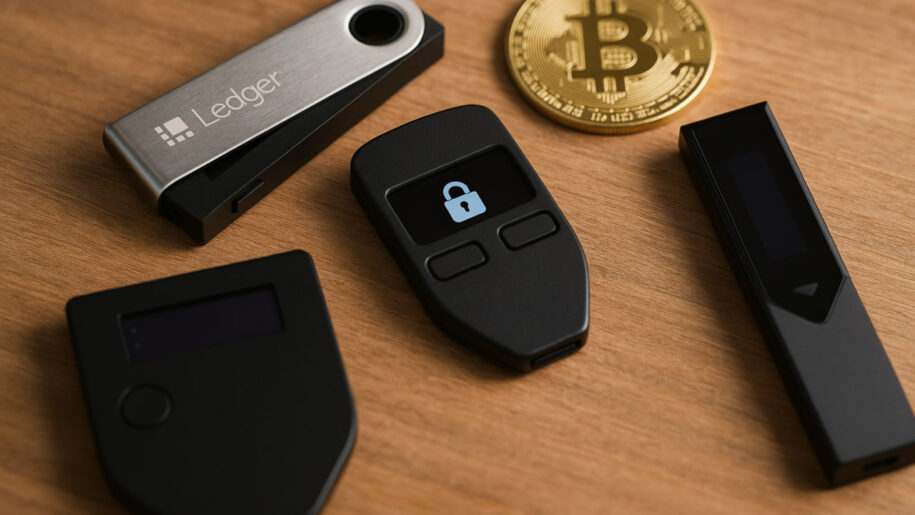
A wallet does not normally store coins as files inside a phone or hardware device. The assets remain recorded on the blockchain, while the wallet manages the keys that allow the user to control them.
This is why protecting a private key or recovery phrase is essential. Anyone who obtains it may be able to move the funds, while losing it can permanently remove the owner’s ability to access the wallet.
Coins, Tokens and Stablecoins
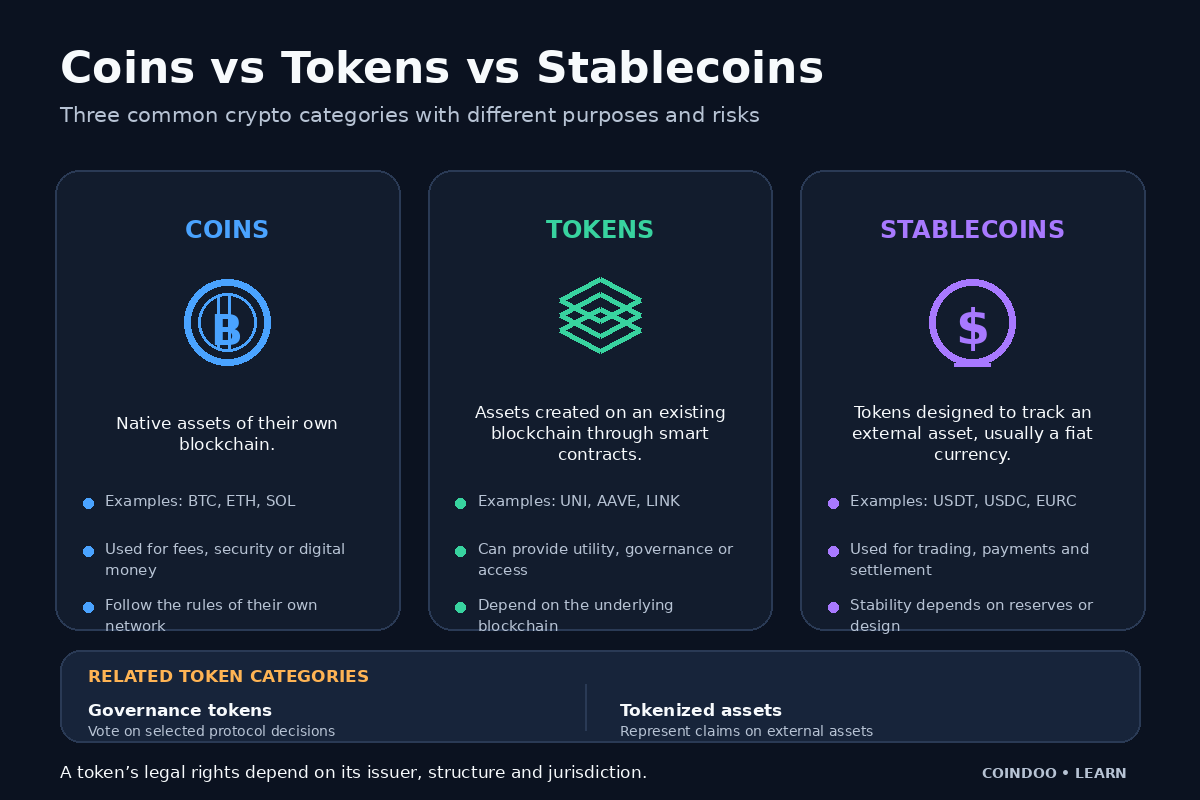
Our guide to the purpose of stablecoins explains how they differ from freely traded assets such as Bitcoin.Although the terms are often used interchangeably, not every cryptocurrency works in the same way.
- Coins are native assets of their own blockchain. Bitcoin is the native coin of the Bitcoin network, while ETH is the native asset used on Ethereum.
- Tokens are created through an existing blockchain’s smart-contract system. They may provide access to an application, governance rights or a digital representation of another asset.
- Stablecoins aim to maintain a value linked to an external asset, commonly the US dollar. Their stability depends on the issuer, reserves, redemption model or protocol supporting them.
- Governance tokens allow holders to vote on certain decisions involving decentralized applications or treasuries.
- Tokenized assets represent financial or real-world claims such as funds, bonds, commodities or shares, subject to the legal structure behind the token.
Advantages of Cryptocurrencies
Probably the main advantage of cryptocurrencies is their accessibility. Anyone with a compatible device and internet connection can technically create a wallet, although access to exchanges and regulated services may depend on location and identity checks.
Besides accessibility, cryptocurrencies can offer a gateway to greater financial independence. They do not always rely on the infrastructure provided by banks, financial institutions or governments. This allows people to transfer value directly across borders and outside traditional banking hours.
Another potential advantage comes in the form of privacy. A user can create a wallet address without attaching a public name to it. However, most public blockchains are pseudonymous rather than anonymous.
Transaction amounts and wallet addresses are normally visible on the ledger, and activity can sometimes be connected to an individual. Exchanges and other regulated services also commonly require users to complete Know Your Customer procedures.
Furthermore, cryptocurrencies can offer lower fees than some traditional payment methods, particularly for certain international transfers. This is not always the case. Network congestion, blockchain choice and the amount transferred can make a crypto payment more expensive than an ordinary domestic bank transfer.
Other advantages include 24-hour operation, programmable transactions and the ability to use financial applications without asking a centralized platform to approve every action.
How Cryptocurrency Is Used in 2026
Cryptocurrency is used differently depending on the asset and the user.
- Bitcoin is commonly held as a speculative investment, a long-term store-of-value asset or a way to transfer value;
- Stablecoins are used for trading, payments, remittances and settlement;
- Native blockchain coins pay transaction fees and help secure networks;
- Smart contracts support decentralized trading, lending and borrowing;
- Users can earn rewards by staking cryptocurrency on proof-of-stake networks;
- Tokenized assets bring traditional financial exposure onto blockchain infrastructure;
- Regulated investment products provide crypto exposure through conventional securities accounts.
These uses should not be treated as equal. Holding a stablecoin, staking a native network token and buying shares in a regulated crypto investment product involve different rights and risks.
Common Problems of Cryptocurrencies
Cryptocurrency carries real risks. The market is highly volatile, which leads some investors to treat it like a minefield while others try to benefit from its rapid price changes.
The technology behind it is complex, and people tend to be afraid of cryptocurrencies because they do not fully understand how they work.
Some of the most significant disadvantages associated with crypto are its varying token economics, limited consumer protection, irreversible transactions and the high risk of loss.
Users may also face exchange failures, wallet theft, smart-contract bugs, bridge exploits, misleading token promotions and assets with little or no market liquidity.
Scams remain a major problem. The US Federal Trade Commission warns that guaranteed returns, unexpected investment offers and requests to send cryptocurrency in advance are common signs of fraud.
And then there is the problem of double-spending: an attempt to spend the same digital funds more than once. It was one of the biggest obstacles to creating decentralized digital currencies before Bitcoin.
If anyone could spend the same money repeatedly, that money would become worthless. The scarcity and reliability of the currency would disappear.
Bitcoin’s proof-of-work system and distributed network are designed to make double-spending extremely difficult. An attacker attempting to reverse a confirmed transaction would need to create a competing transaction history and overcome the work supporting the accepted chain.
It is not accurate to say that such an attack is mathematically impossible. Its difficulty and cost increase as more blocks confirm the transaction and as the network’s total computing power grows.
For cryptocurrencies that followed Bitcoin, the answer depends on their design and the security of their networks. Smaller proof-of-work systems have historically been more exposed to majority attacks because gaining control of their available mining power can be less expensive.
How Many Cryptocurrencies Are There?
There is no single authoritative number of cryptocurrencies in existence. Major market trackers list many thousands of tradeable assets, while the number of tokens created across public blockchains is far larger.
The total changes constantly because new tokens are created every day, while inactive, abandoned or fraudulent projects may remain visible in databases long after meaningful trading has stopped.
Because of the fierce competition, only a small percentage achieve lasting adoption, liquidity or active development. The raw number of listed tokens therefore says little about the health or size of the usable cryptocurrency market.
Alternatives to Bitcoin
Altcoins are one of the main reasons why the world of cryptocurrencies is so varied. The term “altcoin” originally meant a coin that was an alternative to Bitcoin. Today, it is often used more broadly to describe most crypto assets other than BTC.
There are many innovative altcoin projects. Some were born with the mission of improving on the groundwork laid by Bitcoin, while others were designed for entirely different purposes.
Earlier projects such as Dash focused on faster payments, while IOTA explored a distributed-ledger model for connected devices. Newer blockchain ecosystems have concentrated on smart contracts, decentralized finance, gaming, tokenization and high-throughput applications.
Ethereum remains the largest programmable blockchain ecosystem, while other widely followed assets and networks include BNB, XRP, Solana, Cardano, Stellar, Polkadot, Monero and Bitcoin Cash. In recent years, networks such as Solana and Base have attracted particular attention for high-throughput trading, consumer applications and tokenized stocks and funds.
Stablecoins such as USDT and USDC are also among the largest crypto assets, but they serve a different purpose because they attempt to track the value of the US dollar rather than appreciate freely against it.
Market rankings change continuously. A token’s position by market capitalization does not prove that it is decentralized, secure, profitable or suitable for a particular user.
Is Cryptocurrency Regulated?
Cryptocurrency is regulated differently around the world. A token may be treated as a commodity, security, payment instrument, property or a separate class of crypto asset depending on its design and the jurisdiction involved.
The EU’s MiCA framework creates common rules for many crypto-asset issuers, stablecoin providers and crypto service businesses. Other countries use existing securities, commodities, banking, payments or anti-money-laundering laws.
The approval of regulated crypto investment products does not mean that regulators guarantee the value or safety of the underlying assets. It only means that the product can operate under the applicable legal and disclosure rules.
Users may also owe taxes when selling, exchanging, earning or spending cryptocurrency. Local legal and tax requirements should always be checked before completing a transaction.
Frequently Asked Questions
Is Cryptocurrency Real Money?
Some cryptocurrencies can be used as payment, but most are not legal tender. Their acceptance depends on the merchant, jurisdiction and network. Many people use them primarily as investments or digital assets rather than everyday money.
Is Cryptocurrency Anonymous?
Usually not. Many public blockchains are pseudonymous, meaning transactions are connected to wallet addresses rather than names. The ledger remains public, and additional information can sometimes connect an address to a real person.
Is Cryptocurrency Safe?
A blockchain network may be highly resistant to attack while the wallet, exchange or smart contract used to access it remains vulnerable. Security depends on the specific network, service and way the user protects private keys.
Can Cryptocurrency Be Converted Into Cash?
Many cryptocurrencies can be sold through an exchange, broker, payment service or peer-to-peer transaction. Availability, withdrawal methods and identity requirements depend on the user’s country and chosen provider.
What Is the Difference Between Bitcoin and Cryptocurrency?
Cryptocurrency is the broader asset category. Bitcoin is one cryptocurrency within that category and was the first widely adopted decentralized digital currency.
Do All Cryptocurrencies Use Mining?
No. Bitcoin uses proof-of-work mining, while Ethereum and many other networks use proof of stake. Other projects use different methods for selecting participants and confirming transactions.
What Gives Cryptocurrency Value?
Value can come from scarcity, network use, demand, liquidity, security, access to an application or claims on external assets. These factors vary widely between projects, and some tokens may have little lasting utility or value.
Final Thoughts
The crypto world can seem daunting for newcomers, just as the crypto market can seem wild for new investors.
In the crypto sphere, each day brings new developments. New cryptocurrencies emerge, old ones disappear, applications gain or lose users, and investors either make or lose money.
Cryptocurrencies have illustrated how blockchain technology can challenge parts of the existing financial system and support new approaches to payments, ownership and digital services.
At the same time, adoption should not be confused with guaranteed success. Cryptocurrency still involves significant technical, market, custody and regulatory risks.
The best starting point is to understand what an asset does, who controls its development, how its supply works, where it is traded and what could cause users to lose access to their funds. Our cryptocurrency terms guide can help explain unfamiliar concepts encountered during further research.
Updated in July 2026 using the Bitcoin white paper, Ethereum’s official documentation, SEC publications, EU and ESMA regulatory material, the Bank for International Settlements and Federal Trade Commission consumer guidance.
This article is provided for informational purposes only and does not constitute financial, investment, legal or tax advice.



Alexander Zdravkov is a market analyst and crypto journalist with interests in economics, broader financial markets and digital assets. His journey into crypto began more than four years ago, driven by a fascination with the rapid evolution of blockchain technology and the transformative potential of decentralized finance. He began analyzing market cycles and identifying emerging trends before they reach the mainstream. He holds a degree in International Relations - a background that helped shape his broader perspective on global economics, geopolitics, and the interconnected nature of modern financial markets. Whether covering the latest developments in the crypto sector or exploring broader macroeconomic themes, Alexander focuses on giving readers context rather than simply repeating headlines. During his career, he has authored more than 5,000 articles covering cryptocurrencies, traditional finance, and global market developments. His work spans everything from Bitcoin and altcoins to macroeconomic trends influencing risk assets worldwide.