Ethereum Drops Below $3,000 as Selling Pressure Intensifies – But It May Not Be All Bad News

Ethereum’s downturn escalated this week as the second-largest cryptocurrency fell beneath the $3,000 threshold, marking the continuation of a sharp multi-week correction.
ETH is now trading near $2,966, extending its 17% weekly decline and wiping out a significant portion of the gains accumulated during the previous quarter. The latest drop coincides with a broader risk-off sentiment across digital assets, where traders appear increasingly reluctant to take long positions even on high-conviction assets.
The sell-off has been fueled partly by liquidations and partly by waning confidence among retail investors, many of whom anticipated a strong end-of-year performance from Ethereum following elevated network activity and staking figures earlier in the quarter. Instead, the market is now confronting its most uncertain moment since the early summer correction.
Technical Indicators Show a Deeply Oversold Market
Ethereum’s technical structure reflects prolonged downward pressure. On the daily chart, the Relative Strength Index (RSI) has plunged to around 30, a zone typically associated with oversold conditions and historically followed by short-term relief rallies. However, analysts warn that oversold metrics alone are not a guarantee of immediate recovery, especially when accompanied by intense macro-driven uncertainty.
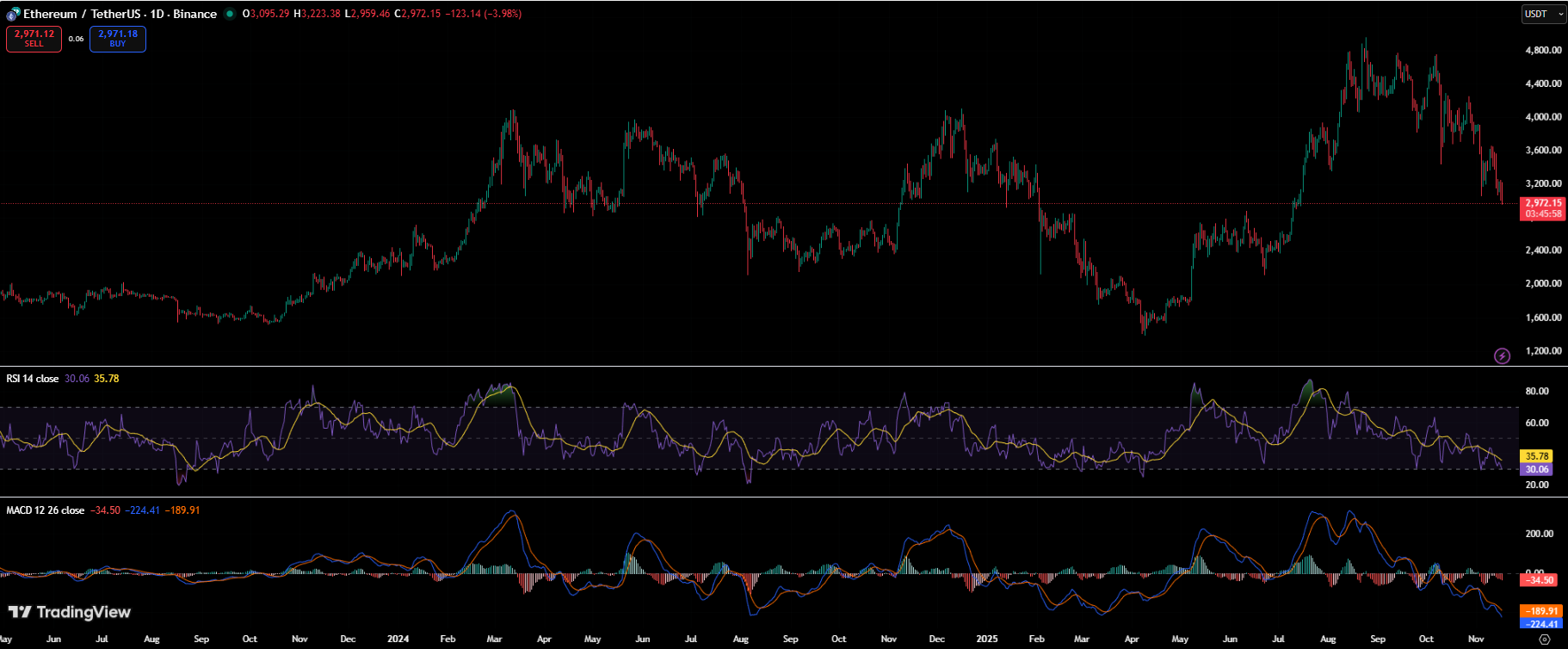
The MACD indicator also remains deeply bearish, registering widening negative momentum. The histogram continues to form lower lows while the MACD line stays beneath the signal line, demonstrating an ongoing lack of buying strength. For bullish traders to regain control, both indicators would need to show stabilization or at least signs of momentum slowdown — neither of which has materialized yet.
Crypto Analysts Split: Breakdown or Setup for a Major Rebound?
While technical data paints a cautious picture, sentiment among analysts is sharply divided. A prominent chart comparison resurfaced on social media from crypto analyst Merlijn The Trader, who highlighted striking structural similarities between Ethereum’s 38% plunge in 2020 and the latest 38% correction in 2025. His argument is rooted in cyclical repetition — that deep and uncomfortable downturns have historically preceded Ethereum’s largest rallies.
ETHEREUM REPEATS. THEN EXPLODES.
2020: ETH dumped 38%.
2025: ETH just dumped 38% again.Same fear. Same pattern.
Last time? It triggered the breakout of the decade.
This time? Don’t sleep.Breakouts start when doubt is highest. pic.twitter.com/aGbaEDBzCm
— Merlijn The Trader (@MerlijnTrader) November 17, 2025
The charts he shared illustrate how market disbelief and fear preceded the 2021 breakout that sent ETH from hundreds to over $4,000. In his view, the present downturn could be another case of deceptive weakness before a major expansion phase. His message — “Breakouts start when doubt is highest” — has resonated widely among bullish traders searching for confirmation that the sell-off may actually be a setup rather than a warning.

Tom Lee Predicts Ethereum Will Bottom Out This Week
Adding to the bullish camp, Fundstrat’s Tom Lee told CNBC that Ethereum is likely approaching its market bottom right now and could find support within this week. According to Lee, extreme pessimism — especially when ETH is already down sharply — has historically marked conditions where the asset stabilizes before reversing.
JUST IN: Tom Lee Says #Ethereum Will Bottom This Week pic.twitter.com/7JH6gggYjQ
— Altcoin Daily (@AltcoinDaily) November 17, 2025
Lee pointed out that the Ethereum network’s fundamentals remain solid, including stable staking flows and rising institutional engagement, neither of which reflect the panic seen in price action. He emphasized that volatility does not necessarily signal structural weakness and warned long-term investors against interpreting short-term market fear as a definitive trend reversal.
$3,000 Becomes the Psychological Battleground for Traders
The $3,000 level has effectively become Ethereum’s psychological wall, shaping sentiment on both sides of the market. Bulls are treating this range as the last major checkpoint before renewed upside, while bears view a sustained break below it as confirmation of a deeper downtrend.
If ETH manages to reclaim the $3,000–$3,150 zone with conviction, technical analysts say a relief rally could trigger short-covering and inject momentum back into the altcoin sector. However, if the price continues to drift lower from current levels, market anxiety could escalate rapidly, especially as traders begin to speculate whether Ethereum could slide toward even more significant long-term support areas.
Outlook
Ethereum stands at a defining moment — positioned between widespread fear and equally strong conviction. The technical oversold readings suggest that sellers may be losing steam, while cycle-focused analysts argue that dramatic shakeouts historically precede ETH’s most explosive rallies. Yet, without a strong reversal from the $3,000 battleground, bearish pressure could remain dominant.
What happens next on the charts is likely to influence not only ETH’s trajectory but also sentiment across the broader crypto market for the remainder of the year. The next move — whether a recovery bounce or a deeper drop — may become one of the most consequential pivots of the 2025 trading cycle.
The information provided in this article is for educational purposes only and does not constitute financial, investment, or trading advice. Coindoo.com does not endorse or recommend any specific investment strategy or cryptocurrency. Always conduct your own research and consult with a licensed financial advisor before making any investment decisions.




Alex is Editor-in-Chief of Coindoo and co-founder of Millennial Media Group, with nearly a decade of experience covering financial markets - crypto first, then everything else. It started in 2016 with Bitcoin. Like most people at the time, he didn't fully understand it - so he kept digging. Blockchain, tokenomics, the projects, the cycles. That curiosity never stopped, and eventually pulled him into traditional markets too: equities, commodities, macro. Not because he left crypto behind, but because you can't properly understand one without the other. What drives him is straightforward: he wants to know why something is happening, not just that it's happening. Most market coverage stops at the headline - price up, price down, here's a chart. Alex finds that kind of reporting actively unhelpful. If you walk away from an article without understanding the mechanism behind the move, what did you actually learn? He holds a degree in Tourism from New Bulgarian University - not the most obvious path into financial markets, but markets have a way of pulling in people who are simply too curious to stay out. He has authored over 200 in-depth analyses and more than 10,000 articles across crypto and traditional finance. He still thinks every day in markets teaches him something new. That's probably why he hasn't stopped.